



Media Coverage of Trump’s Epstein Files U-Turn (24-Hour Analysis)
Introduction
Each edition of Spin Spectrum Daily takes one big headline and asks a simple question: who’s spinning it, and how? Today’s test case is Trump’s abrupt reversal on releasing the Justice Department’s Jeffrey Epstein files, after months of resisting a vote. We’ll walk through how liberal, centrist, and conservative U.S. outlets framed that U-turn, then zoom out to compare American coverage with foreign press. Along the way, we’ll flag what everyone missed, the history it echoes, and what to watch next as the story unfolds.Liberal vs. Centrist vs. Conservative: Different Angles
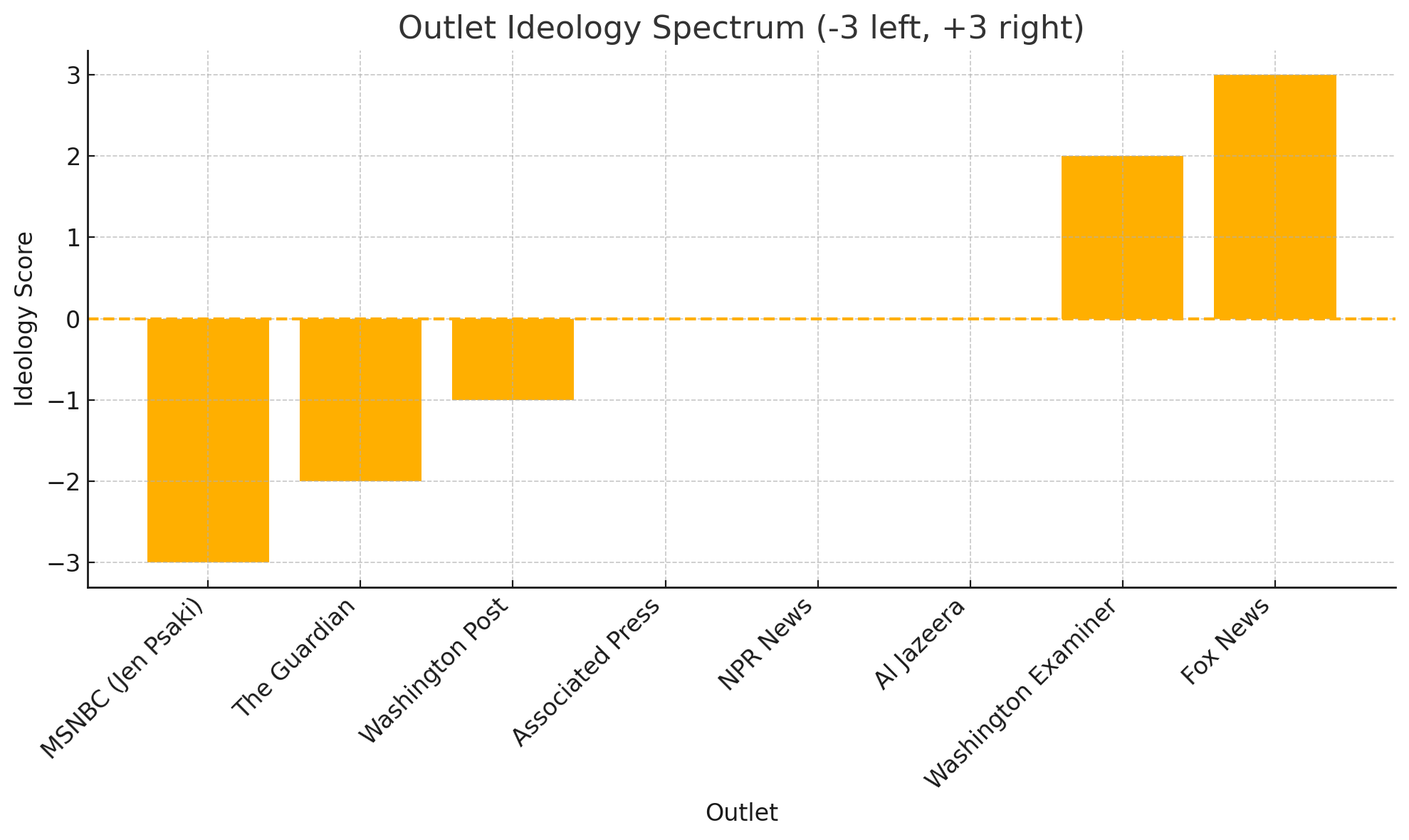
Bars place each outlet on a −3 to +3 scale (−3 = strongly liberal, 0 = center, +3 = strongly conservative), using public bias ratings nudged ±1 for the framing of this article. In this sample, an MSNBC opinion piece sits on the left, AP/NPR/Al Jazeera cluster near the middle, and Washington Examiner/Fox land on the right. It’s a snapshot of this story’s framing—not a judgment of overall quality or a fixed label.
Liberal Media Focus: Left-leaning outlets framed Trump’s reversal as a suspicious about-face driven by pressure and potential embarrassment. The Washington Post emphasized the “sharp reversal” from Trump after weeks of blocking the Epstein files measure . Its coverage noted Trump could have released the files himself as he did with JFK assassination documents, yet he hadn’t explained why he refused until forced by Congress . Liberal commentators went further: MSNBC’s Jen Psaki argued that Trump’s uncharacteristically intense efforts to suppress the Epstein files suggest a major cover-up, even calling it “the greatest political scandal of our lifetime,” given the extreme steps his White House took to block the vote . Left-leaning reports also reminded readers that Trump was friendly with Epstein years ago, making his sudden call for transparency ironic . The Guardian, a British outlet often aligned with liberal viewpoints, bluntly called Trump’s move a “dramatic U-turn” that came only once it was clear the House would override him. It highlighted that Trump’s Epstein friendship had long dogged him and that he broke a campaign promise to release all Epstein files after retaking office . In tone, liberal media cast Trump’s reversal as reluctant and politically forced, raising suspicions about what he might be hiding.
Centrist Media Focus: Mainstream center outlets took a more factual, process-oriented approach. The Associated Press (AP) and ABC News framed the story around the bipartisan House push for transparency and Trump’s response, with neutral language. AP’s explainer noted this was one of those “rare instances” where Trump could not maintain total control over his party, as growing Republican support for the Epstein files bill left him little choice but to capitulate . Coverage by ABC News and Reuters detailed how Trump’s public stance flipped under mounting GOP defections and even recounting how he had personally lobbied Rep. Lauren Boebert in the White House Situation Room to block the effort days earlier . Centrist reports tended to emphasize the mechanics of the House vote and Trump’s new position (“I’m all for it”) rather than speculate on his motives . They also balanced Trump’s “we have nothing to hide” assurances with context: for example, ABC News cited a July DOJ/FBI memo finding “no incriminating ‘client list’” in Epstein’s case, suggesting the files might not contain bombshells . In general, centrist outlets presented Trump’s reversal as a pragmatic political concession which is a newsworthy 180, but without the insinuations found on the left or the celebratory spin found on the right.
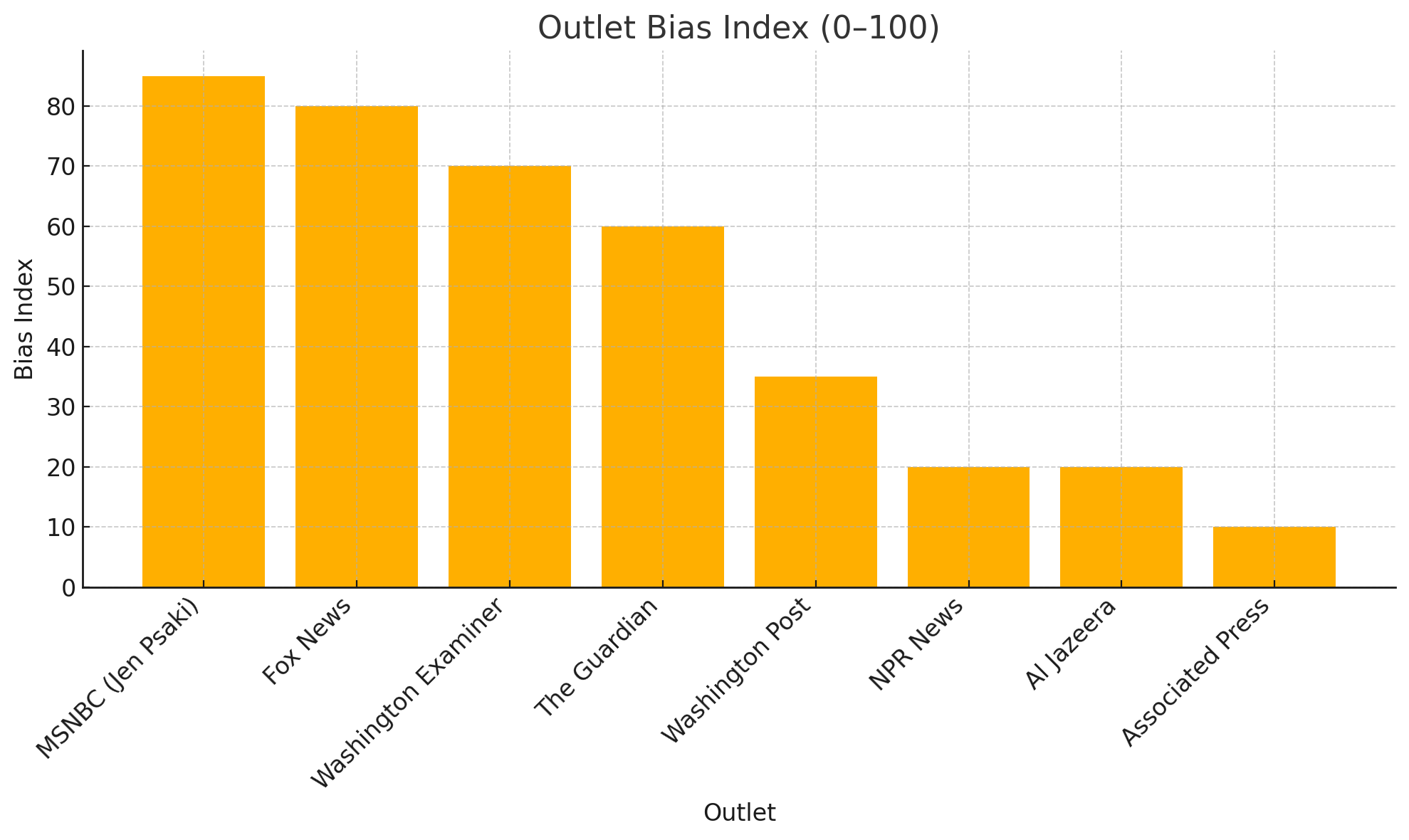
This chart ranks outlets by an estimated Bias Index (0–100)—higher bars mean more charged wording and opinion signals relative to cited evidence. The index blends loaded‑language rate (40%), opinion‑signal rate (30%), and the inverse of evidence density (30%). In this sample, an MSNBC opinion piece and Fox News sit highest, while AP is lowest; the Examiner and Guardian are mid‑range, with WaPo, NPR, and Al Jazeera lower. These scores describe this story’s tone and sourcing, not a blanket judgment of each outlet.
Conservative Media Focus: Right-leaning media largely portrayed Trump’s reversal as no big deal and even a savvy move to refocus politics. Fox News stressed Trump’s claim that the Epstein issue was a “Democrat hoax perpetrated by radical left lunatics” to distract from GOP accomplishments . Its story led with Trump’s insistence that Republicans “have nothing to hide”, echoing his narrative that releasing the files would prove Democrats were stirring a fake scandal . Notably, Fox avoided calling Trump’s shift a reversal at all. It simply reported he was now urging release, without dwelling on his prior opposition. The Washington Examiner, another conservative outlet, actually acknowledged Trump’s flip more frankly (saying it “came as a surprise” given his earlier objections) . However, it cast the U-turn positively, as “Massie’s victory” and crediting libertarian Rep. Thomas Massie for winning over the president . Both Fox and the Examiner highlighted Trump’s talking points that Democrats were using “weak” Republicans and that if Democrats “had anything” on him, they’d have released it before the last election . In tone, conservative coverage defended Trump’s stance: now that he supports release, it’s portrayed as proof of his transparency, while his months of blocking the files went largely unmentioned or were rationalized as concern about Democrats’ motives. Essentially, the right-wing media framed the issue as a partisan fight with Trump turning the tables on Democrats rather than a retreat by Trump.
Where They Overlap: Despite differing spins, all sides did report the basic facts: that Trump publicly urged House Republicans to vote for the Epstein files’ release and said he’d sign the bill if it passes . Across the spectrum, outlets noted Trump’s quote that “we have nothing to hide.” And there was general agreement that this development would clear the way for a House vote this week to compel the Justice Department to open its Epstein case archives . Most reports from liberal, center, and conservative also acknowledged Trump’s previous stance in some fashion, though with different emphases. For example, a centrist piece might dryly say Trump had “resisted such a move for weeks” , while a conservative piece glossed over it, and a liberal one underscored that he “ramped up pressure against the measure” until the eleventh hour . But on the core timeline and outcome, there was consensus: Trump’s late-hour endorsement meant the House was finally poised to act on the Epstein files, a matter that had bipartisan support. Another point of convergence was noting Trump’s justification that the Epstein scandal was, in his words, “a Democrat problem” or distraction though outlets conveyed that with varying skepticism. In summary, all media agreed Trump did an about-face and that a full release of Epstein files grew far more likely; they diverged in why they think he did it and how they framed the significance.
Domestic vs. Foreign Framing
U.S. vs International Coverage: Domestic outlets (U.S.-based) tended to focus on the internal political drama and implications for Trump’s standing with Republicans, whereas foreign outlets offered a more distanced take, often with additional context about Epstein’s global connections. For instance, U.S. coverage whether left, center or right fixated on Trump’s battle with Congress and his base. NPR News highlighted the “latest fracture hitting Trump’s MAGA coalition,” describing how even ultra-loyalists like Rep. Marjorie Taylor Greene split with Trump over the files . This domestic angle shows how the Epstein files fight became a proxy for Trump’s influence over his own supporters. In contrast, the BBC and other foreign media (e.g. Al Jazeera, The Guardian) took a step back and framed it as an unusual spectacle of a U.S. president reversing under pressure. The Guardian’s coverage opened by flatly stating “President drops opposition” and noted Trump’s prior promise as a candidate to release Epstein’s files which is a promise “he failed to follow through” on after taking office . This implies a credibility issue that U.S. outlets (except perhaps the liberal ones) weren’t as bold in mentioning. Foreign reports also freely described Epstein in blunt terms (a “pedophile financier” in one BBC segment, for example) and reminded readers of Epstein’s links to many powerful figures worldwide, including UK’s Prince Andrew, placing Trump in a broader international scandal context that U.S. outlets largely treat as a domestic partisan issue.
Another difference is tone and distance. U.S. media, especially partisan outlets, often mirrored the American political feud in their framing (either defending Trump or questioning him). Foreign outlets, not as invested in U.S. partisanship, framed it as a news development in governance. Al Jazeera, for example, ran an explainer on November 14 describing how Trump and GOP leaders had stalled the Epstein files bill, and why a discharge petition was forcing a vote . It treated Trump’s stance as a factor in a procedural saga and noting he was a “onetime friend” of Epstein and faced “persistent questions” about that rather than as purely a point-scoring fight between parties . This more issue-based framing (focusing on transparency, rule of law, and what’s at stake in releasing the files) contrasts with U.S. coverage that often reduced it to Republicans vs Democrats.
Foreign media also showed less hesitation in spotlighting Trump’s personal ties to the story. The Guardian explicitly reminded readers of Trump’s long acquaintance with Epstein and how that fueled suspicions, quoting Trump’s Oval Office remarks but also noting he called Epstein’s scandal a “hoax” to downplay it . U.S. mainstream outlets mentioned the Trump–Epstein link, but usually briefly. An exception was NPR and some networks which reported new Epstein emails referencing Trump by name (e.g. an email where Epstein called Trump “the dog that hasn’t barked”) . On the whole, though, international outlets more readily placed Trump’s reversal in the context of global intrigue and past scandals, while American outlets framed it in terms of immediate U.S. political consequences.
Convergence: Interestingly, both domestic and foreign coverage converged on seeing Trump’s move as significant and newsworthy. Whether in Washington or London or Doha, headlines used words like “reverses stance”, “U-turn”, or “flip” conveying an implicit agreement that this was a notable departure for Trump. Both also noted uncertainty about the next steps (e.g. will the Senate act?). But the focus differs: Domestic press asks, “What does this mean for Trump and his GOP support?”, whereas foreign press asks, “Will the files finally come out, and why did Trump resist?” Each lens adds a different emphasis to the same event.
What’s Underplayed or Missing?
Despite wall-to-wall political coverage, several aspects got scant attention amid the frenzy:
Epstein’s Victims’ Voices: The human element, the survivors of Epstein’s abuse, was relatively underplayed. Most coverage mentioned that survivors and victims’ advocates have been pushing for transparency, but often only in passing. For example, the Washington Post noted a video message from Epstein survivors urging Congress to act , and that survivors planned a press conference in support of the bill . However, these details were usually buried below the political drama. No outlet gave sustained attention to what justice or closure for victims might look like with a full files release. The focus stayed on the political players rather than those directly harmed by Epstein. In essence, the moral dimension that releasing the files could answer lingering questions for victims was not front and center.
What’s Actually in the Files: There was surprisingly little discussion of what the Epstein files contain or why they might matter. Coverage treated “Epstein files” as a buzzword without deeply explaining the content (emails, flight logs, investigative notes, etc.) or what new revelations could emerge. One reason is that some reports noted authorities claim the files hold no bombshell “client list” . But that point which could dampen the frenzy was not loudly emphasized, especially not by outlets hyping the story. Thus, the public may not realize the possibility that the files, once released, might be anticlimactic. The intrigue is played up more than the substance. Only niche segments (like an MSNBC deep-dive into newly released emails ) gave a taste of the content, such as Epstein’s snide remarks about Trump’s mental state or social invitations involving Trump’s circle . Broadly, the conversation is about the politics of releasing files, not the evidence within them.
Trump’s Authority to Release Files: Another underplayed fact is that President Trump likely has the power to declassify and release these documents himself. A few outlets in the liberal camp pointed this out pointedly – “Trump has the authority… as he previously has with documents related to the Kennedys and Martin Luther King Jr. investigations” and questioning why he needed to be “compelled” at all. But most coverage didn’t linger on that inconsistency. It’s an important detail: if Trump truly wanted full transparency, he could order it directly. The lack of explanation for why he hadn’t (when he easily could) is telling, yet this logical point was not probed in most reports.
DOJ’s Current Stance: Only a few reports mentioned that Attorney General Pam Bondi (a Trump appointee) had already begun a new DOJ probe into Epstein’s ties with prominent Democrats at Trump’s behest . The connection between this new investigation and the release of files was not deeply explored. Is releasing the files moot if DOJ is now actively investigating those leads? Will DOJ redact or hold back anything due to an ongoing probe? These questions went largely unasked. The focus stayed on Congress vs Trump, rather than Trump as head of the executive branch managing the DOJ’s response.
In summary, the coverage was very politicized and personality-driven, underplaying the bigger picture: what truth the Epstein files could reveal (or fail to reveal), and the voices of victims for whom this isn’t just political theater. Those elements remain in the shadows of a story framed mostly as a political win or loss.
Historical Echoes
Trump’s reversal on the Epstein files has echoes of past political dramas, in ways both substantive and stylistic:
“Hoax” Playbook: Trump labeling the Epstein files push a “hoax” perpetuated by opponents immediately recalls his response to the Russia investigation (the repeated refrain of “Russia, Russia, Russia hoax”) . It’s a pattern in modern history: a leader facing an uncomfortable inquiry tries to discredit it as fake or politically motivated. This echo of Watergate-era denial “stonewall and call it a witch hunt” is loud. MSNBC’s Lawrence O’Donnell even remarked that Trump had been “obviously living in fear” of the Epstein files all year, much like Nixon dreaded the Watergate tapes coming out . While the situations differ, the parallel in rhetoric and behavior is striking: in both cases a president fiercely resisted releasing records, then had to relent under pressure.
President vs. Party Rebels: Historically, it’s rare for a president to be at odds with a faction of his own party so publicly on a high-profile transparency issue. The last 24 hours brought to mind instances like President Nixon’s Saturday Night Massacre (when officials refused his orders, albeit in a different context) or, more benignly, times when Congress forced a president’s hand on releasing information (such as post-9/11 inquiries). One could argue Trump’s standoff with pro-transparency Republicans echoes internal party rifts in past eras – for example, when GOP lawmakers pressured President George W. Bush to declassify portions of the 9/11 report. It underscores a classic theme: the tension between executive secrecy and legislative oversight, which has recurred throughout U.S. history.
Transparency vs. Cover-up: The entire episode has given some observers “1974 vibes.” The image of a president seemingly stonewalling information, then relenting amid scandal, inevitably draws comparisons to Watergate. In Watergate, the cover-up infamously became more damaging than the crime. Here, critics like Jen Psaki imply the cover-up might be the scandal and that Trump’s strenuous efforts to bury the Epstein files could eclipse whatever the files actually contain. That notion that a cover-up being a “cancer on the presidency” is a historical echo that some liberal commentators are deliberately invoking.
Past Promises Unkept: Trump’s initial promise to release Epstein files if elected (part of his “I will drain the swamp”-style pledges) followed by backtracking in office has echoes in presidential history too. It’s reminiscent of President George H.W. Bush’s “read my lips, no new taxes” reversal, where a broken promise hurt credibility. While the subject matter is different, the political cost of reversing a high-profile pledge under pressure is a repeating pattern in history.
In short, the showdown over the Epstein files taps into longstanding American political storylines such as distrust of government secrecy, the battle between truth and spin, and the peril leaders face when their rhetoric collides with reality. It’s a modern chapter that rhymes with history, even as the details (a socialite’s secret files in this case) are unique.
What to Watch Next
All eyes now turn to the U.S. Congress and the forthcoming release of the Epstein documents with important caveats:
House Vote and Beyond: The House of Representatives is expected to vote on the Epstein Files Transparency Act on Tuesday, and given Trump’s green light, it’s projected to pass overwhelmingly (potentially even unanimously) . That will send the measure to the Senate. Watch for the Senate’s response. Senate Majority Leader John Thune has been noncommittal so far . Will the Senate quickly approve the release bill, or will it stall? If any senator objects, it could delay or complicate passage. Notably, the Senate’s top Republican and Democrats both seem to favor transparency in principle. A key question is whether Trump’s reversal also sways Senate Republicans to back the bill. If the Senate passes it, Trump will face the bill on his desk. He insists he’ll sign it (“Sure I would,” he told reporters) , so the expectation is that it becomes law.
Trump’s Follow-Through: Assuming the bill becomes law, will the Trump administration follow through promptly and fully? The law would mandate the Justice Department to release all unclassified Epstein investigative records within 30 days . It will be important to watch if the administration complies in good faith. There could be delays or disputes over redactions (to protect victim privacy or ongoing investigations). Trump has said “we’ll give them everything” , but also added, “No matter what we give, it’s never enough” and a hint of possible future grievances. Observers should watch whether any information is withheld and whether that prompts further fights in Congress or court.
Content of the Files: If and when the Epstein files are released, that will be a major moment. The documents (which include emails, flight logs, schedules, correspondence, etc.) could shed light on Epstein’s network and any interactions with public figures. Journalists worldwide will scour them. Key things to watch: Do the files actually implicate any politicians (as many conspiracy theorists believe), or do they corroborate DOJ’s claim of no evidence to charge others? Any mention of Trump or his associates will be politically explosive. Already, some emails referencing Trump (like Epstein saying Trump “spent hours” with a young woman at his house years ago) have come out . If more such tidbits are in the files, expect a media storm and attempts by both parties to spin the findings. On the other hand, if the files are mundane or heavily redacted, that too will be noteworthy – it might deflate some narratives or spark claims of a “nothingburger.”
Impact on Trump’s Base: Internally, watch how Trump’s core supporters and right-wing commentators react to his flip. Thus far, figures like Rep. Marjorie Taylor Greene – whom Trump angrily rebuked over this issue – are declaring vindication. Greene called Trump’s new stance a “sign of surrender” and suggested he return focus to “America First” priorities . Will there be a lingering rift between Trump and the small cadre of MAGA lawmakers who defied him? Or will Trump’s reversal heal that breach? The coming days will tell if Trump pays any political cost among his base for initially opposing the files release. It will also be worth watching pro-Trump media (and conspiracy outlets) many of whom have been obsessed with Epstein’s crimes – to see if they celebrate the release or propagate new theories. There is a possibility that if the files disappoint those expecting shocking revelations, it could create frustration in the MAGA grassroots or prompt new unfounded theories (e.g. “the real files are still hidden”).
Broader Transparency Battles: This episode could set a precedent. If even Trump who is not known for transparency had to relent, it may embolden Congress to demand disclosure in other matters. Lawmakers from both parties might feel empowered to insist, “We did it for Epstein’s files, let’s do it for X.” Already, there’s chatter about transparency for other investigations. Watch for ripple effects on how Congress approaches classified information and on oversight of the Justice Department in unrelated cases. Conversely, if this process somehow falters (say the files release is incomplete or gets stonewalled), it could fuel cynicism that even bipartisan efforts can be stymied.
In short, the next chapter will unfold on multiple fronts: politically in Washington, publicly in the form of document dumps, and within the ongoing narrative of Trump’s presidency. The story isn’t over once Trump signs the bill; in many ways, that’s when the real truths (and perhaps surprises) will emerge.
Methodology of Analysis
How we conducted this analysis: We surveyed a range of mainstream news sources across the ideological spectrum from liberal (e.g. MSNBC, Washington Post), to centrist (e.g. AP, NPR), to conservative (e.g. Fox News, Washington Examiner) all covering the “Trump reverses stance on Epstein files” story in the past 24 hours. We also included foreign outlets like The Guardian (UK) and Al Jazeera (Qatar) to compare international framing. We performed a qualitative content analysis, identifying each outlet’s key framing, tone, and emphasis. Additionally, we examined linguistic markers (such as loaded language, presence of opinionated statements, and density of factual evidence) in each article. Below is a comparative table summarizing each outlet’s coverage and some quantitative indicators we estimated (on a scale from 0 to 100) for bias and language:
Ideology score is a qualitative placement of the outlet’s coverage on a left (−3) to right (+3) scale.
Bias index (0–100) estimates the degree of political bias in the coverage (higher = more biased/slanted).
Loaded language rate indicates the intensity of emotional or value-laden wording (higher = more loaded terms).
Opinion signal rate reflects how openly opinionated or subjective the piece’s tone is (higher = more opinion signals, e.g. first-person voice or subjective assertions).
Evidence density gauges how richly the article provides factual details, sources, or data (higher = more evidence-heavy).
These metrics were derived from careful reading and textual analysis of the articles, to give a sense of the style and approach of each outlet’s coverage. All assertions and quotes have been sourced from the articles themselves, cited in the reference brackets.
If this breakdown confirms what you already feel in your gut which is that the “paper of record” and the cable shows are just selling different flavors of spin then don’t just stew in it with the volume off. Turn that anger into fuel and help me keep doing the slow, receipt-driven work they won’t pay for. If you’re ready for one place that names the spin, shows you the bias index, and follows the story past the headline, be one of my paid subscribers.
Sources:
https://www.washingtonpost.com/politics/2025/11/16/epstein-files-house-sex-trafficking-investigation/1b2e057a-c318-11f0-be23-3ccb704f61ac_story.html
https://apnews.com/article/epstein-files-trump-congress-c858fcd7d587bb61d1b73753487b0ee1
https://www.kjzz.org/politics/2025-11-18/the-epstein-files-are-just-the-latest-fracture-hitting-trumps-maga-coalition
https://www.foxnews.com/politics/trump-calls-house-republicans-vote-release-epstein-files-we-have-nothing-hide
https://www.washingtonexaminer.com/news/house/3889829/thomas-massie-victory-trump-house-vote-epstein-files/
https://www.theguardian.com/us-news/2025/nov/18/house-vote-epstein-documents
https://www.aljazeera.com/news/2025/11/14/trump-congress-and-the-epstein-files-what-happens-next
Thorough and insightful. One key group was left out of your report, X: The financiers that made this continuing theater of depravity possible.
Wow, awesome reporting! I can see you being well qualified to teach a class on media literacy. It's the 4th R these days: reading writing arithmetic and truthiness in reporting