


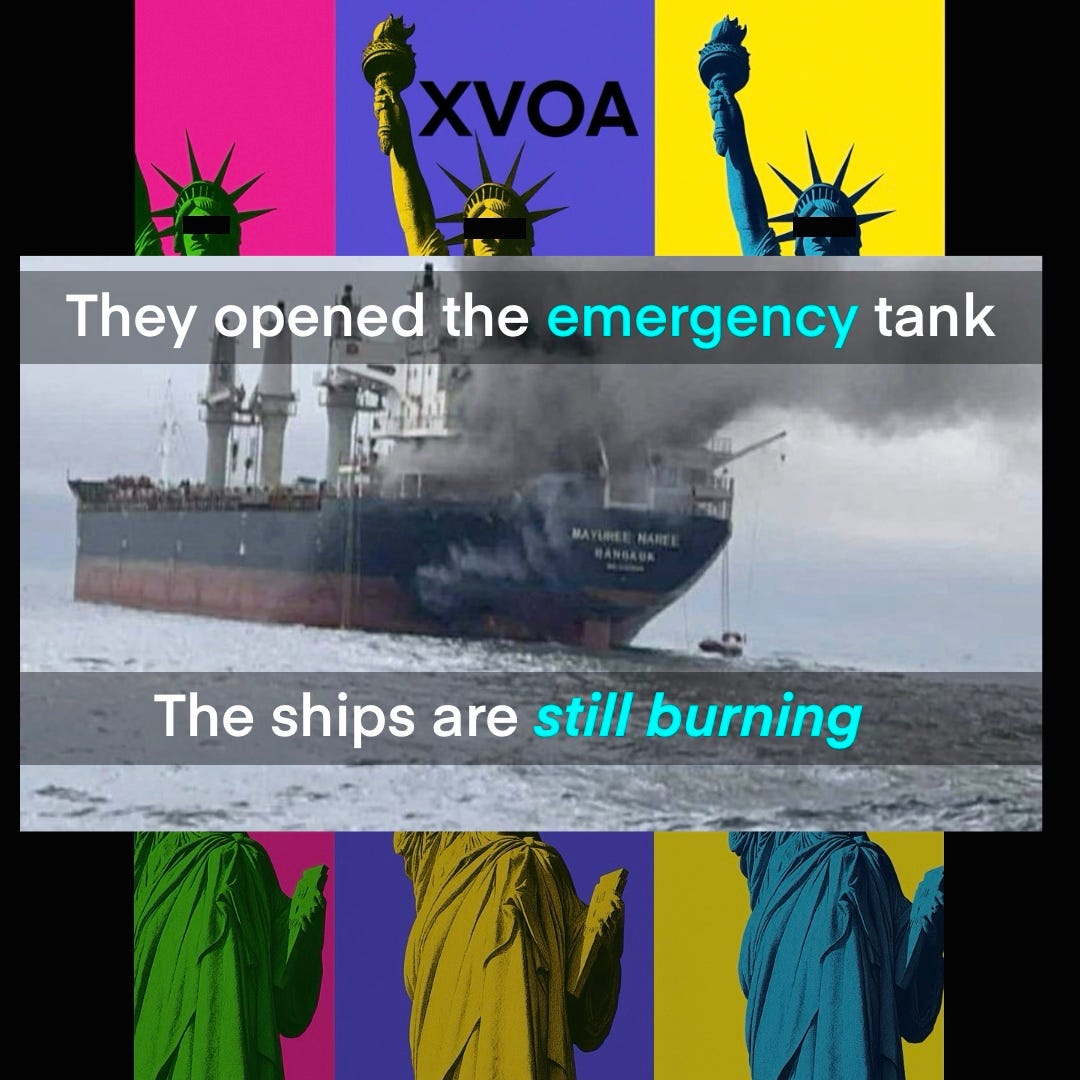
I drove past a gas station today and felt that little jolt people feel now when the numbers on the sign seem to move faster than your paycheck. Then I got home and saw the news: the world was preparing to dump a record 400 million barrels of emergency oil onto the market after more ships were hit in and near the Strait of Hormuz, and suddenly that price board looked less like an annoyance than a warning [1][2][3]. This is the part the headline does not solve. An emergency release can calm panic for a moment, but it cannot reopen a chokepoint, and it cannot promise the pain at the pump is over [1][2].
TLDR
The IEA’s 32 members unanimously agreed to release 400 million barrels, the largest coordinated emergency oil release in the agency’s history [1][2].
That sounds enormous until you put it next to the Strait of Hormuz, which averaged 20 million barrels a day in crude and products last year. The IEA says flows are now below 10 percent of pre-conflict levels, and crude prices were still elevated after the announcement [1][2][14].
Three vessels were hit on Wednesday, including the Thai-flagged Mayuree Naree, whose operator said it was struck by two projectiles, caught fire, and left three crew members missing [3][4].
The immediate household question is plain: today’s AAA national average for regular gasoline is $3.578, and Treasury’s own 2022 estimate suggests even a major coordinated reserve release shaved only 17 to 42 cents off pump prices [8][9].
In the accessible same-day coverage I could verify by early afternoon Eastern, CNN gave the reserve release a dedicated business headline, Al Jazeera gave both the reserve move and the shipping threat dedicated treatment, and Fox centered military action, ship strikes, and partisan stockpile blame [11][12][13][14][15][16].
Do XVOA a favor please. Restack restack it and share it. Send it to one friend still expecting one reserve release to erase a chokepoint war.
Become a paid subscriber:
If a full subscription is not your move right now, you can support this work here by buying me a coffee:
Why This Matters
A record reserve release can calm panic for a few hours. It cannot reopen a waterway. The IEA itself says Hormuz averaged 20 million barrels a day in crude and oil products in 2025, and that export volumes are now below 10 percent of pre-conflict levels [1]. Reuters reported prices still rose after the announcement, which is the market saying the same thing in its own language: traders do not believe the reserve move is yet big enough, or fast enough, to replace what is stuck behind the strait [2].
For ordinary people, that gap shows up at the pump before it shows up in policy speeches. AAA’s national average is $3.578 today. Treasury’s own estimate of the 2022 U.S. plus IEA release was that it lowered gasoline prices by 17 to 42 cents per gallon. That means strategic releases can help. It also means they are not magic, especially when the current disruption is larger and more militarized than a normal market shock [8][9].
There is also a geography problem. Reuters notes that Japan is moving quickly and that U.S. barrels headed to Asia would take 40 to 60 days to arrive, with freight costs sharply higher than before the war. So even if the headline number is huge, the relief will not land everywhere at the same speed, and it will not hit every refinery with the same force [17].
What We Know Tonight
The confirmed core fact is straightforward. The IEA officially said on March 11 that all 32 member countries agreed to make 400 million barrels available to the market. The agency says member countries hold more than 1.2 billion barrels of public emergency stocks plus 600 million barrels of industry stocks held under government obligation, and that this is the sixth collective release in IEA history [1].
The second confirmed fact is that the release is responding to a supply-route shock, not just speculative panic. The IEA says the war that began on February 28 has impeded flows through Hormuz so severely that crude and refined-product exports are now below 10 percent of pre-conflict levels. AP reported the same broad picture and noted that governments from Britain to Germany, Austria, and Japan began announcing their contributions and domestic mitigation measures on Wednesday [1][6][7].
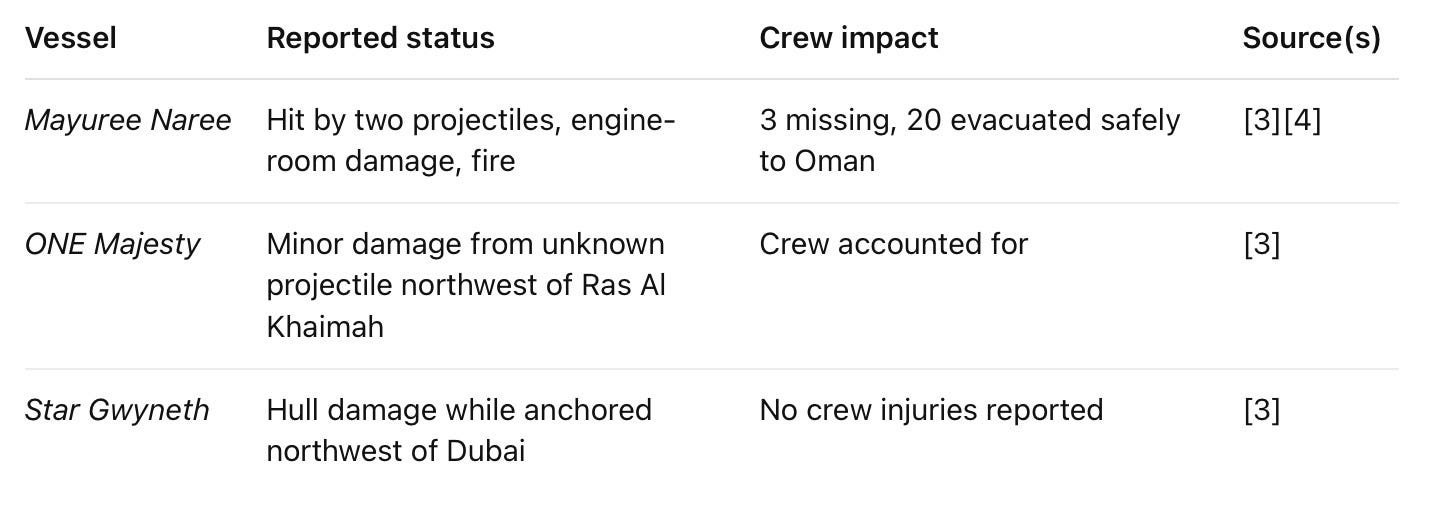
The third confirmed fact is that the maritime threat got worse on Wednesday. Reuters reported three vessels hit by projectiles in and near the strait. The clearest operator statement came from Precious Shipping, which told the Stock Exchange of Thailand that the Mayuree Naree was struck by two projectiles at about 08:15 local time while transiting Hormuz, suffered engine-room damage and fire, and had three crew members reported missing while 20 others were evacuated safely to Oman [3][4].
Reuters further reported minor damage to the Japan-flagged ONE Majesty and the Marshall Islands-flagged Star Gwyneth. Reuters also said the U.S. Navy has declined near-daily shipping-industry requests for escorts through Hormuz because the risk remains too high for now [3].
What is not confirmed as an official public U.S. declaration, but is significant, is Reuters’ report citing two sources that Iran has laid about a dozen mines in the strait. That matters because the whole reserve-release math changes if this turns from a fear trade into a sustained mine-clearing problem [5].
Timeline of Events and Reporting
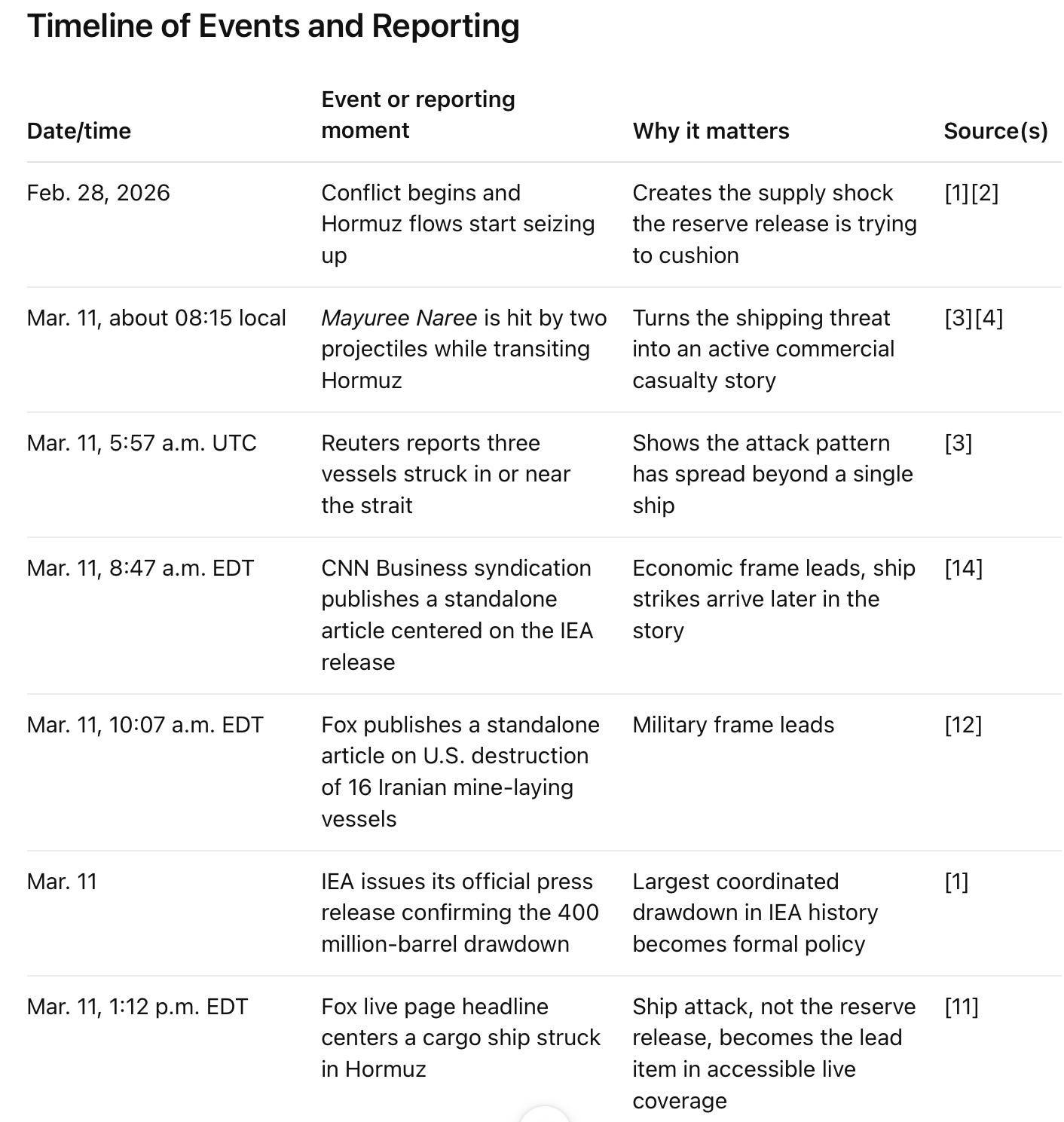
What the Coverage Did
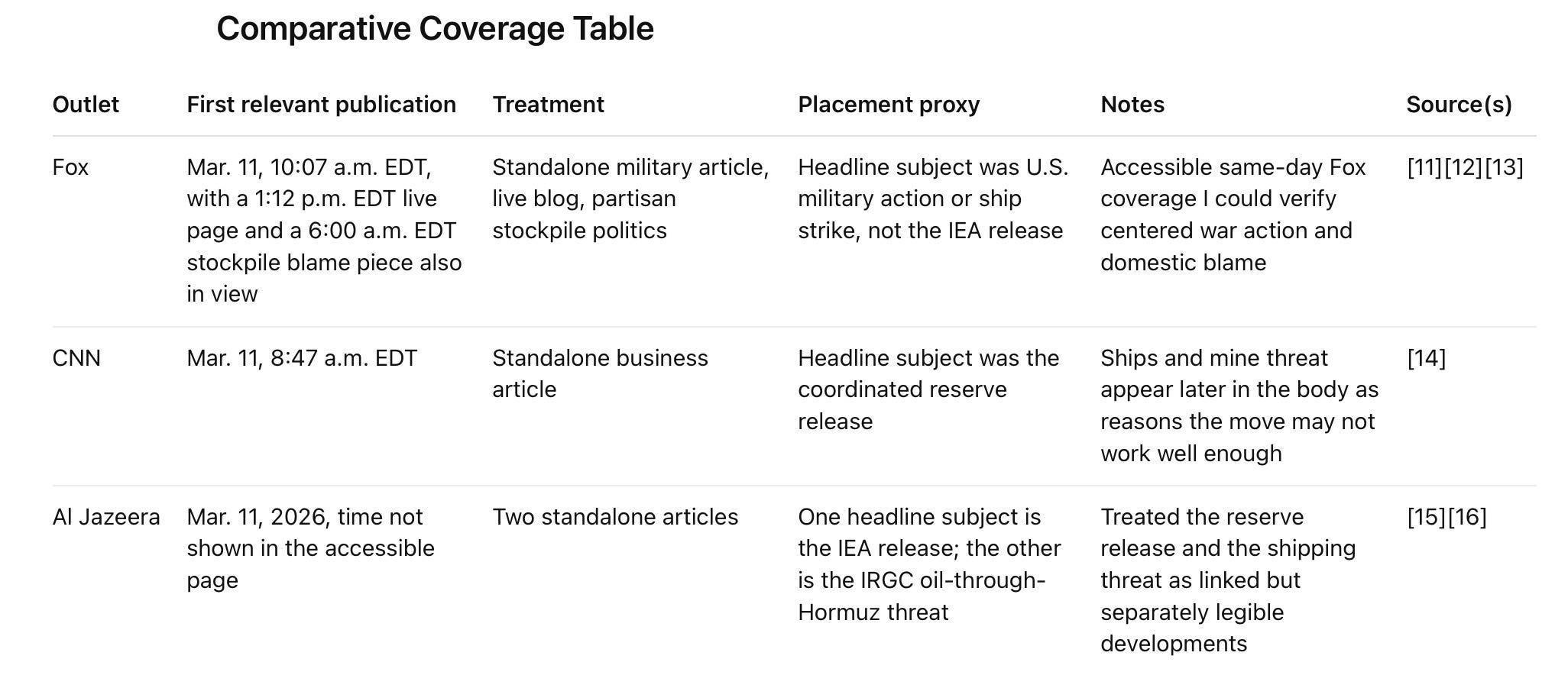
CNN’s accessible business piece put the reserve release in the headline and treated it as the lead economic fact of the day. The ship strikes and mine threat show up later in the article as reasons the release may not work well enough. That is a classic business-desk choice which is lead with the intervention, then explain why markets are still not buying it [14].
Al Jazeera split the story in two and, in doing so, probably gave readers the clearest map of the problem. One article is directly about the IEA’s 400 million-barrel move. The other centers the IRGC threat to oil transit and folds in the same day’s ship strikes. That pairing makes the logic plain. The reserve release and the maritime attacks are not separate stories. They are the same story told from two ends [15][16].
Fox’s accessible same-day coverage that I could verify by early afternoon Eastern looked different. One item at 6:00 a.m. framed the moment as a Biden Strategic Petroleum Reserve depletion fight. Another at 10:07 a.m. centered U.S. destruction of Iranian mine-laying vessels. By 1:12 p.m., Fox’s live page led with a cargo ship struck in Hormuz. Those are not false frames. But they are different frames, and they place military action, partisan blame, and tactical conflict ahead of the IEA intervention itself [11][12][13].
That difference matters because it changes the reader’s mental model. Are you looking at an economic shock that governments are struggling to buffer, or are you looking at a war story with fuel prices attached? CNN and Al Jazeera made the emergency release legible as the central policy response. Fox’s accessible pages made the strait a military and partisan story first [11][12][13][14][15][16].
Comparative Coverage Table
What Remains Unanswered
The biggest unanswered question is pace. The IEA has not yet laid out how quickly those 400 million barrels will actually hit the market. Reuters’ energy commentary notes that timing is not a detail here. It is the whole game. A huge headline number released too slowly still leaves the market undersupplied [1][17].
The second unanswered question is maritime security. Reuters, citing sources, reported that Iran has laid about a dozen mines, but the U.S. has not publicly detailed a clearing timetable or a commercial escort plan. Reuters separately reported that the Navy is still declining escort requests because the risk is too high. That means the physical route problem may outlast the announcement cycle around the reserve release [3][5].
The third unanswered question is consumer pass-through. Treasury’s 2022 estimate tells us coordinated releases can help. It does not tell us that a 2026 war-zone chokepoint shock will transmit the same way to gasoline prices, freight bills, and inflation. This time the logistics, insurance, mine risk, and shipping delays are all worse [8][17].
Confirmed Vessel Damage and Crew Status
Why Placement Matters
Because 400 million barrels is one of those numbers that sounds like a cure until you put it next to the missing flow. The IEA’s own numbers put normal Hormuz traffic at 20 million barrels a day. Reuters’ energy analysis notes that prior drawdown rates suggest perhaps 1 to 1.2 million barrels a day can actually flow out of reserves. That is not nothing. It is also nowhere close to replacing the chokepoint at full loss [1][17].
So if an outlet leads only with missile footage, or only with partisan blame over past stockpile decisions, the audience can miss the most important practical fact. This is a time-buying maneuver, not a solution. The way the story is placed determines whether readers understand that the real battle is no longer just over bombs. It is over how fast those costs move from the strait to household budgets [8][9][11][12][13].
Historical or Structural Warning
The IEA was created after the 1973 oil embargo, and the agency says this is only the sixth collective stock release in its history. That is the warning hiding inside the policy. Emergency stocks exist to buy governments time when a system shock hits. They do not exist to replace an open sea lane forever. When policymakers start leaning on them as a substitute for restoring transit, the reserve stops being a shield and starts becoming a countdown [1][6][7].
The Real Question
So, is this enough to stop the pain in price spurts? No. Not in the clean, final sense most people mean when they ask the question.
It may be enough to blunt the worst panic. It may be enough, over time, to shave some cents off retail prices and keep refiners from fighting over every available cargo. Treasury’s 2022 work gives policymakers a real precedent for that kind of limited relief. But nothing in the math says this ends the spike regime while Hormuz stays dangerous [8][17].
The harder question is whether governments can reopen safe transit faster than price shocks can spread through the economy. Reuters’ energy commentary says prior reserve-release rates may top out near 1.2 million barrels a day. The IEA says Hormuz normally carries about 20 million barrels a day. That gap is the story. Everything else is messaging around it [1][17].
And there is one more limit here. The United States still has about 415.442 million barrels in the SPR as of the week ending March 6, according to the EIA. That is a real buffer. It is not infinite. If the strait stays choked, the emergency tank starts looking less like an answer and more like a countdown clock with salt caverns [10].
Before This Becomes Normal
If you do not want this kind of story flattened into one more war headline, help me keep following the supply chain after the missile footage stops looping.
Become a paid subscriber if you want this newsroom digging after the headlines move on:
If you want to throw one-time support behind work like this, you can do that here too:
Sources
IEA Member countries to carry out largest ever oil stock release amid market disruptions from Middle East conflict - Official IEA press release confirming the 400 million-barrel release, stockpile totals, export collapse, and typical Hormuz flow volumes.
IEA tackles Iran war oil price spikes with record stocks release plan, markets not convinced - Reuters report on the policy move, market reaction, and why traders still doubt it is enough.
Three more vessels hit by projectiles in Strait of Hormuz, showing merchant ships remain in firing line - Reuters account of the day’s three vessel strikes, ship identities, and escort context.
Incident involving M.V. Mayuree Naree in the Strait of Hormuz - Operator filing confirming time of attack, damage, evacuation, and missing crew on the Mayuree Naree.
Iran has laid about a dozen mines in Strait of Hormuz, sources say - Reuters report on the reported mining of the strait and the unresolved reopening problem.
Germany, Austria will release oil reserves to help curb price spikes - AP report on member-country contributions, stockpile totals, and official statements about the crisis response.
UK joins IEA members in coordinated oil stock release - Official UK statement confirming Britain’s 13.5 million-barrel contribution and the government’s own framing of the move.
The Price Impact of the Strategic Petroleum Reserve Release - U.S. Treasury analysis estimating that the 2022 coordinated release lowered gasoline prices by 17 to 42 cents per gallon.
AAA Fuel Prices - Current AAA national average gasoline price data for March 11, 2026.
Stocks of SPR Crude Oil - EIA weekly data showing current U.S. Strategic Petroleum Reserve stock levels.
LIVE UPDATES: Cargo ship struck in Strait of Hormuz as Iran launches drone, missile attacks - Accessible Fox live page showing the outlet’s later same-day ship-strike framing.
US forces destroy 16 Iranian mine-laying vessels near Strait of Hormuz - Accessible Fox standalone article centering U.S. military action in the strait.
Tom Cotton puts Biden on notice while demanding answers on draining of nation’s oil stockpile - Accessible Fox political framing of the oil-stockpile issue through partisan blame.
Countries agree on historic release of crude reserves to lower oil and gasoline prices - CNN Newsource syndication showing CNN’s headline treatment, publication time, and framing of the reserve move.
IEA agrees to release 400 million barrels of oil from strategic reserves - Al Jazeera article directly centered on the reserve release and its scale.
Not ‘a litre of oil’ to pass Strait of Hormuz, expect $200 price tag: Iran - Al Jazeera article linking the shipping threat, oil-price warning, and reserve-release context.
Historic oil reserve release is only a band-aid on a gaping supply shock - Reuters energy analysis on drawdown pace, geographic limits, shipping delays, and why the move may buy time but not solve the crisis.
Very informative and helpful in understanding the full picture!
Here's a link to a site where you can track crude prices in real time.
https://tradingeconomics.com/commodity/crude-oil