


I have a confession to make.
Instead of spending the previous weekend writing the deep-dive you were expecting, I spent it building a video machine. Makeup. Lights. Software. A run-of-show. Then a workflow that goes from script, to livestream, to a readable essay-style transcript with sources and inline citations. I went back and forth for hours rewriting lines to fit on-camera commentary. Rehearsing. Editing. Revising again. Then breaking news hit right before I was supposed to go live, which meant another round of last-minute rewrites while the clock was already chewing on me.
And then the small, stupid realities started piling up. The teleprompter hit a character limit and chopped the script, so I had to break it into three parts and figure out how to copy and paste sections while live, on air, without sounding like a man wrestling his own notes. The plan was ambitious as hell with a full hour, five separate topics, five separate segments, five separate pieces of commentary, all stitched together like a newsroom broadcast.
Here’s what happened instead. After five hours of research and writing the run of show, an hour dialing in lights and tech, and two more hours rehearsing, I hit a wall. Not the “I’m tired but I can push through” wall. The wall where you can’t hide it on your face no matter how good your skin looks. I realized I was about to go live exhausted, and I wasn’t going to pretend that was “professional.”
And that’s when I thought about you. About the subscribers who told me straight up they don’t even want video. About how it would look if I vanished all weekend chasing the platform’s new incentives and didn’t publish anything. Not even an audio podcast. Not even the kind of essay-like transcript you’ve come to expect from me.
So I stopped. Yes, my eyebrows were looking great. Yes, my face felt better than it has since I was fifteen. But what about the writing? Behind the scenes I was getting reps as a producer and a scriptwriter, but nobody was reading those pages but me.
That’s why I’m here now, with one last straight essay. Because I owe you that. I owe you a real post, in the pure written format that built this place, thanking you for saving this newsletter from the quiet oblivion the algorithm has been trying to push me into these past two weeks.
TLDR
Substack’s own CEO interviewed his CTO/cofounder and the quiet part slipped out: discovery and paid conversion are increasingly routed through the app feed. [3]
When the feed becomes the front door, it starts selecting for feed-native content, and that reshapes what writers make and what readers get. [3][7]
Scroll-based engagement runs on variable rewards and habit loops, which is why video and fast-hit formats tend to win inside feeds. [1][2][4]
The January “dip” chatter matters because multiple unrelated writers reported the same sudden drop pattern at the same time, which fits a product/weighting shift more than “you forgot how to write.” [6][7]
If this moved you in any kind of way, do two things: restack it and share it.
Send it to one friend who keeps saying “it’s just a format change” as if incentives don’t change outcomes.
If you’ve been on the fence, hop it. A paid subscription is how you keep this indie outlet alive and keep this kind of reporting coming. Join here:
The ritual away from the keyboard
As part of my ritual away from the keyboard, I try to get inspiration for the next XVOA piece without staring at news clips (lawd no, not mainstream news) and without doom-scrolling other creators. I try to watch something completely unrelated to the madness. Something with a beginning, a middle, an end. Something that isn’t “breaking news at 100 mph,” but still tells the truth about how people get hypnotized.
That’s how I ended up back in the seventies and eighties. Saturday Night Fever first. Not the disco glitter everybody remembers, but the anti-hero core of it with its blue-collar Brooklyn, a tight little life, and a man trying to dance his way out of a cage. Then I drifted into the making of Scarface, and the thing that always jumps out at me is how the creators talk about it like a morality play. Like it’s a warning label. And yet the camera can’t stop staring at the greed. The power. The appetite. The myth. You can feel the fascination underneath the sermon.
And that’s when it clicked for me. Sometimes a platform doesn’t have to announce that it’s changing its values. It just changes what it can’t stop staring at. It tells you one story about itself, while the incentives reveal the real obsession.
That is why I stopped treating my shutout like a personal failure and started treating it like a product change. When a platform’s incentives shift, it does not send you a memo. It just starts paying different bills. The only way to know what it values is to look at where new people are coming from, and where they are not. So I went hunting for the closest thing to an official answer.
The algorithm answers, and the answers it won’t give
I went looking for answers the way you do when the lights start flickering. Not vibes. Not coping. Answers.
So I found this deceptively casual video podcast called “Secrets of the Substack algorithm,” (3) and I listened like a man trying to catch the one sentence that would explain why my numbers suddenly feel like a dead phone line.
And I’m going to be honest: I didn’t even clock what the hell I was watchhing at first. This isn’t some random podcaster doing a “creator economy” episode. It’s Chris Best, the CEO of Substack, interviewing his own CTO and cofounder, Jairaj “Jay” Sethi.
And listen the format matters. The fact that this explanation lives as a video podcast, not a written post, speaks volumes. It tells you which medium gets the microphone.
On paper, the conversation sounds reassuring. Jay says Substack has an algorithm because “there’s no other way to do it.” He says chronological works for some people, and that’s why there’s a Following tab. He says the real question is what the algorithm is optimizing for and who it’s serving. He even takes shots at ad platforms that optimize for endless scrolling, and he says Substack is different because subscribers and creators are the customers.
And then he says the quiet part, almost casually. The Substack app and feed are driving the majority of discovery on the network. (3) The algorithm is driving about half of all subscriptions. (3) More than a third of paid subscriptions are coming through the app. (3) They “budget a certain amount of the feed” for ranking long-form posts, but the journey starts in the feed, often through Notes, then follows, then more exposure, then maybe the long-form post, then subscribe.
So why did it feel like I got nothing? Because what Jay never says tells you more than what he does.
He never says what the feed is rewarding right now. He never says what they changed recently. He never says which signals got heavier, which signals got lighter, which kinds of posts get surfaced more often, which kinds get quietly parked in the back. He talks about objective functions like a professor. He talks about experiments like a scientist. But he does not name the current scoreboard.
And that’s the moment I realized what I was really listening to. Not an explanation. A confession wrapped in politeness.
Because if the feed drives that much discovery and that much paid conversion, then being “in the inbox” is not the center of gravity anymore. It’s the side room. The quiet room. The room where people who already love you keep loving you. And the main room, the room where strangers become subscribers, is the feed.
So when writers say, “It’s not that my writing got worse, it’s that the oxygen changed,” they’re not imagining things. Jay basically told us: the oxygen is in the feed now. He just didn’t tell us what kind of breathing the feed rewards.
MTV and the Christopher Cross problem
MTV didn’t just “add music videos.” It rewired the music industry’s definition of what talent even looked like. Before MTV launched in 1981, radio was the gate. If the song hit, the song hit. When MTV arrived, the song still mattered, but the image became the delivery system, and the delivery system started deciding who got to exist.
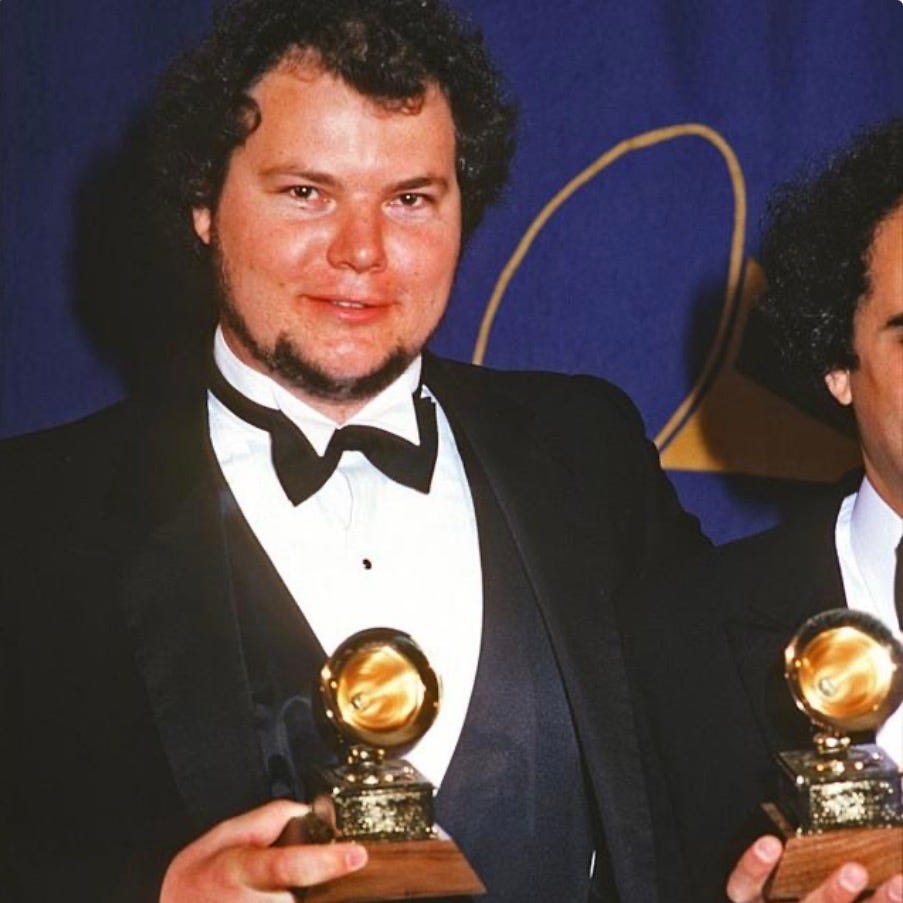
That’s why Christopher Cross is such a clean parable for what writers are feeling right now. Even if the name doesn’t ring a bell at first, the songs usually do: “Sailing,” “Ride Like the Wind,” and “Arthur’s Theme (Best That You Can Do)” were the kind of radio staples that seeped into American air like weather. In 1981 he wasn’t some obscure niche act. He swept the Grammys in a way that was basically historic, and his debut went multi-platinum. Then just a few years later, the same industry started treating him like a problem to solve: lose weight, change the look, maybe wear tighter pants, because he “didn’t look right for television,” and by 1985 he couldn’t get his videos played on MTV. The music didn’t suddenly get worse. The standards of distribution changed.
That’s what this “MTVication” idea is really naming. A platform can swear it still loves the old art form, can even mean it, but if the main discovery engine starts favoring what is most visually legible, most instantly clickable, most face-forward, then the people who built their craft for the previous gate feel like they’re being erased in real time. Not because they failed but because the gate moved.
And the wild part is this right here. Substack basically tells you the new gate out loud if you listen carefully. The CTO explains that the app and feed drive the majority of discovery, that the algorithm drives about half of all subscriptions, and that a big chunk of paid subscriptions come through the app. Translation: the “radio” is no longer the inbox alone. It’s the feed.
So the question isn’t, “Do you support writers?” The real question is: what kind of writer and what kind of reader does your discovery system reward now that the feed is the main stage. Because once the stage changes, the whole culture changes with it.
Tartikoff, “MTV Cops,” and the primacy of the picture
And then I ran into the same lesson again, only this time it wasn’t music. It was television.
Back when network TV was still trying to figure out how to survive the new youth culture, Brandon Tartikoff had this reputation for understanding one brutal truth which is that people don’t fall in love with a concept, they fall in love with a picture. The idea, the logic, the plot, the “message” all comes later. First comes the visual. First comes the vibe. First comes the thing you can recognize in half a second from across the room.
And the way the story gets told, the whole thing started as a memo. Not a screenplay. Not a pitch deck. A memo with a phrase on it that was half joke, half diagnosis: “MTV Cops.”
If you are too young to remember what that meant, here is the quick history. Remember, MTV hit in the early eighties and suddenly the culture learned a new language that had motion, style, a face, a vibe, a hook you could feel before you could explain it. NBC was trying to compete in that world. So “MTV Cops” wasn’t just a cute phrase. It was a blueprint.
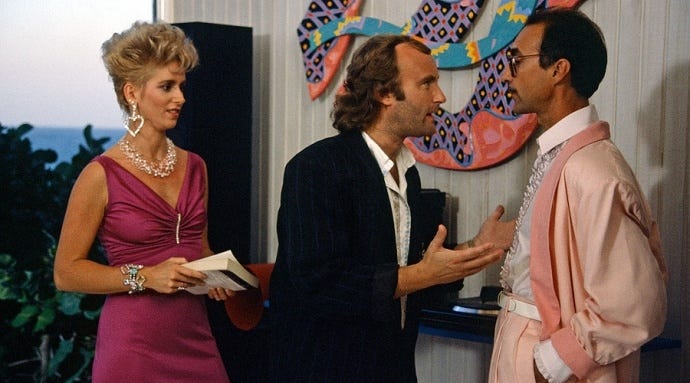

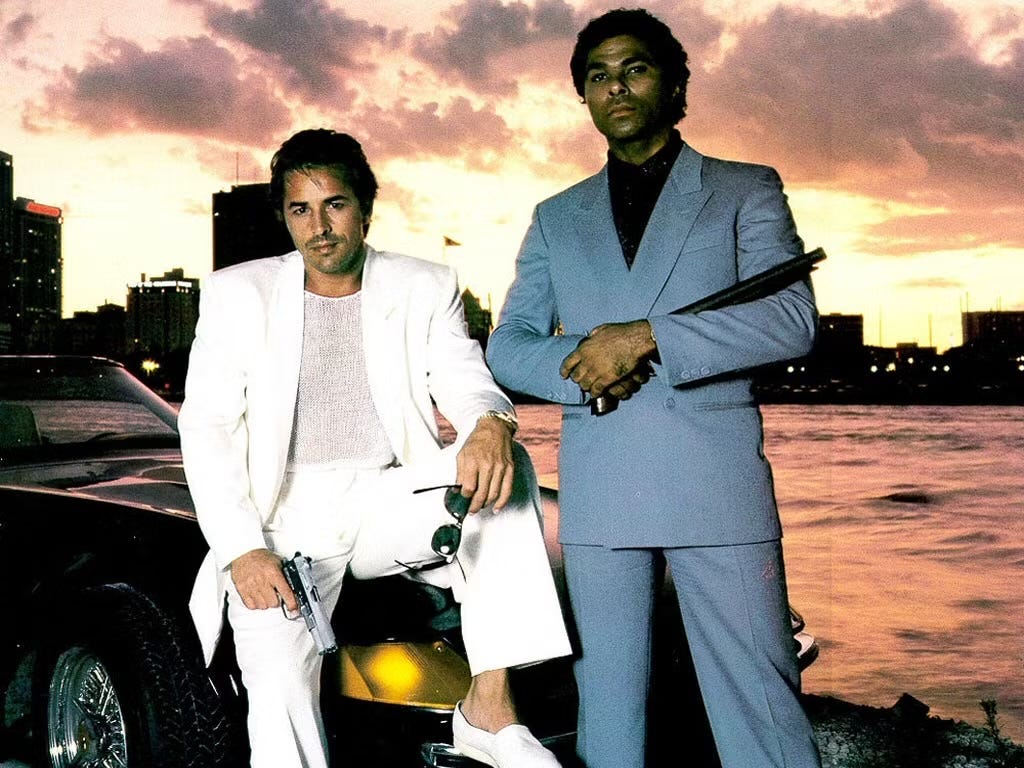
That blueprint eventually became Miami Vice. It was still a cop show, sure, but it was also a weekly music video dressed up as crime drama. Pastel suits. Neon nights. Speedboats. A soundtrack that did as much storytelling as the dialogue. A show you could catch for ten seconds and instantly know what it was. You didn’t have to follow the logic, because the visuals did the persuading for you.
That’s the jab. Substack is building a place where the feed is the front door, and the front door rewards what can be seen in a blink. That turns writers into “MTV writers,” whether we asked for that job or not. It’s not that video exists. It’s that video starts getting treated like the default, and reading gets treated like a niche hobby. When the picture outruns the paragraph, the reader loses too.
You can see the same principle in advertising. There’s a reason pharmaceutical ads almost never live on radio. Not because radio can’t sell things, but because the persuasion isn’t the argument. It’s the imagery. The return to normal life. The smiling couple. The walk in the park. The sunlight on somebody’s face like the future is gentle again. And those visuals do one more job. They let the disclaimer run in the background. While the voice is rattling off that long list of side effects, your eyes stay on the sunshine, so your brain files the warning as wallpaper.
So when I say “MTVication,” I’m not being nostalgic. I’m naming a business reality which basically says that when the platform’s discovery engine starts rewarding what’s most visually legible, writers get pressured to become producers of “feed-optimized” work, whether they asked for that job or not, and readers get nudged away from slow reading and toward whatever plays fastest.
Now we can talk about the mechanism that makes all of this feel so automatic. Not a memo. Not a press release. A reflex. The timeline scroll is the machine that trains both writers and readers, quietly, without asking permission. And once you understand what the scroll does to the human brain, you stop wondering why the feed keeps winning.
Scroll psychology: engagement and dopamine hits
The timeline scroll runs on conditioning. It trains you. (1)
The core trick is variable reward. (1) You don’t know what the next swipe will give you, so your brain keeps paying the “one more scroll” tax. The uncertainty is the hook. Unpredictable rewards build stubborn habits, which is why feeds feel like slot machines with better lighting. One swipe gives you a laugh, the next gives you a fight, the next gives you that little jolt of “wait, what,” plus a shot of social proof. And after a while, the anticipation becomes its own reward.
Tristan Harris, a former Google design ethicist and the cofounder of the Center for Humane Technology, has described this exact design pattern as “intermittent variable rewards,” (2) the habit loop that keeps people refreshing and scrolling because the next pull might pay out. Not because the content is nourishing, but because the mechanism is sticky. You can see it in your body. You don’t even need to “agree” with what you’re watching. Your thumb is still moving.
Now bring that back to Substack, because this is where the tension gets real. In their own “Secrets of the Substack algorithm” conversation, Substack’s leadership basically admits that you can optimize feeds for more scrolling, (3) and they say they have run experiments that increase scrolling, but they frame it as something they didn’t ship because it gets in the way of reading longform and subscribing. That’s important, because it tells you two things at the same time:
The scroll-optimization playbook is known, testable, and available. (3)
Even Substack feels the gravitational pull of the feed, because the feed is where discovery lives. (3)
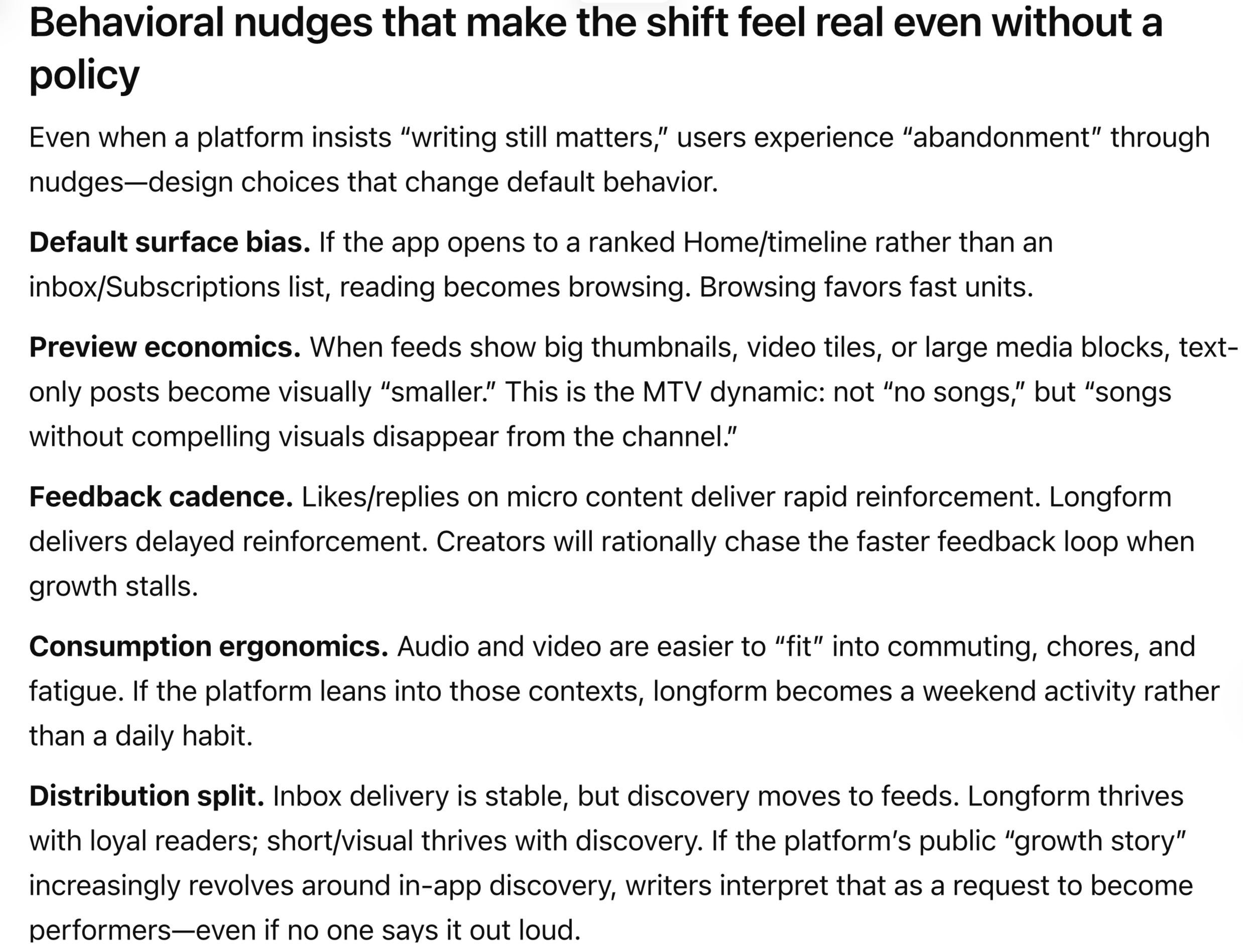
They also say the quiet part out loud: the app and feed drive the majority of discovery, the algorithm drives about half of all subscriptions, and more than a third of paid subscriptions come through the app. (3) Translation: whether Substack intends to become TV or not, the incentives of the feed push everything toward what performs best inside the feed. And the feed rewards what lands fast. What moves. What plays without requiring silence, stamina, or sustained attention.
This is why video becomes a privileged substance in any feed ecosystem, even a “writer-first” one. Video is the most efficient delivery system for micro-rewards. (4) It carries motion, face, tone, music, conflict, reaction. It can hook you before you’ve even decided you’re interested. Longform writing is the opposite. It asks you to slow down. It asks you to consent to complexity. It doesn’t deliver a hit every two seconds.
The squeeze
So the fear underneath all of this is not “I hate video.” It’s that once the discovery engine becomes feed-native, it starts selecting for feed-native content. And if you don’t adapt, you don’t merely lose reach. You get trained into a smaller and smaller room such as the email room. The loyal room. The room where you’re loved, but not discovered.
That’s the MTVication in scientific terms. The platform doesn’t have to censor writers. It just has to reward the medium that generates the most measurable engagement signals inside the feed. And the rest of us will feel it as a sudden chill.
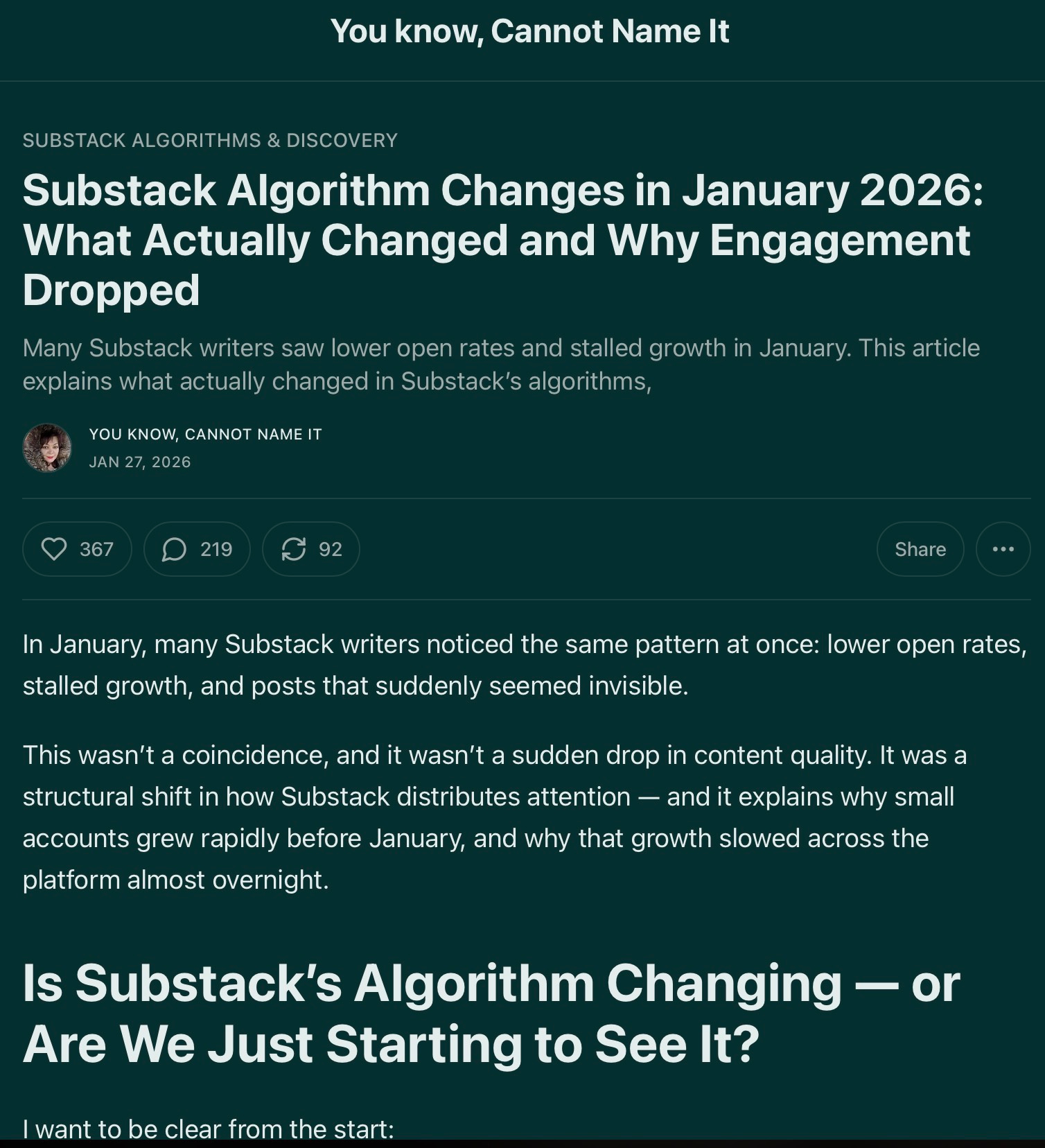
I kept thinking about that January dip people were whispering about. Then I read the piece by You know, Cannot Name It titled “Substack Algorithm Changes in January 2026: What Actually Changed and Why Engagement Dropped” What hit me wasn’t some grand accusation. It was the restraint. The writer doesn’t have access to internal dashboards, and they’re not pretending certainty. What they do have is something more annoying than certainty which is the same weird signals showing up across a bunch of unrelated accounts at the same time.
That matches what I felt in my own stats. The shift doesn’t look like a slow decline. It looks like the same work landing, and then not traveling. The posts are “seen” unevenly. Growth stalls after an earlier surge. Engagement feels delayed, muted, selective. And the reason writers start whispering is because inconsistency is scarier than failure. If you can name the rule, you can adapt. If the rule keeps moving, you start comparing notes.
So I’m not here to claim I caught Substack in some evil plot. I’m saying the same thing that writer said, in plainer language which is that when multiple people start reporting the same break at the same time, you at least have to consider that something upstream shifted.
That is why I do not need to believe in a cartoon villain to take this seriously. A platform can change ranking weights, change what the Home feed shows first, change how much “new people” traffic gets routed to long posts versus Notes or media, and never call it an “algorithm change.” Substack even describes the Home tab as a discovery feed paired with a queue, and it explicitly says Home is where notes, posts, recommendations, and conversations surface. (7) That is not sinister. That is product design. It is also the part of the product that decides who gets discovered.
Now look at my own pattern. My loyal room still opens the email. The posts still get read. The oxygen is not gone. The oxygen is just not spreading. For a stretch, I was getting zero new subscribers on multiple posts in a row while views and open rates held steady. That is the fingerprint of a discovery problem, not a writing problem.
A word for Substack
To the founders of Substack, Chris Best and Jairaj Sethi as well any other co-founders at Substack I failed to mention, I ain’t mad at ya. I can’t be mad at capitalism for acting like capitalism. You have a business to run. You have numbers to hit. You have a product roadmap. I get it.
But I need you to hear something that surprised even me. The loudest drumbeat in my comments was not writers complaining. It was readers. Paying readers. Loyal readers. People who built the culture of this place with their attention and their wallets. And they were adamant. They want no part of this livestream push. They do not want to be turned into an audience of watchers. The writers want to write. The readers want to read.
So listen Chris Best and Jairaj Sethi , when this ends up on your screens, do me one small favor. Please answer this in plain language, publicly, where your writers and readers can see it. Did anything materially change in how Home, Notes, or discovery routes people into longform around January? If the answer is no, say no. If the answer is yes, say what changed in human terms.
Because right now people are whispering that they are leaving. Not because they hate you. Because they do not know what game they are playing anymore.
And listen, I am not asking you to reveal the secret sauce. I’m just asking you to tell us if you changed the temperature on the stove.
I know video looks like the universal language. I know video looks like growth.
Here is the problem. If you chase that growth by sidelining the very people who made Substack what it is, you do not just lose writers. You lose trust. You lose the readers who came here precisely because they were tired of being trained by a feed. They came here to slow down. To think. To read a full argument. To sit with a paragraph long enough for it to change them.
So listen to your own audience. You can build the runway for video without bulldozing the library. You can invite the TikTok refugees in without telling the book people to go sit in the email basement and be quiet.
Because if this platform stops rewarding reading, you do not get a better Substack. You get one more timeline. And the whole reason we came here was to escape that.
Conclusion
MTV is gone. The music is still here. Christopher Cross is still here.
MTV is gone, and the whole music video era that once felt unstoppable is basically a relic. Music did not die. It just moved. It found new pipes. New rooms. New ways to travel.
They told us video was going to kill the radio star. The radio star did not die. The radio star became podcasting. We still get in the car and let a voice carry us through traffic. We still drive into dusk and let the daylight get swallowed up by the windshield. We still need something that can ride with us when we cannot stare at a screen.
That is how I think about writing. Feeds come and go. Timelines get redesigned. Engagement tricks get exhausted. The scroll will have its day. And then it will get replaced by the next trick that promises speed.
But books will still be here. Writing will still be here. Reading will still be here.
And when you are riding home and the darkness takes over the daylight and the radio is on, and out of nowhere you hear Sailing come through the speakers, that is the universe telling you: slow down. Stay human. Keep the words. Keep the receipts. Keep building the kind of work that cannot be replaced by a swipe.
So yes, I will adapt. I will learn the new pipes. I will package the work so it can travel.
But I am not surrendering the core.
The writers want to write. The readers want to read. And I am not letting a timeline talk me out of that.
This is my attempt to get this message on the screens inside Substack. Not just on your devices. On theirs. The Slack channels. The internal threads. The rooms where product decisions get made.
I have already had two viral posts. I have watched them travel into hands totally unconnected to my original subscriber base, way outside the Substack bubble. It is like a NASA moon landing. You press publish in one little corner of the internet and somehow the signal ends up in places you never aimed for.
So if you feel what I am saying here, do not just nod at it. Move it.
Because this is how messages reach those screens inside Substack headquarters. Not by vibes. By momentum.
Share this. Then share it again.
And do the other piece people forget: engage. Like it. Comment on it. Quote it. Restack it. Those signals are the difference between a post that stays in your corner and a post that starts traveling into rooms you will never see.
Share it to writers who have been grinding on this platform and feel like the floor moved under their feet.
Share it to readers who have noticed the push but have not had the words to explain what their eyes are seeing.
And if you are able, go paid. Not as charity. As a trade.
New paid subscribers keep my lights on so I can keep building this indie media operation, keep doing receipts first work, keep shining light into the darkness that mainstream media left behind, and yes, keep holding platforms like Substack accountable to the decisions they make when those decisions quietly push my readers into the quiet room.
Paid also buys me time to innovate without abandoning you. To respect the readers who want to read, while still using the livestream tools I need to fuel growth and live to see, and write for, another day.
Sources (in numerical order)

https://www.sciencedirect.com/science/article/pii/S0306460321002008
https://www.theverge.com/2024/9/18/24248308/substack-live-video

7.

Super clarifying! I have wondered why I’m suddenly seeing every video and needing to dig for material to read. I came here to appreciate those who write and to read, read, read. A clue for me, as a reader, is the subtle tone of panic underlying a couple of my favorites. It has been what seemed like an over-emphasis on readers unsubscribing. It just seemed like an unusual vibe. At one point, that vibe crept into my head and had me looking backward. Hey, wait, what? Did I miss an important post? Am I one of the folks they are talking about, who didn’t show up, didn’t read or restack or comment? And then that began to be problematic for me. Too much like the big social media platforms, for which I have little patience.
Writers gotta write. And readers gotta read. Give me words; my brain is fabulous with creating the images and with connecting the dots. Give me flexibility to go slow or do a skim. Time to take a pause when I read a quote that blows my mind open.
XPLISSET I subscribed because I admire your writing and your delivery of an idea. If video is dressing up, just know that’s not what drives my subscription- just as you pointed out so well in your post!! I’m a sweat pants and hoodie reader, old school and okay with that. I’ll try to do the vids occasionally, but reading is my bag.❤️
A million thanks for explaining all of this. I will read, read, read!
I wondered why things were changing before my eyes.
Do what you must, but keep your writing coming! I read books. That's why I can stay with a post for more than a paragraph or two before scrolling on to some other shiny object on my screen.