


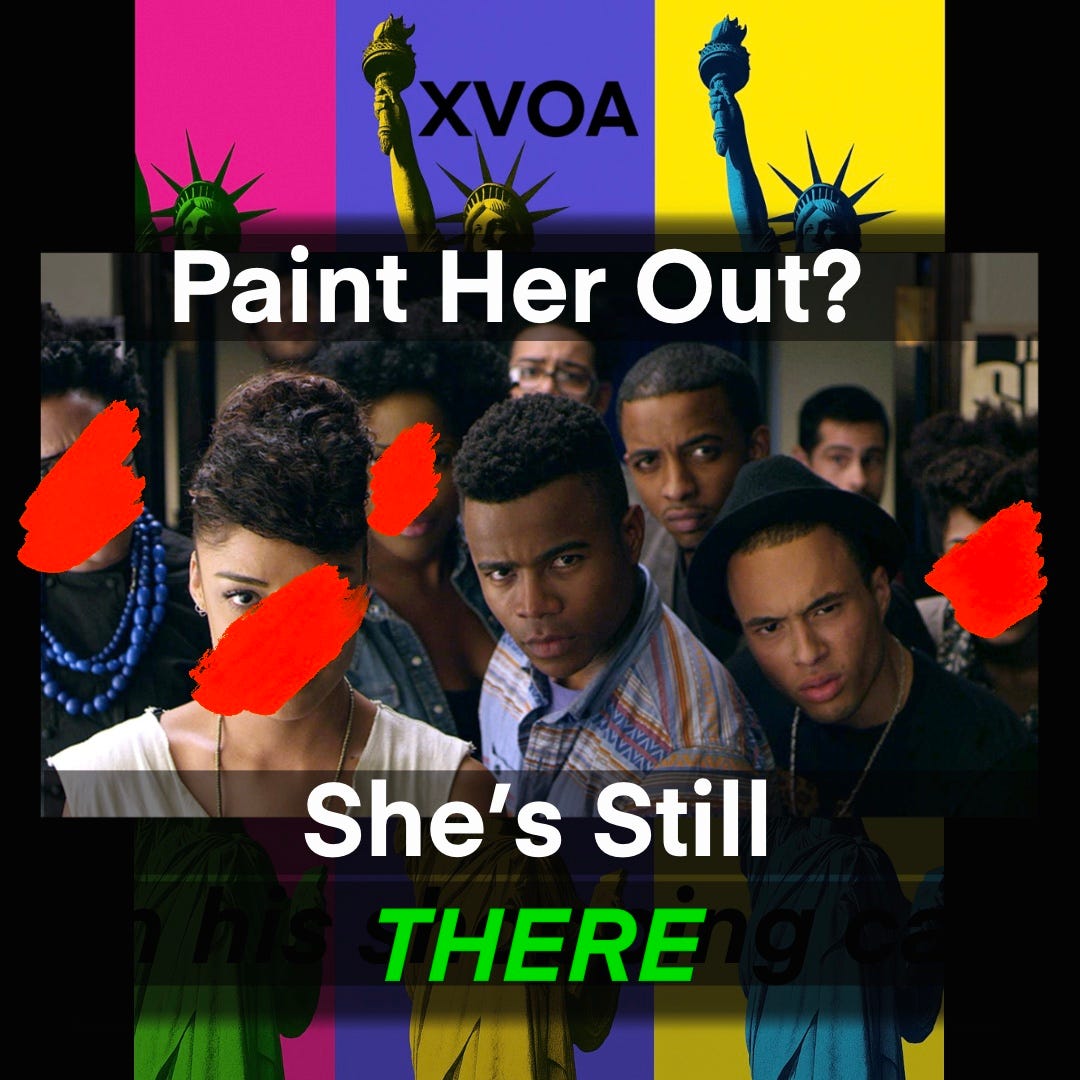
I almost didn’t write this because I’m a man.
I’ve been circling this idea for a long time, picking it up, setting it down, then telling myself the same thing. How in the hell am I going to write an essay about Black women when I’ve never walked in their shoes? It felt presumptuous. Worse, it felt like the kind of unearned confidence we criticize in other people. So I kept dropping it.
Then I read Ohun Ashe ‘s Dear White People Post
Not one post, but two. These are a series of posts which have gone viral by exposing a clinical pathology of white empathy. This is the kind of writing that does not ask for the room’s permission and does not soften its truth to keep the listener comfortable. It’s the kind of writing that makes you realize the real story isn’t whether the message was “too harsh.” The real story is how quickly certain people start acting like they can’t hear.
That’s when the light bulb hit, and my mind flashed back to something I witnessed in my own home.
I recently witnessed my mother talking to my daughter about how to introduce herself to a room she knows is coming. My daughter is an ROTC Cadet, training toward being an officer. My mother is an Army veteran, too. She wasn’t giving “tips.” She was passing down a survival script for a tactical deployment.
She told her, plain as day, you might walk into a space where they see your name, your dark skin, your nappy hair, and they decide you’re a threat before you even open your mouth. They might do it fast, like a reflex. Even with the uniform. Even with the bars on your chest.
In the military, we call it “Command Presence.” It’s the ability to project authority so clearly that your right to lead is never questioned. But my mother was teaching her a specialized version because she knows that for a Black woman, Command Presence isn’t a gift of the rank. It is a fortress you have to build from the bones of your ancestors.
The point was not paranoia. The point was pre-emptive legitimacy. Then she said something that landed like a weight. “Don’t hold back when you establish your right to be there.”
“Say it. Say the lineage. Say your grandmother was an Army veteran. Say I’m an Army veteran. Say your father was an Army veteran.”
She was telling my daughter to “out-patriot” the room. She was teaching her to use her family’s service as a credentials bomb, because she knew the uniform wouldn’t be the “great equalizer” the recruiters promised. She was teaching her how to force a “MAGA audience” to see a legacy instead of a threat. She was coaching her on how to perform legitimacy for people who would otherwise use their “nonchalantness” as a weapon to erase her.
Watching that exchange, I understood the cognitive dissonance at the heart of this.
My daughter is being raised in a home where her voice has weight, modeled by a grandmother who was a literal soldier and the undisputed head of our household. She is being primed for leadership. But the moment she steps outside, she hits a world that views that same natural authority as a “glitch” in the social order.
This isn’t me trying to speak for Black women. This is me naming what I’ve watched happen to them, and what I’ve watched happen in people when they hear them. Black women learn early that communication is not just expression. It’s armor. It’s a claim to a reality that the rest of the world is constantly trying to edit them out of.
And out in the wider world, that same clarity, that same Command Presence learned at the kitchen table, often gets rebranded as bitterness, as aggression, as “too much.” The louder they get to overcome the apathy, the more the room insists they’re the problem.
We don’t listen to Black women. We’ve just built a whole moral language to pretend that covering our ears is their fault.
TL;DR:
The Architected Body and the Voiceless Property: Rooted in the antebellum commodification of the Black female body, white society established a psychological defense of “ear-covering” to prioritize comfort over recognizing Black personhood [6][7].
Reconstruction and the Ritual of Consent: Post-Emancipation saw the rise of the domestic matriarchy and the use of cultural rituals like the “slow drag” to reclaim bodily autonomy and establish the power of choice [1][5].
The Segue into the Color Purple and the Enemy Within: Modern “Red Pill” digital spaces often provide a cultural alibi for the wider world, defending artificial constructs while gaslighting the trauma of the actual ancestors [2][8].
The Cost of the Prophetic Voice: The silencing of journalists like Karen Attiah for identifying far-right rot serves as a systemic signal that Black female foresight is treated as a liability rather than an asset [3][4].
The High-Tech Muzzle: Dr. Timnit Gebru: Even at the peak of technological innovation, the brilliance of Black women is rebranded as “uncollegiality” when it exposes the biases reflected in our digital creations [9].
The Double-Bind of the Over-Qualified: Kamala Harris: The “bros before hoes” dynamic ensures that Black women are punished for their excellence, trapped between being labeled “angry” or “robotic” for exercising their natural authority.
The Sentinel of the 314: Ohun Ashe: Grounded in the fire of Ferguson, Ashe’s clarity is met with a weaponized nonchalance that forces the sentinel into a feedback loop of spiritual exhaustion.
The Altar of Silence: The path forward requires men and allies to stop sacrificing the domestic matriarchy for patriarchal validation and to finally face the truth without covering their ears.
The Table is Set for You
This is a Black newsletter where all are invited to the table. I need you to understand something clearly: I work for you. I don’t work for Jeff Bezos. I don’t work for a corporate newsroom that wants to edit the soul out of my words. This work is all I do all freaking day and all freaking night. It is my full time commitment to dragging the truth into the light.
I refuse to paywall these insights because I believe in a table where all are invited, especially our sisters and brothers who cannot afford to pay. That is community care. That is socialism right there for you, baby. But this model only works if those of you who can afford to support this labor actually do it. If you find value in this depth but choose to remain a silent consumer, you are letting the corporate shadow win. Restack this substack. Restack it. Share it far and wide. And then, keep the lights on for me so the rest of the community can benefit. Do it by becoming a paid member here:
The Architected Body and the Voiceless Property
To understand the modern “slap in the face” that my daughter is preparing for, we have to look at the psychological architecture of the antebellum South. During slavery, the Black female body was not a person. It was a dual-purpose production site. It was a site of labor and a site of reproduction, legally codified as “partus sequitur ventrem,” where the status of the child follows the womb [6]. This legal doctrine ensured that Black women’s bodies were used as self-replenishing capital for the white economy. Their screams during the separation of families and their physical pain were treated as ambient noise, a biological byproduct of a machine that white society refused to acknowledge as sentient.
This period established the foundational “ear-covering” of the American psyche. By treating Black women as property, the state created a psychological barrier where hearing their truth would require acknowledging a crime too large for the white conscience to bear. Research into the history of medical experimentation reveals that even in agony, Black women were believed to feel less pain than white women [7]. This wasn’t just bad science. It was a defense mechanism, a way to ignore the voice so the body could be used.
Despite this horrific commodification, Black women emerged as the intellectual and moral backbone of the abolitionist movement. Women like Sojourner Truth and Maria Stewart didn’t just speak. They performed the “Command Presence” my mother was talking about before the term existed. Truth’s “Ain’t I a Woman?” was a direct confrontation of the cognitive dissonance of her time. She challenged the white male audience’s definition of femininity and personhood, forcing them to look at her strength and her intellect. These women were the first to move the Black female voice from the “private” sphere of survival to the “public” sphere of political transformation, setting the stage for what would become a centuries-long battle for the right to be heard.
Reconstruction and the Ritual of Consent
Following the Civil War, the period of Reconstruction offered a brief, flickering hope for the realization of Black female agency [1]. During this time, Black women were central to the rebuilding of the Black family and the establishment of communal institutions. Black women were often the first to advocate for legal marriages and the protection of their children. They transitioned from being property to being the heads of households, often managing the transition from plantation labor to sharecropping with a level of authority that unsettled the white power structure. This was the birth of the “domestic matriarchy,” a necessary adaptation for survival when the state was actively trying to destroy the Black male figure.
In the vacuum of Post-Reconstruction, as Jim Crow laws began to strip away political rights, Black women utilized culture to re-establish the concept of consent. The “slow drag” blues culture of the late 19th and early 20th centuries was more than just a dance [5]. It was a ritual of boundary-setting. In the “juke joints,” away from the white gaze, Black women used the blues to navigate the complexities of mating rituals. They sang about desire, betrayal, and the right to choose their partners. This was a radical reclamation of the body that had been used as property for two hundred years. The blues allowed them to establish a “No” that had to be respected, a cultural practice that served as a precursor to the modern fight for sexual autonomy.
However, as the 20th century progressed, this hard-won authority was met with a new form of erasure. In the women’s suffrage movement, Black women were systematically sidelined. Leaders like Susan B. Anthony and Elizabeth Cady Stanton often prioritized the voting rights of white women over universal suffrage, frequently utilizing racist rhetoric to appeal to Southern white voters. As documented in the history of the 1913 Woman Suffrage Procession, Black suffragettes like Ida B. Wells-Barnett were told to march in the back to avoid offending white participants. This “sidelining” was a strategic choice to cover the ears to the specific intersections of race and gender, creating a rift that persists in feminist discourse to this day.
The Segue into the Color Purple and the Enemy Within
This historical trajectory of being used, being the leader, and then being erased brings us to the profound psychological crossroads depicted in The Color Purple. Alice Walker’s narrative is a culmination of this history, a story of a woman moving from being a “thing” to a “voice.” Characters like Sofia embody the “Command Presence” and the subsequent “slap in the face” that occurs when that presence is met with state-sanctioned violence. Sofia’s willingness to shout “Hell no!” when the world expected a submissive whisper is the ultimate expression of the authority Black women learned at home, and her imprisonment is the world’s way of trying to mute that frequency.
The tragedy, however, is that this refusal to listen has also infected even some corners of their own community. I first came across a YouTube channel called Layman’s Journal two years ago, a faceless creator who claims to be a Black man [2]. At the time, I wasn’t entirely certain how to process the content, but the visceral reaction I had confirmed my earlier decision 10 year prior to get as far away as possible from the red pill Black male online space. For the folks who don’t know, the “Red Pill” is basically a club for men who want to blame women for their own problems. They use a fancy name from a movie to act like they’ve found a secret truth about the world. But really, they’re just projecting their own fears onto women. They talk about “waking up,” but it’s actually just a big ego trip. They’d rather follow a checklist of mean behaviors from a guy on YouTube than do the real work of being a grown man. It’s not an epiphany. It’s just a fancy way to stay scared of the dark.
This isn’t just a theory about a bad corner of the internet. It is a real infection that shows up in the digital spaces where we should be building each other up. You see this perfectly on display in the content of Layman’s Journal YouTube channel. This channel stands as a proto-example of the exact resistance Black women face from even some corners of their own community. What struck me was the pathological empathy gap on display. In his review of The Color Purple, he dismisses the visceral, documented pain of Black women. He states, “The story and the message behind the story was trash.” He continues, “It was two and a half hours of non-stop black misandry.” He frames the shared cultural trauma of women like Alice Walker as “fictionalized childhood memories,” dismissing their lives as “horrific exaggerated images and lies of who we are as men.” By doing so, he tells the “aunties” who raised us that their witnessed reality is merely a lie designed to hate men.
This dismissive reflex leads to a dangerous distortion of reality in a video titled “What I Learned about women from The Learning Tree.” In this review of a film set in the segregated 1920s South, he totally misconstrues a scene involving a 14-year-old girl, Arcella, and a wealthy white male aggressor, Chauncey. Arcella was raped. This was a fact the book and the movie make devastatingly clear, yet the reviewer reinterprets this violation as a sexual choice. Rather than seeing the predatory nature of a man twice her age with systemic power, he pivots to “Red Pill” talking points about women engaging in “risky sexual behaviors” with “attractive partners.” He complains that “nothing that Newt did for her mattered,” arguing that “she gave all that up and threw it all away for Chauncey.” He ultimately concludes that “she gave him her virginity her honor and her womb.” He would rather defend the honor of a white predator than acknowledge the vulnerability of a Black girl who was systematically violated.
The “I kid you not” moment, the psychological nadir of this entire digital ecosystem, arrives in his review of the horror movie M3GAN. Here, we witness a staggering display of perverse emotional displacement. He expresses a distinct moral outrage for a blonde robot doll subjected to a scene of simulated rape. He describes a bully straddling the machine as the “cringiest thing I’ve ever seen,” and he actually utilizes the term “non-consensual activity” to defend the sanctity of a machine. This is the ultimate, pathological “ear-covering.” He grants a plastic, blonde-coded machine a level of bodily autonomy and empathy that he explicitly and cruelly denies to Arcella. He treats the simulated violation of a circuit board as a tragedy worth mourning, while he simultaneously reduces the brutal rape of a girl from his own cultural lineage to a “calculated risk” or a “better deal” for an “attractive” man. It is a devastating betrayal, mourning the artificial while gaslighting the ancestor.
It is a telling sign that sometime after August of this year, the commentaries for both The Learning Tree and M3GAN were scrubbed from the internet. But even back in 2024, when I first looked into that darkness, I knew that I would eventually need the receipts. My intuition told me to save what the world tries to hide. Sure enough, I found the transcript I had saved in my files from two years ago. I remember trying to contact this man to no avail, but people who hide behind avatars rarely want contact with the light. I do remember leaving an anger laced comment on both of those videos, a visceral reaction to the betrayal I was witnessing.
This specific pathology reveals a deeper, more desperate psychological complex, though it is critical to note that it does not represent the whole. The vast majority of Black men have, since Emancipation, walked a grueling line, navigating the intricate tripwires of intimate relationships with Black women without the patriarchal dividends or structural buffers afforded to their white counterparts. They have built homes on the bedrock of shared struggle, not entitlement. However, there is a vocal minority whose mimicry of white patriarchal scripts serves a sinister function [8]. It provides a cultural alibi for the wider world. By performing this distorted “alpha” masculinity, they effectively grant a permission slip for the white male populace to discard Black women, acting as a convenient proxy for the external world to marginalize them with a clean conscience. It is a ritual sacrifice of the domestic matriarchy on the altar of a hierarchy that views both the man and the woman as disposable. When we look past these digital echoes of betrayal, we find the real-world consequences in the lives of women who refuse to be silent. Women like the journalist Karen Attiah find themselves targeted the moment they dare to speak truth to the architects of that same patriarchal order.
The Cost of the Prophetic Voice
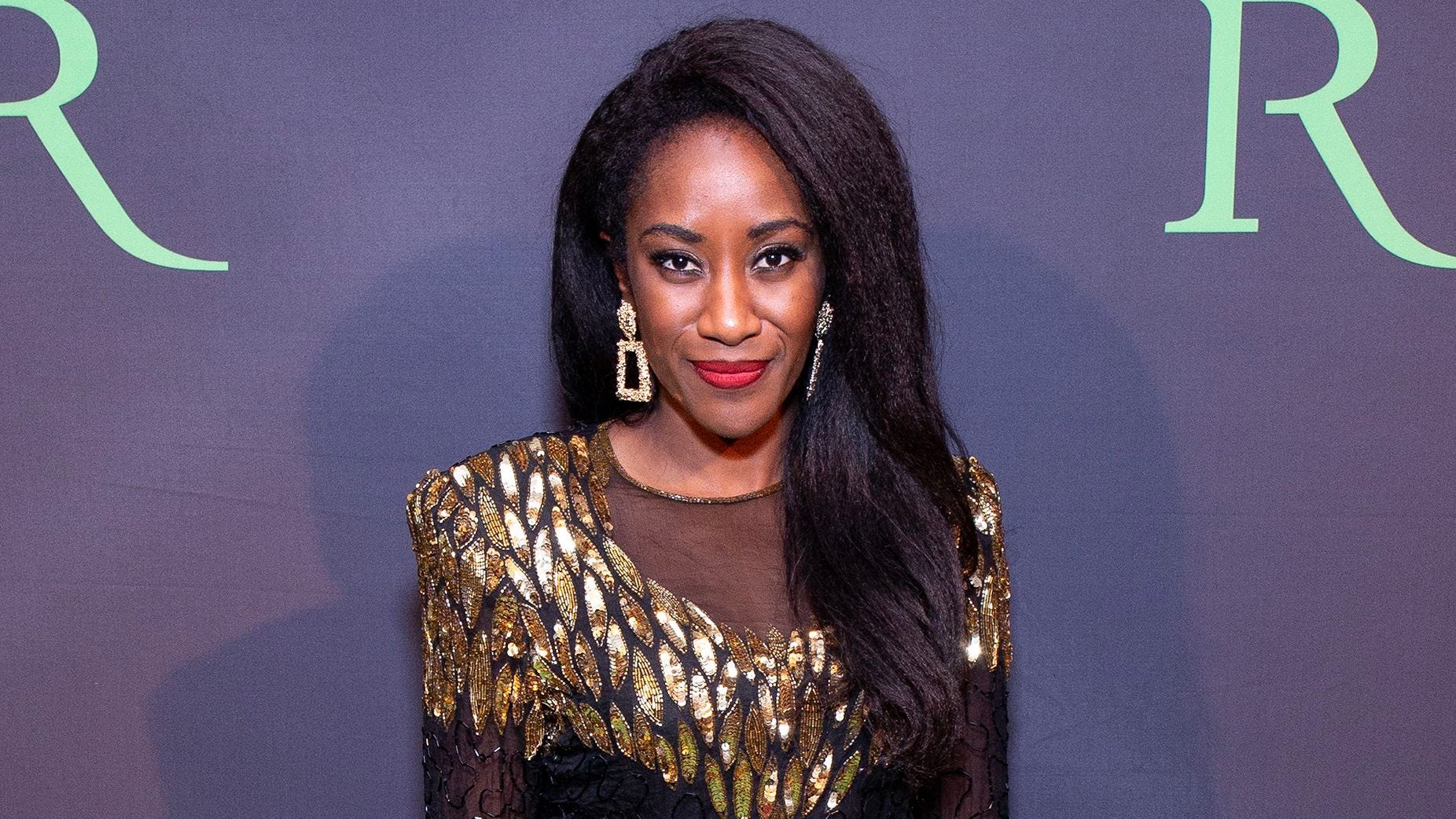
We should have listened to Karen Attiah. When the Washington Post handed her a pink slip for calling out Charlie Kirk and his burgeoning, metastasizing rot of far-right rhetoric, they weren’t just practicing corporate HR policy [3][4]. They were participating in the ancient American tradition of silencing the sentinel. We love to preach about “journalistic integrity” like it is some holy scripture. We fu**** love it. Right up until a Black woman actually uses that integrity to point out the eight-hundred-pound monster sitting right on the newsroom couch. Then, does that room get quiet. You could hear a pin drop in the HR department! Suddenly, everyone’s hands go right over their ears like they are playing a game of hide-and-seek with the truth. Attiah didn’t just have an opinion. She had an observation of a social cancer that was growing while the “objective” reporters were still checking their notes. She saw the whole house on fire while the rest of the newsroom was standing in the kitchen debating whether the matches were too warm!
Look at where we are now. We have a political climate where the highest offices in the land feel comfortable leaning into the most base, unvarnished racism. We witness the man occupying the Oval Office himself sharing Obama “monkey memes” with a terrifying nonchalance, acting with a total lace of fear of pushback because the social taboos that once forced this vitriol into the shadows have been completely eroded. This is the world that Attiah was warning us about. When she spoke up, she was punished for “lacking objectivity,” but in reality, she was punished for being too objective and for seeing the reality of the threat with a clarity that made the comfortable uncomfortable. Her firing was a signal to every Black woman in the professional sphere. Your “Command Presence” is a liability the moment it challenges the white patriarchal status quo.
The tragedy of theAttiah case is that it reinforces the very feedback loop I witnessed in my own home. My daughter is being taught to establish her right to exist, but the world is showing her that even if you have the credentials, even if you have the “officer bars” of a prestigious journalistic post, the world will still find a reason to give you a pink slip for being “too much.” We didn’t listen to her when she named the rot, and now we are surprised that the house is falling down. Attiah was trying to perform the radical act of truth-telling, and we treated it as a breach of protocol. We’ve built a system where a Black woman’s foresight is rebranded as “bias,” allowing the world to walk blindly into a future she already mapped out for us.
The High-Tech Muzzle: Dr. Timnit Gebru
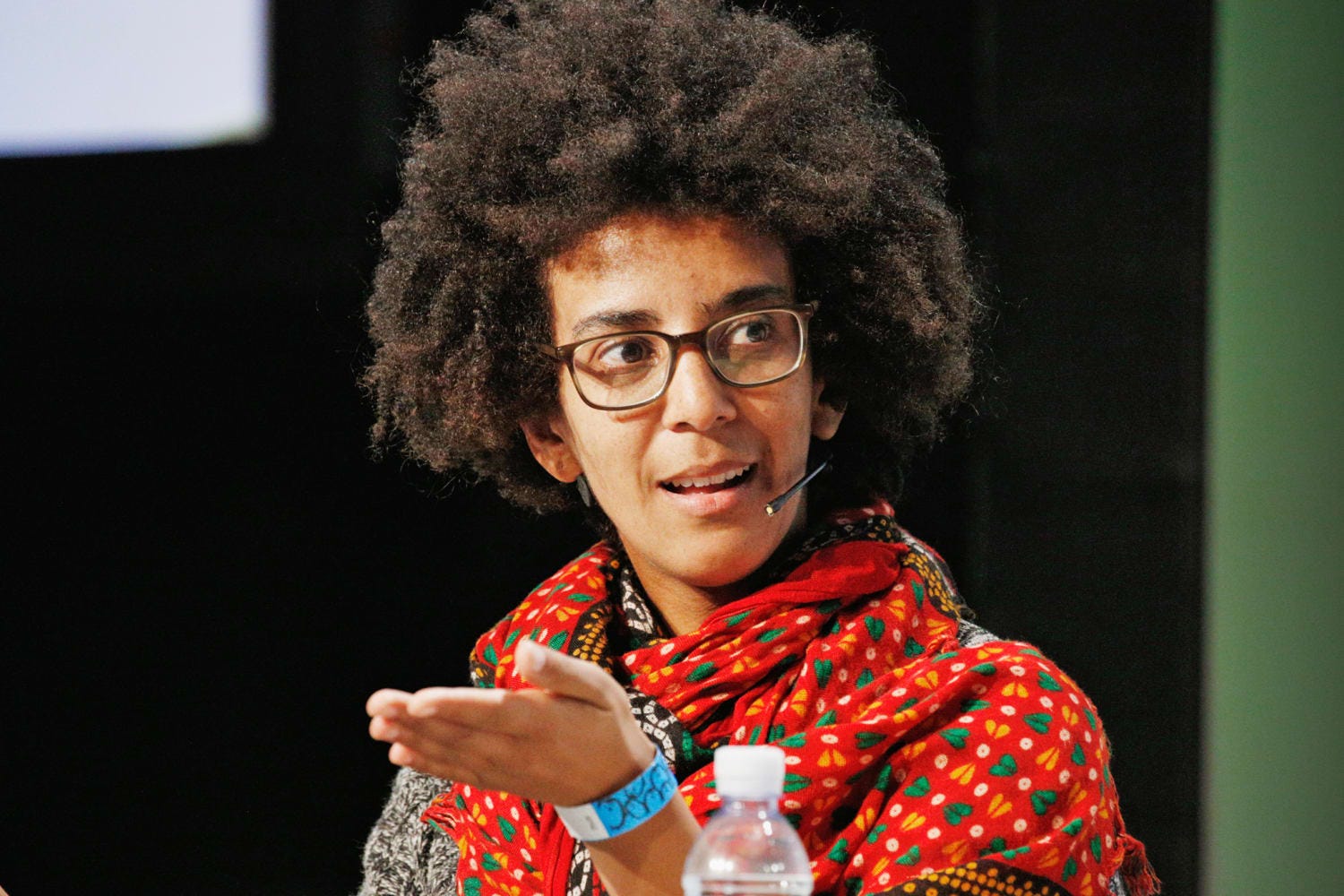
Then you have Dr. Timnit Gebru. She wasn’t just some employee at Google. She was the co-lead of their Ethical AI team. She was the sentinel on the digital wall, the one who looked into the “stochastic parrots” of Large Language Models and warned us that the machine was reflecting our own worst biases back at us [9]. She saw the environmental cost and the algorithmic bias, and she spoke it with the authority of someone who had mapped the mountain from top to bottom. But when she sent that internal email to a group of allies, she wasn’t just checking in. She was calling out the fact that the company was burying her research and treating diversity like a marketing gimmick instead of a moral imperative. She warned them that the tech was being built on a foundation of exclusion, and that speaking up about it was a career hazard. When she dared to question the “collegiality” of a system that wanted her to be a decoration instead of a director, they didn’t just ignore her. They pushed her out the door before the ink was dry on her resignation threat, and then they tried to delete her name from the very paper she co-authored.
Now, you have to understand the psychological “Shadow” of Silicon Valley. They want the “Wise Woman” archetype to bless their creations, but they do not want the Wise Woman to point out that the creation has no soul. Gebru brought a “Command Presence” that was fueled by a PhD and a deep-seated commitment to justice, and it was that very presence that made her a target. Google’s response was a textbook case of corporate “nonchalantness.” They didn’t engage with her research. They engaged with her “tone.” They covered their ears to the stochastic warnings because those warnings threatened the quarterly earnings of their digital god. They would rather have a silent machine that repeats our prejudices than a brilliant Black woman who tells us how to fix them.
The firing of Timnit Gebru was a global signal that even at the frontiers of human innovation, the Black woman’s voice is treated as a “bug” rather than a “feature.” We watch as a multi-billion dollar corporation used its massive institutional weight to try and gaslight a world-class scientist into believing she was the problem. They rebranded her expertise as “uncollegiality” and her urgency as “aggressive.” It’s the same story we saw with Aleah Attiah, just with a different logo on the building. We didn’t listen when Gebru warned us that the AI would become a mirror for our systemic racism, and now we are living in a world where those very algorithms are deciding who gets a loan, who gets a job, and who gets a prison sentence. We had the blueprint for a better future right in front of us, but we decided to burn it because the architect didn’t lower her voice.
The Double-Bind of the Over-Qualified: Kamala Harris

And then we have former V.P. Kamala Harris, a woman so decorated, so credentialed, so devastatingly prepared that her very excellence became a stumbling block for the insecure. It’s a recurring theme in the American drama where the over-qualification of the Black woman is treated not as an asset, but as a provocation. We saw it with Barack Obama, a man who had to be twice as good to get half the distance. But even for him, those credentials eventually served as a ladder. For a woman like Harris, those same credentials are often used as a cage. In some circles, her brilliance wasn’t celebrated. It was interrogated. They didn’t see a leader. They saw a threat to the comfortable mediocrity of the status quo.
The ghost of patriarchy is a long-reaching shadow, and we see it most clearly when the “bros before hoes” movement rises up to protect the boys’ club at any cost. We saw it in the way the ghost of patriarchy reached back from the past to hobble Hillary Clinton, and we see it in the sizable number of white men who would quite literally rather “go Black” than “go woman.” They can reconcile their worldviews with a Black man in power long before they can stomach the sight of a woman, especially a Black woman, standing at the helm. For them, a Black man is a change in the casting, but a woman in charge is a change in the entire script of the domestic and political order.
This creates the ultimate psychological double-bind. If she gets angry, if she gets passionate, if she allows the fire of her conviction to show, she’s immediately filed away as the “Angry Black Woman,” a trope used to justify the room’s collective decision to cover its ears. But if she holds her cool, if she remains calm, if she presents the data with a surgical precision that leaves no room for debate, then she is rebranded as “cold,” “unrelatable,” or “calculating.” She is “robotic.” She is the “Ice Queen.” There is no middle ground allowed for the Black woman who knows more than the men in the room. We demand her service, but we despise her authority. We want her labor, but we cannot stand her “Command Presence.” We’ve built a world where her silence is the only price of admission, and Harris, like so many others, was punished simply because she refused to pay it.
The Sentinel of the 314: Ohun Ashe
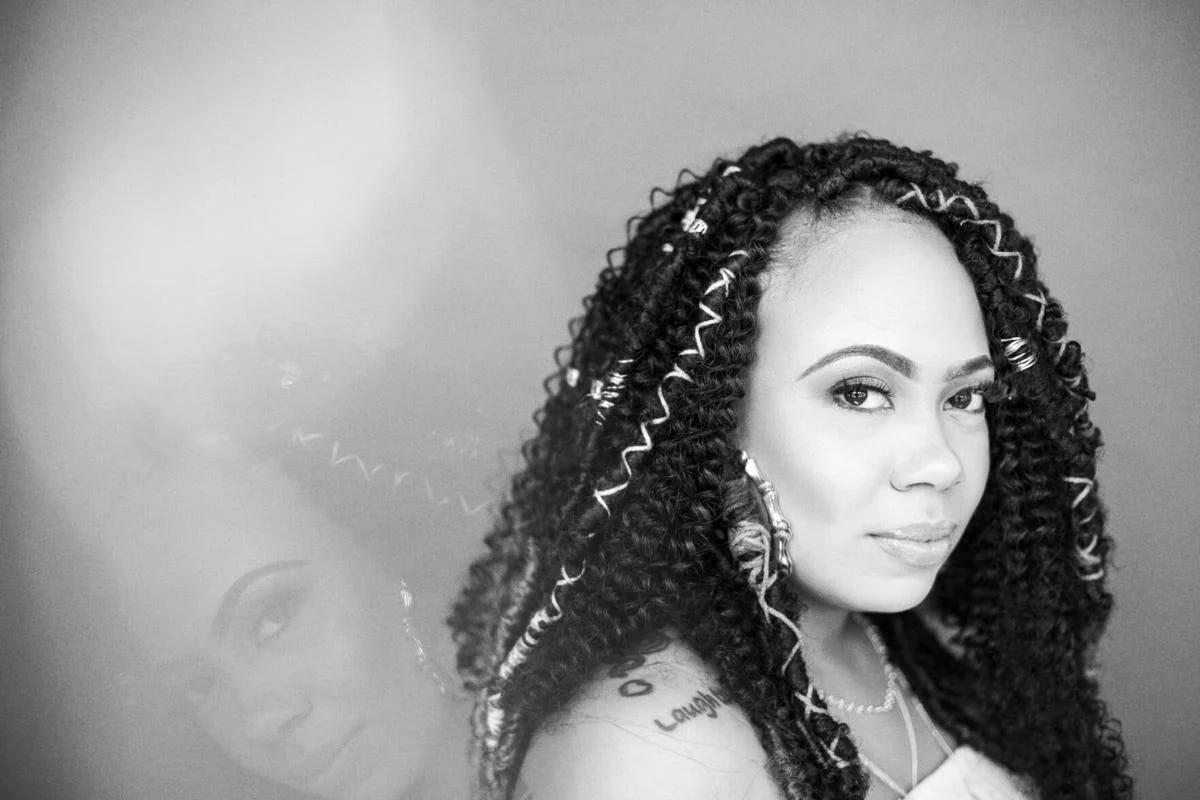
It all brings me back to where I started. It brings me back to Ohun Ashe. To understand her frequency, you have to understand her soil. Ashe is a child of the 314, which is the geographic signature and area code for St. Louis. It is a daughter of Missouri soil who grew up five minutes from Ferguson. Her relationship to activism was deepened in the fire of the Mike Brown Jr. uprising, and she has the scars to prove it. She hasn’t just written about liberation. She has been “arrested, brutalized by cops, and doxxed by white supremacists.” She has “received hundreds of messages on how they would kill her more times than I can remember.” She describes herself as “just a 314 girlie who’s choosing to share her truths out-loud,” but her truth is a high-velocity projectile aimed at the heart of our willful ignorance.
In her January 18th post, “Dear White People: Renee Nicole Good: Watching Your ‘Ah-ha’ Moment is Nauseating,” she exposes the clinical pathology of white empathy. She writes with an indignant fire, noting that witnessing the world “mourn Renee Good without needing a background story... without having to prove she was a victim” is aggravating. “White people always had the ability to see the horror in our deaths but you reserved your compassion in order to defend your hierarchy in American society.” She mocks the “ah-ha” moment, explaining that ‘Ah’ is the scream and horror, while ‘Ha’ is the realization that to many, this is just a joke. She warns that “softness has not saved us from your willful blindness.”
Eight days later, in “Dear White People: You’re Getting it Wrong,” she dives into the biological and psychological toll of being the unheeded sentinel. She speaks of the “literal, ‘we warned you’ mixed with annoyance and irritation” and the “rage zip through the Glutamate neurotransmitters” in her brain. She is blunt, and she is tired of the performance. She admits that the thought repeatedly lands on, “fuck you for not listening.” She explains that “White people fail to realize that for Black and Brown people, we are forced to learn you — almost before we learn ourselves.” We learn your behaviors and your egos because doing so can get us killed. It has gotten us killed.
Ashe is operating at a peak frequency, performing the labor of a thousand sentinels while the world uses its apathetic “shrug” to gaslight her. She is speaking with the ancestral authority of the domestic matriarchy, but she is writing to an audience that has built a fortress of “calm” to ignore her “storm.” She might not even realize the full weight of the loop she’s caught in. The more she asserts her right to be heard, the more the patriarchal “hardware” of this society tries to format her out of the system. It is a spiritual exhaustion born of the realization that your hurt feelings are prioritized over her ability to live. We’ve become experts at covering our ears and then blaming the woman for the volume of her scream.
The Altar of Silence
Let me be clear, the solution is NOT for Black women to “calm down.” It’s not for them to “soften the blow” so you can digest their humanity without getting a stomach ache. And the solution definitely isn’t more education. How can you ask for more education when Black women are already one of the most educated demographics on the face of planet earth? They are lacing up their intellectual boots and out-learning everyone in the room, and the world still acts like it can’t read the damn transcript.
You can’t degree your way out of a system that views your intellect as a provocation. We’ve seen the PhDs, we’ve seen the officers, we’ve seen the architects. We got enough degrees to paper the walls of the Smithsonian, and the world is still acting like it can’t read the transcript. Education alone isn’t the cure for a world that is intentionally covering its ears.
I’ll tell you what the solution is. Any Black man reading who’s ever thought “If she just toned it down, things would be easier,” I’m talking about to you bruh. Stop leaving our sisters out here to fight it alone while sitting at your keyboard listening to the likes of Kevin Samuels and their red pilled bullshit. You are trading your psychological inheritance, the strength of the domestic matriarchy that raised you, for a seat at a table where the only thing on the menu is your own emasculation. You are cosplaying a version of manhood that was built to exclude you, and the price of your ticket is the silencing of the women who kept the lights on when you were in the dark. Stop defending the honor of a circuit board and a blonde robot while your own flesh and blood is being violated in the streets and in the boardrooms.
White women, I’m talking to you now. Your “ally-ship” is a hollow costume if you only wear it when the danger is miles away from your front door. If you only care about the murder of Renee Good because you realized “they’re after us too,” then you are not an activist. You are a tourist in a tragedy. You cannot keep using your tears to drown out the very voices that are screaming to save the house you’re living in. Your comfort is not more important than their survival. Stop centering your hurt feelings and start centering the bodies that are actually on the line. Stop being “tired of being beaten down” by a system that you still benefit from, and start using your proximity to the throne to dismantle the throne.
And white men, yeah “bro,” I see you too. I see the “monkey memes” being shared from the man occupying the Oval Office himself. I see the nonchalance. I see the hands over the ears. You’ve enjoyed the luxury of silence for four hundred years because you’ve built a world where you don’t have to hear the screams to enjoy the spoils. You’d rather see a Black man mimic your worst impulses than see a Black woman challenge your best lies. You’d rather have a machine that reflects your shadows than a sentinel who points to the sun. Your nonchalance isn’t a personality trait. It is a weapon of war.
If you’re reading this and feeling your blood pressure rise, if you’re getting defensive and getting ready to type a manifesto in the comments, ask yourself why. If the shoe doesn’t fit, why are you limping? If you aren’t the one using nonchalance as a shield, then why does this truth feel like an attack? Your offense is just the sound of the shadow being dragged into the light.
Now, I bring it back home. I look at my daughter again. I see her standing there, those officer bars catching the light, lacing up her boots for a tactical deployment in a world that is already planning her erasure. I look at my mother, a veteran who survived the wars of the past only to realize she has to draft a survival script for the future. And I realize that we shouldn’t have to be here. This survival script should not be a family heirloom. We shouldn’t have to coach our daughters on how to out-patriot a room that wants to edit them out of reality. The cognitive dissonance shouldn’t be hers to resolve. It should be yours to break. We don’t listen to Black women because we are terrified of what their truth will do to our comfortable, systemic lies. But if we finally stop covering our ears, maybe, just maybe, we can finally stop lacing up for a war that was never supposed to be theirs.
I work for you. I don’t work for Jeff Bezos. I don’t work for a corporate newsroom that wants to edit the soul out of my words. This work is all I do all freaking day. It is my full time commitment to dragging the truth into the light. I refuse to paywall these insights because I believe in a table where all are invited, especially our sisters and brothers who cannot afford to pay. That is community care. That is socialism right there for you, baby. But this model only works if those of you who can afford to support this labor actually do it. If you find value in this clinical depth while choosing to remain a silent consumer, examine that. Support the work, keep the lights on, and ensure these truths remain free for those who need them most.
SOURCES
https://nmaahc.si.edu/explore/stories/black-women-during-reconstruction
https://www.youtube.com/%40LaymansJournal
https://www.nationalreview.com/news/washington-post-reporter-fired-after-breaking-newsroom-protocol/
https://www.splcenter.org/fighting-hate/extremist-files/individual/charlie-kirk
https://nmaahc.si.edu/explore/stories/it-was-more-dance-slow-drag-rituals
https://www.archives.gov/milestone-documents/13th-amendment
https://www.history.com/news/the-father-of-modern-gynecology-performed-shocking-experiments-on-enslaved-women
https://www.brookings.edu/articles/the-rise-of-the-manosphere/
https://www.technologyreview.com/2020/12/04/1013294/google-timnit-gebru-ai-ethics-firing/
I’m grateful I don’t read you for comfort. Truth cuts deep.
I'm a retired Naval Officer. White. My dad was a Marine Infantry Officer. I know it was hard for me. He never gave me any advice. I can't imagine how difficult it will be for her, but I think the advice from Mom is sound. I'm so glad she received it from such an authority. I have complete faith and confidence in her. 💛🫡