
You Don’t Really Want Cheaper Eggs
“STFU & Pay More” economics, and other fairy tales told by people who never look at price tags

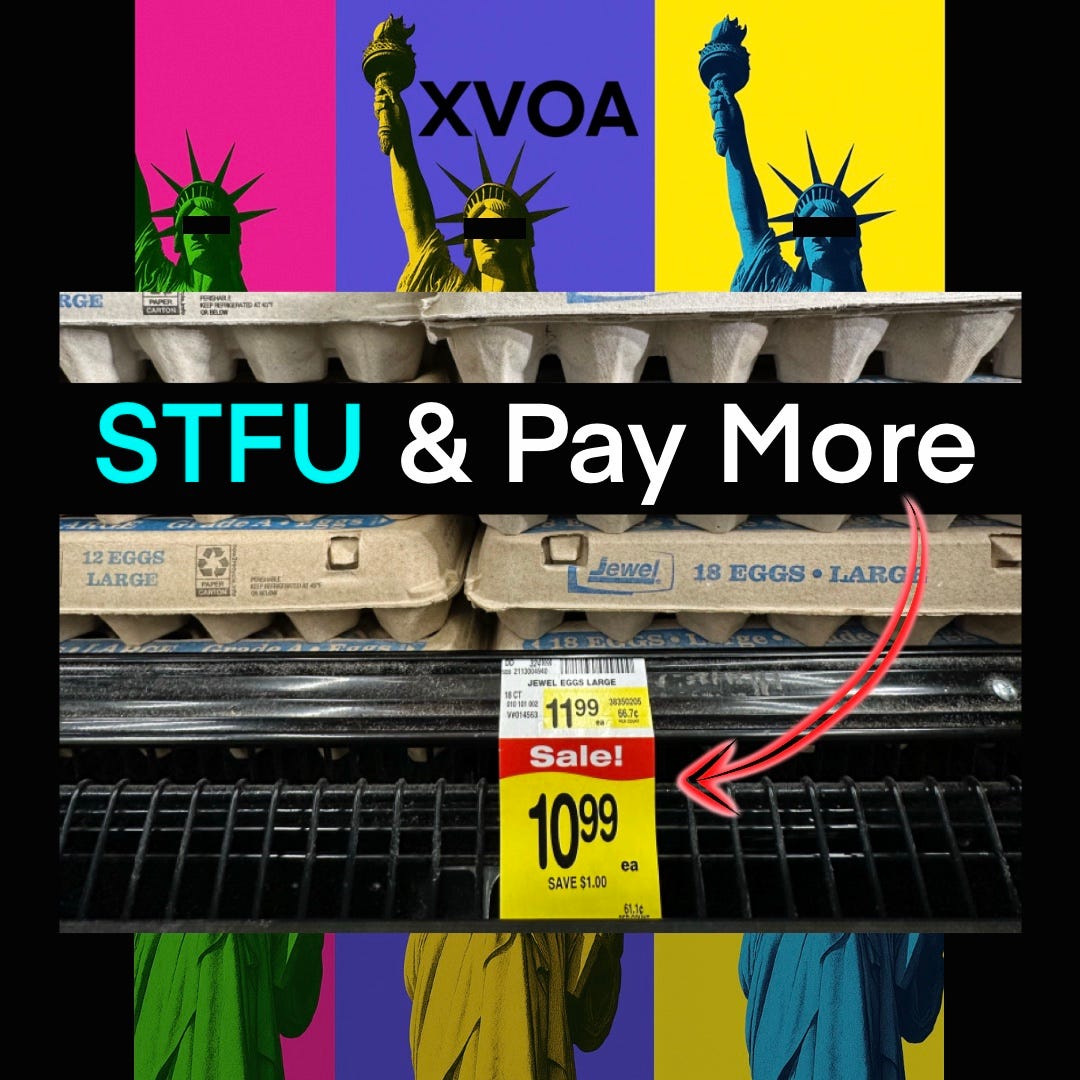
I’ve been trying to be more “professional” now that there’s a little Bestseller badge sitting next to my name, but I’m not even sure what “professional” is supposed to mean.
I thought it meant I wouldn’t do this no mo: subjectively bash another outlet on my own pages while tossing any pretense of objectivity in the trash.
I thought it meant I wouldn’t do this no mo: curse, or lean into crass Ebonics and slang like “no mo.”
I thought it meant I wouldn’t do this no mo.
F*** it, I’m pissed.
The Washington Post is pissing in our faces again and calling it rain.
Now, you ever read something and feel like you just watched a comedy sketch where the punchline is “Actually, the pain is good for you”?

That’s what this Washington Post piece on prices sounds like: a straight-faced news article dressed up to deliver a very peculiar point of view. The headline translation is simple: “You say you want lower prices, but you really don’t. Also, you’re welcome.” And sitting behind it, in my mind’s eye, is Jeff Bezos with a yellow sticky note on the newsroom wall:
“Remind the peasants that cheaper stuff is bad for them.”
Again, I’m not saying that happened. I’m saying the vibes are strong.
The setup: Americans are broke, but let’s talk about economists’ feelings
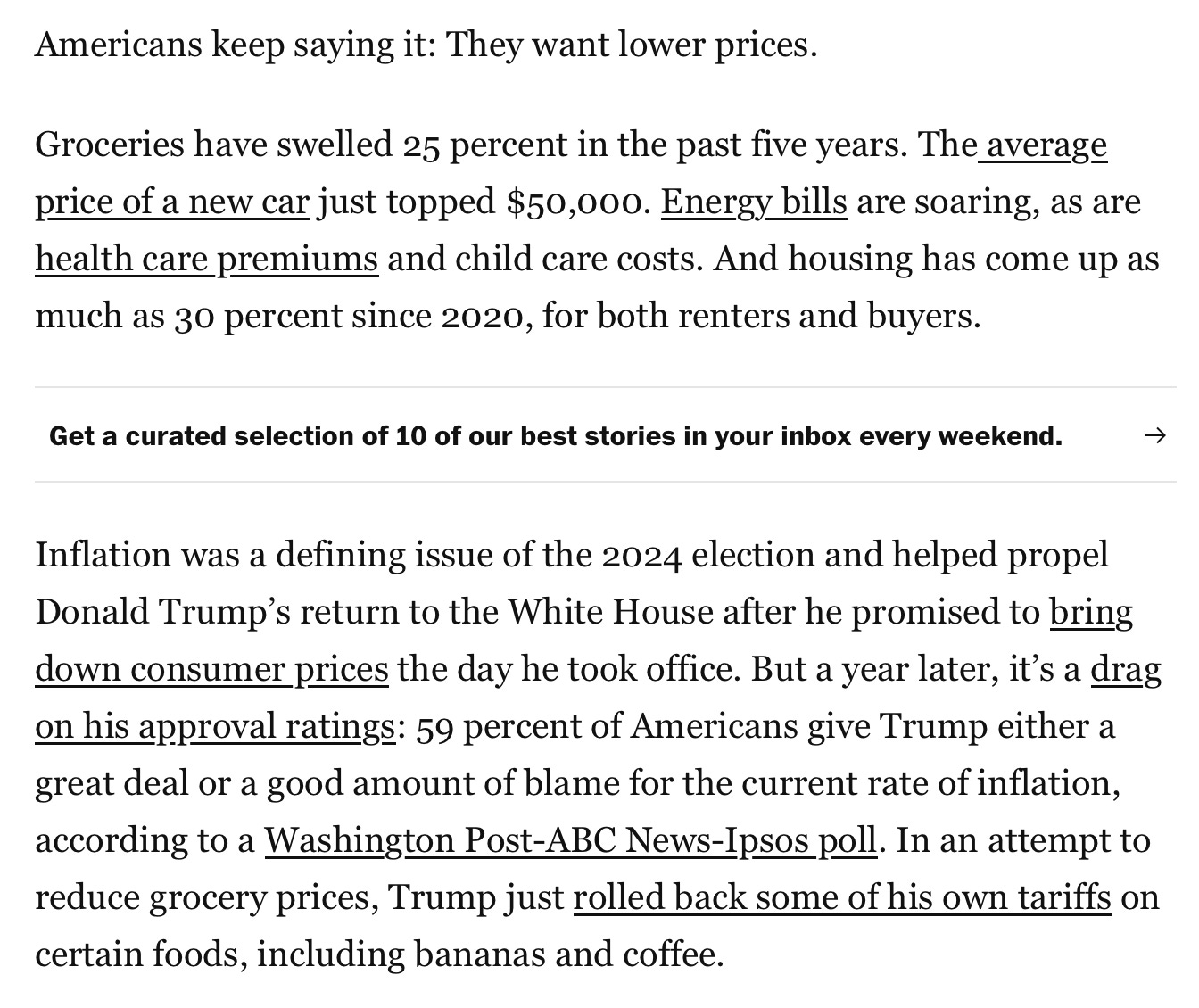
The article opens by walking you through your own exhaustion: groceries up 25 percent, cars over fifty grand, housing up as much as 30 percent, energy, health care, child care all squeezing you. Then it pivots. Instead of staying with the pain, it hands the mic to “economists” who gently explain that the real danger here is not that your paycheck can’t keep up.
The real danger, they say, is prices actually coming down.
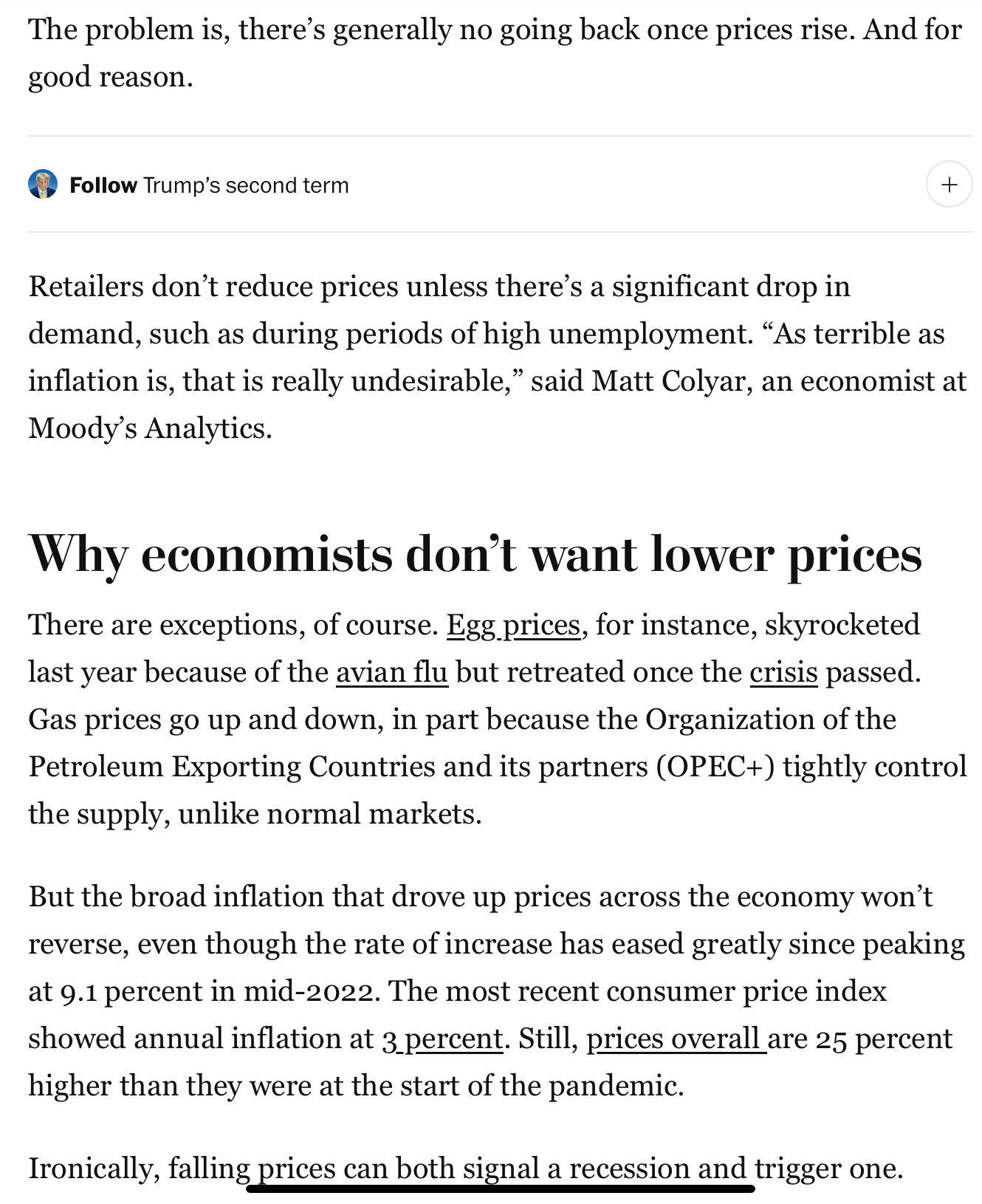
There is a narrow technical sense in which this is true. Broad, sustained deflation can wreck an economy: people delay purchases, companies see falling revenue with fixed wage bills, profits collapse, layoffs follow, and you end up in a Japan-style “lost decade” of stagnation and wage cuts. That’s Econ 101, and it’s not made up.
But notice what the piece does with that fact. It uses a real macroeconomic fear to shut down a different, very human demand. Why did everything jump 25 percent in four years and stay there when corporate profits are at record highs?
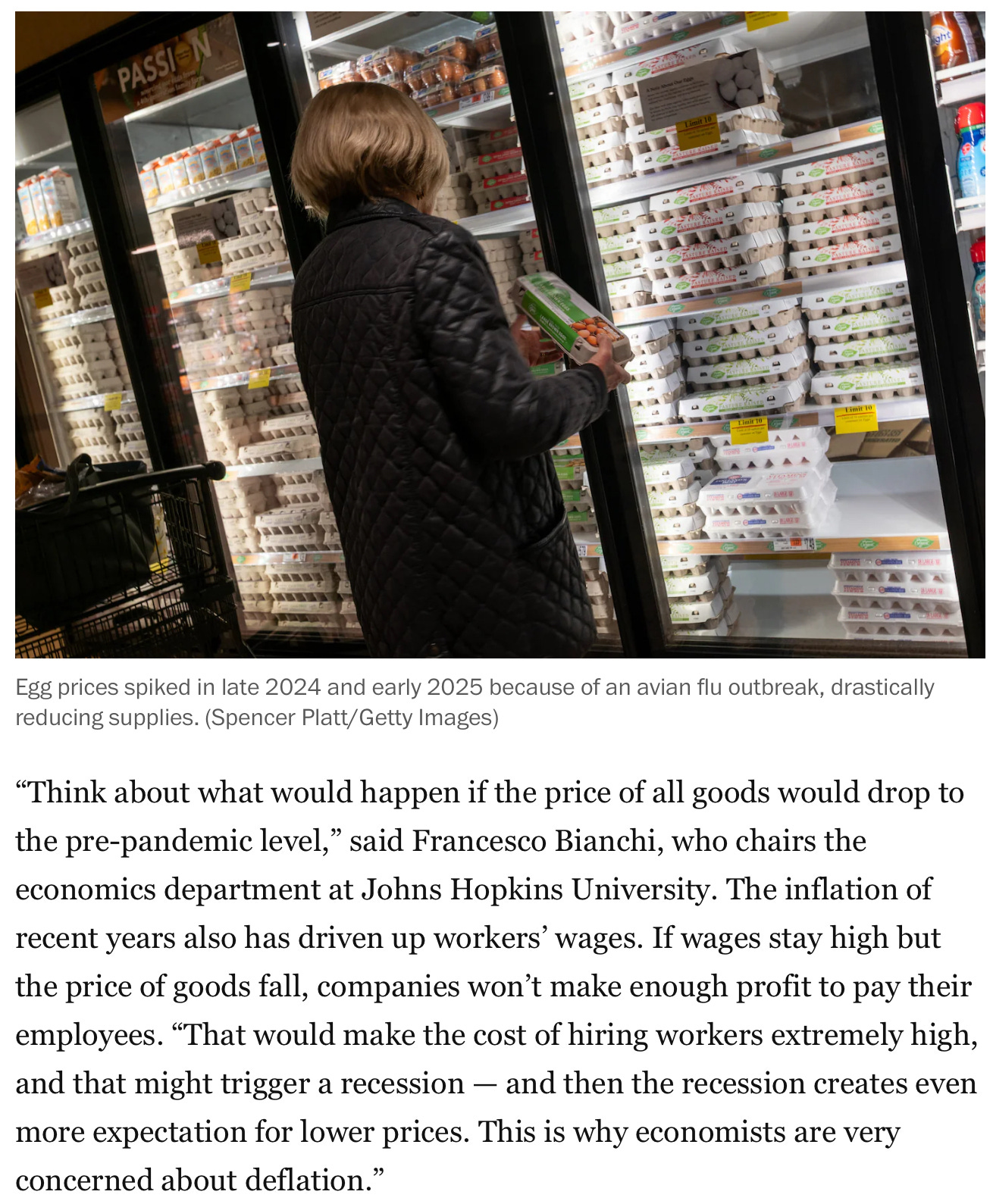
That’s like telling someone, “I know your landlord just doubled the rent, but if they ever lower it, the whole building might collapse, so stop wishing for that.”
The magic trick: turning deflation into a scarecrow
Look at the structure. The article basically walks you down this ladder:
Prices are crushing you.
Trump promised to fix it, hasn’t, and people are mad.
But economists say price drops are dangerous.
Therefore, you should stop dreaming of lower prices and focus on ‘stability’.
Deflation, in the real world, is not “your rent goes down 10 percent” or “eggs finally stop costing six dollars a dozen.” It is a broad, prolonged fall in prices across the entire economy, usually because everything else is already on fire: unemployment high, credit frozen, demand collapsed.
The piece blurs that line. It barely distinguishes between:
“We don’t want a deflationary spiral like Japan,” and
“So your grocery bill and rent should probably stay right where they are, sorry.”
Instead of asking why prices ratcheted up so quickly, why profit margins spiked, why many firms kept those margins even as supply chains normalized, the article invites you to feel a little guilty for wanting to go back to 2019 prices.
That’s the hustle. Not the Econ 101 part. The framing.
Where are the villains?
This is where the Econ 101 comedian-in-my-head voice kicks in:
You telling me the price of everything went up 25 percent, corporate profits hit records, CEOs cash out stock options like scratch-offs, and the moral of the story is… “don’t you dare wish prices were lower”?
The piece gestures toward tariffs and Trump’s trade policy, but mostly as a sort of technocratic tweak. Tariffs went up, prices followed; now Trump is rolling some back on bananas and beef; maybe that shaves a little off the top.
But Amazon’s entire model rests on extreme price sensitivity, algorithmic pricing, and pressure on suppliers. Buy a TV on Monday and watch the price jump around like a meme stock by Friday. This is not a company that believes lower prices are bad in principle. It believes lower prices are a weapon it gets to wield, on its terms, at the time of its choosing.
So when the billionaire who built the dominant price-obsessed retailer owns a major paper, and that paper runs a piece titled “Why you may not want lower prices as much as you think you do,” Xavier Plisset is going to raise an eyebrow.
Especially in the same year he tightened the opinion pages to favor “free markets” and “personal liberties,” narrowing the range of acceptable dissent.
The article admits, in passing, that corporate markups have grown, that companies aren’t likely to actually lower sticker prices even when tariffs go away, because once they’ve trained you to pay more, why stop. But it treats that as a quirk of the universe, not a political choice.
The missing words: “corporate profits”
If you really want to explain why people are furious about prices, you can’t dodge three words: corporate profit margins.
Since the pandemic, non-financial corporate profits as a share of national income have been significantly higher than before. Retail, construction, manufacturing, health care: a lot of firms discovered they could raise prices faster than their costs and blame it on “inflation” or “supply chains.”
The Economic Policy Institute finds that in the early part of the post-pandemic recovery, rising profits explained over 40 percent of the price increase, compared to the usual 11 to 12 percent. That’s not just “the business cycle.” That’s an exercise of pricing power.
If the story were honest about that, it would push past “deflation is bad” and ask:
Why did firms seize the chance to permanently ratchet up prices?
Why have regulators and lawmakers been so timid about confronting that?
Why are we more afraid of upsetting investors than of families skipping meals?
Instead, the article gently escorts you away from those questions and toward something more polite: maybe government can cover more of your bills (health care, child care), maybe wages can creep up some more, but the basic price level is here to stay.
Translation: the owners already got their raise. You can fight for scraps around the edge.
“Democracy dies in darkness”… and in euphemism
The Washington Post’s slogan says democracy dies in darkness. Darkness is not only the absence of information. It is also what happens when you flood people with partial truths that never quite connect the dots.
Technically valid statements about deflation and recessions become part of that darkness when they are deployed to make your righteous anger at high prices feel unsophisticated. You are invited to identify with the central banker who fears a deflationary spiral, not with the cashier who sees her rent eat half her paycheck.
You are told that “people anchor to certain prices” and feel anxious as those prices rise, as if the problem is your brain’s attachment style, not the very real math of stagnant wages plus skyrocketing essentials.
There is no serious exploration of what it would look like to push prices down in targeted sectors: housing via zoning reform and public construction, drugs via aggressive negotiation and patent reform, groceries via antitrust against food giants and supermarket chains. Those are fights that put you in direct conflict with capital. Those do not fit neatly on a sticky note about “free markets.”
So did Bezos send the sticky note?
Real talk: I don’t know what was on Jeff Bezos’s desk the day this piece got green-lit. I don’t know what conversations happen between the business side, the owner, and the newsroom.
What I do know is this:
The owner of the paper is a billionaire whose fortune depends on a system where corporations have wide latitude to set prices and squeeze suppliers.
That owner has recently narrowed the paper’s opinion section to cheerlead “free markets,” provoking resignations and public rebukes from former editors.
The paper just published a “you might not really want lower prices” explainer in a year when consumer sentiment is collapsing, retail sales are weakening, and ordinary people are telling pollsters they feel squeezed to the breaking point.
At some point, you stop calling that a coincidence and start calling it an editorial line.
The economic concept of deflation is real. The way this piece uses it is spin. It is there to make you doubt your own experience long enough for everyone who matters in boardrooms and donor circles to keep their gains.
If you reached the end of this article feeling like the villain for wanting groceries and rent to be cheaper, you are not misreading it. You are seeing the shadow it refuses to name.
If you reached the end of this article feeling like the villain for wanting groceries and rent to be cheaper, you are not misreading it. You are seeing the shadow it refuses to name.
If this made you feel a little less crazy and a lot more pissed off, I’m asking you to turn that feeling into fuel. Every paid subscription is one more hour, one more day I can spend digging receipts, breaking down this kind of economic gaslighting in plain language, and dropping our side of the story right on the doorstep of the people who call it rain while they piss on us. I don’t have a billionaire owner or a corporate HR department. I’ve got a Bestseller badge, a laptop, and readers who decide this work is worth paying for.
If you want more reporting that names the hustle instead of smoothing it over, become a paid subscriber and help me stay independent:
Sources:
Economic Policy Institute – “Profits and price inflation are indeed linked”
https://www.epi.org/blog/profits-and-price-inflation-are-indeed-linked/Economic Policy Institute – “Corporate profits have contributed disproportionately to inflation. How should policymakers respond?”
https://www.epi.org/blog/corporate-profits-have-contributed-disproportionately-to-inflation-how-should-policymakers-respond/U.S. House testimony (Konczal) – “Why Market Power Matters for Inflation”
https://www.congress.gov/117/meeting/house/115145/witnesses/HHRG-117-GO05-Wstate-KonczalM-20220922.pdfFederal Reserve Bank of St. Louis – “What’s Driving the Surge in U.S. Corporate Profits?”
https://www.stlouisfed.org/on-the-economy/2025/apr/whats-driving-surge-us-corporate-profitsBoard of Governors of the Federal Reserve System – “Corporate Profits in the Aftermath of COVID-19”
https://www.federalreserve.gov/econres/notes/feds-notes/corporate-profits-in-the-aftermath-of-covid-19-20230908.htmlFRED Blog (St. Louis Fed) – “Have corporate profits soared?”
https://fredblog.stlouisfed.org/2025/03/have-corporate-profits-soared/Groundwork Collaborative – “Inflation Revelation: How Outsized Corporate Profits Drive Rising Costs”
https://groundworkcollaborative.org/work/inflation-revelation-how-outsized-corporate-profits-drive-rising-costs/Groundwork Collaborative – “New Groundwork Report Finds Corporate Profits Driving More than Half of Inflation”
https://groundworkcollaborative.org/news/new-groundwork-report-finds-corporate-profits-driving-more-than-half-of-inflation/Investopedia – “Deflationary Spiral”
https://www.investopedia.com/terms/d/deflationary-spiral.aspKhan Academy – “Deflationary spiral” (video explainer)
https://www.khanacademy.org/economics-finance-domain/macroeconomics/macro-economic-indicators-and-the-business-cycle/macro-price-indices-and-inflation/v/deflationary-spiralUniversity of Michigan Surveys of Consumers – main site
https://www.sca.isr.umich.edu/University of Michigan ISR – “High prices remain key concern; sentiment holds steady”
https://isr.umich.edu/news-events/news-releases/high-prices-remain-key-concern-sentiment-holds-steady/McKinsey & Company – “The state of the US consumer”
https://www.mckinsey.com/industries/consumer-packaged-goods/our-insights/the-state-of-the-us-consumerAssociated Press – “Consumer confidence slides as Americans grow wary of high costs and sluggish job gains”
https://apnews.com/article/55848421b5ff33ed244c8a4291f7facfReuters – “US consumer sentiment near 3-1/2-year low as government shutdown drags”
https://www.reuters.com/business/us-consumer-sentiment-weakens-november-government-shutdown-drags-2025-11-07/Jeff Bezos on X (Twitter) – note to Washington Post staff about opinion pages
https://x.com/JeffBezos/status/1894757287052362088
If you're as old as I am (or almost), you'll remember when the cost of jet fuel spiked. The airlines reasoned that baggage weight was costing part of that fuel expense, so they decided to charge for bags. (Like, we travel without clothes?) But instead of rescinding the charge when jet fuel prices fell... they kept them. And then raised them. More than once.
But there's more! Now some airlines charge for a carry-on bag. You can have a purse and maybe a briefcase, but nothing that must go into the overhead bin. They probably noticed that passengers used only a carry-on bag for weekend or business trips, so they decided to suck more money out of passenger pockets.
Let's not even get into the fact that Trump says airlines no longer have to compensate passengers for certain cancellations or long delays... But I guess when you belong to the class that travels in their own jets, the great unwashed masses don't matter.
Hey, X. I haven't subscribed to the WaPo for about a year, since whenever Douchey McPenisRocket kibosh'd the paper's Kamala endorsement or thereabouts. I still get their morning summary of a certain seven articles in my inbox, and I have access to read them should I so choose. (I rarely so choose.) Today was different, though. I read the specific article you mention, and was perplexed and irritated by it. I couldn't nail down why but for the fact that the author was telling me that my bills are just about right-sized for my dumb ass-ness. I closed the article, annoyed. Now, after reading your post, I understand why. Thank you.