


Opening Note to Readers
I normally avoid police stories. I did that job for twenty years, and retirement did not leave me searching for a way back to roll call. I also refuse the more profitable retired-cop role, where every abuse becomes an excuse to defend the badge and scold Black people.
Then I read [1] a Washington Post investigation by Drew Harwell, Douglas MacMillan and Aaron Schaffer, with Patrick Marley contributing. They reviewed thousands of pages of court and police records and interviewed seven alleged victims. The reporting was so thorough that I nearly wrote a breaking-news Note announcing that the Post had committed journalism. Those reporters earned their flowers.
One word in the headline still bothered me: rogue. Rogue reduces a failure of access, supervision and accountability to one officer’s moral defect. The reporting describes something larger: a nationwide camera network, frictionless searches, optional safeguards and victims who cannot see the records that could corroborate their accounts.
This Reader’s Cut begins with one woman and follows the architecture surrounding her. It asks what happens when personal obsession can borrow the eyes of the state.
TLDR
The evidence was inside the system. Public logs contained roughly 600 database queries involving plates associated with Marci Bakely and her teenage daughter across about thirteen months. She could not access those records while seeking protection. [1] The Washington Post investigation
The scale changes the danger. Flock reported more than 120,000 cameras, over 6,000 communities and 20 billion monthly plate scans. The Post identified at least 50 officers charged with or accused of misuse; 46 cases involved Flock, and 26 involved women in the officers’ intimate lives or women they wanted to pursue.
This is also coercive control. Most identified targets were women. Anticipated surveillance can make a victim change routes, borrow cars or stay home even when the watcher is nowhere nearby.
Accountability has been divided into fragments. The officer searches, the supervisor audits, the department chooses controls and the vendor supplies logs. Everybody holds a piece of responsibility while prevention remains unclaimed.
The federal door changed after a documented failure. Researchers found direct Border Patrol sharing at eight Washington agencies during 2025 and apparent searches at ten others without explicit authorization. Flock says federal lookup access ended that August; Washington imposed new access, retention and use limits in March 2026. [2] Flock’s federal-access statement [3] University of Washington Center for Human Rights [4] Washington’s Driver Privacy Act
Restack this report, share it and send it to one person who needs to see how personal abuse can borrow the reach of the state. The evidence deserves to travel farther than the euphemism surrounding it.
The Evidence She Couldn’t See
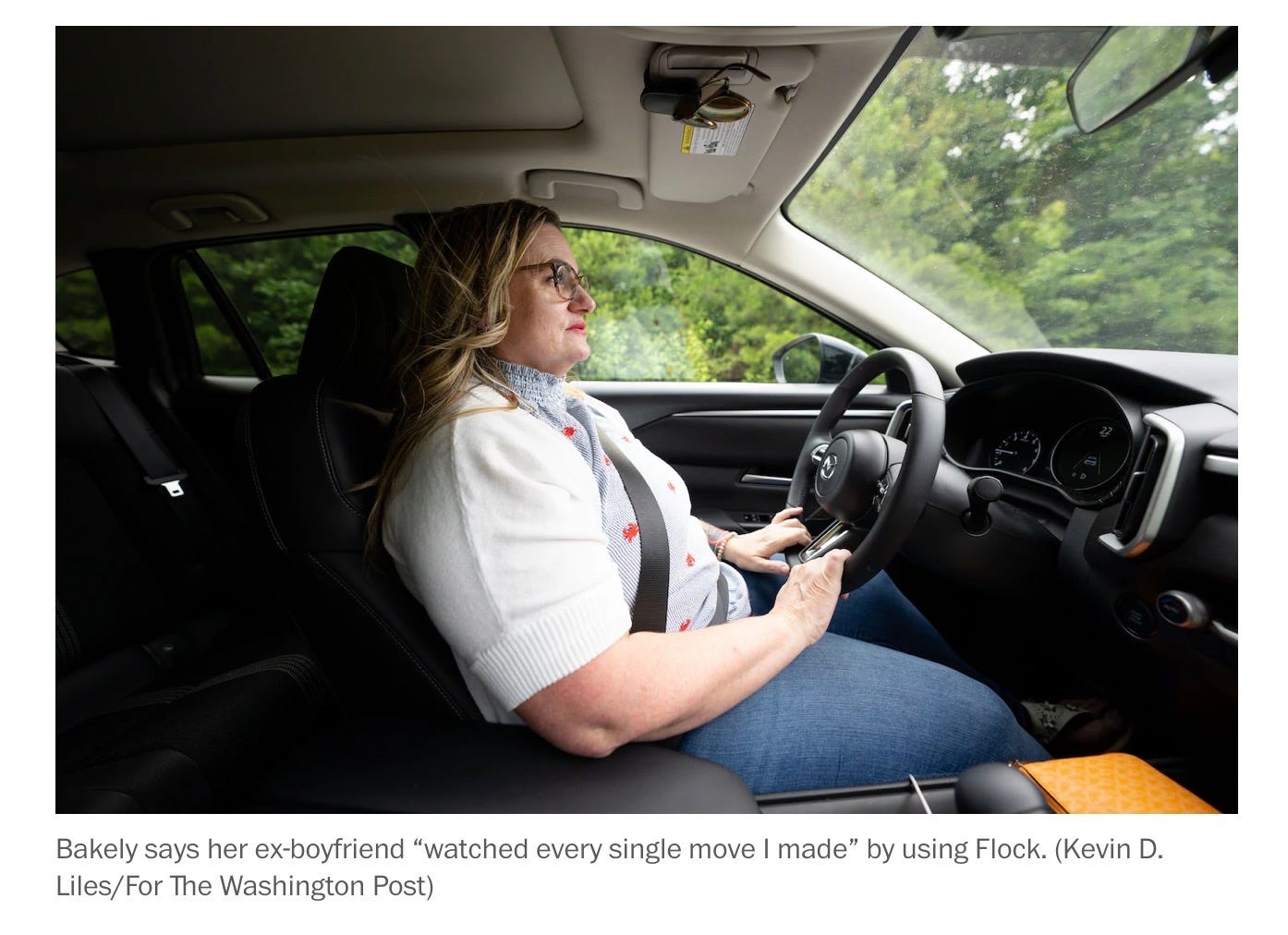
Marci Bakely said her former boyfriend, Michael Steffman, who later became Braselton police chief, seemed to know when she went to the grocery store, the doctor or a date. She installed home cameras, bought a hidden-camera detector and took her car to a mechanic three times. Public logs later showed roughly 600 database queries involving plates associated with Bakely and her teenage daughter across about thirteen months, many between midnight and 4 a.m. A query records a search attempt, rather than a confirmed sighting or successful location result. [1]
Bakely sought a restraining order in August 2025. The Post reported that a judge found Steffman’s behavior concerning but said Bakely had not supplied evidence supporting current allegations of stalking. That ruling contains the institutional trap: records capable of corroborating her account existed inside a law-enforcement system she could not access. She carried the burden of proving what the system would not show her.
The matter eventually reached the Georgia Bureau of Investigation. In November 2025, [5] the GBI arrested Steffman on charges including stalking, harassing communications, violation of oath and license-plate-reader misuse involving several people. Steffman died before trial, so the charges remained unadjudicated. Bakely’s question captures the institutional problem more clearly than rogue: once the person accused of watching you runs the department, the place a victim is supposed to call and the source of danger wear the same uniform.
Rogue Is Too Small a Word
Flock’s automated readers turn plates, dates and locations into searchable records. Officers can search a known plate, create hot-list alerts or use a “vehicle fingerprint” to search characteristics such as color, body style and bumper stickers. The Post reported that officers can run a Flock search without first obtaining a warrant, while each agency controls credentials and internal access rules. [1]
Scale changes what misuse can accomplish. Flock reported 20 billion monthly plate scans through more than 120,000 cameras in over 6,000 communities. One person following a car has physical limits. A distributed camera network can turn thousands of ordinary roads into his eyes.
The Post’s 50 cases do not establish a misuse rate. Flock says abuse represents a tiny fraction of roughly 140,000 active users and that logs have helped departments discipline wrongdoers. The pattern still belongs in the record: 46 cases involved Flock, and investigators or prosecutors said 26 involved women in the officers’ intimate lives or women they wanted to approach. [1]
Calling each accused officer rogue isolates the actor from the permissions around him. The officer may supply the obsession or entitlement; the system supplies reach, secrecy and a searchable map. Supervision decides whether anyone notices before the target reorganizes her life.
The Police Were Already There
The most chilling allegation came from Florida. A sheriff’s incident report said Orange City officer Jarmarus Brown showed his girlfriend videos of herself driving. During another encounter, the report alleged that he grabbed her, invoked his gun and answered her threat to call law enforcement with five words: “The police are already here.” Brown later pleaded no contest to unauthorized computer use and received probation; the plea remains separate from the report’s other allegations. [1]
His alleged answer claims the badge, the weapon, the surveillance system and the officers a victim might call. The machinery of protection becomes part of the threat. Surveillance then teaches a target to anticipate the watcher and restrict herself before he issues another command.
The Wisconsin case pushes the danger into reproductive privacy. An investigative affidavit alleged that Menasha officer Cristian Morales used Flock to determine whether his then-girlfriend had gone to a clinic for a possible pregnancy termination, sought her medical records and called her as many as 19 times a day. Morales was charged with misconduct in public office and had pleaded not guilty when the Post published. [1]
The machine keeps working inside the victim’s mind even when the officer is nowhere nearby. She changes routes, borrows a car or stays home because any camera may return her location to the person she fears. Privacy describes the data loss; coercive control describes what that loss does to a human being.
An Audit Trail After the Damage
Flock’s strongest defense is that every search leaves a record. Its voluntary audit-assistance tool can flag repeated targets or searches conducted while an officer is off duty, and the Post reported that roughly one in four agencies had enabled it. Logs matter, but a receipt found after thirteen months describes what happened. Prevention requires somebody obligated to look while the pattern is forming. [1]
Flock began requiring an offense category for every search in December 2025. [6] Its own description says the additional reason field can remain optional, and agencies can choose whether to require a case number. A category may improve an audit without proving that a search belongs to a real investigation; a broad label can still become paperwork draped over a personal inquiry.
From twenty years in policing, I know competent supervision means recognizing patterns before an outside investigator does. A repeated plate, after-midnight activity, no assigned case and a vague purpose code should create friction. Review also has to be timely and independent when the user under scrutiny supervises the people expected to check him.
Accountability Becomes an Orphan
Flock argues that misuse is inevitable, logs create accountability, safeguards are improving and officers have faced consequences. That defense deserves a fair hearing because audit trails have evidentiary value. The company also sells recurring subscriptions, gains commercial value as adoption expands and leaves many decisive controls to each agency. [1]
Flock CEO Garrett Langley expressed the boundary plainly in a [7] Forbes interview: “I don’t think it’s our job to police the police.” The statement raises the practical question it tries to leave behind. Who owns prevention when the department chooses the safeguards, the chief may be accused and the victim cannot inspect the records?
Responsibility is scattered across the officer, supervisor, chief, department, vendor, prosecutor, court and certification authority. Each can point to a boundary around its role. Everybody owns a piece of accountability until the moment comes to use it. Then accountability becomes an orphan.
This arrangement makes punishment possible while leaving prevention contingent. An officer can be fired, prosecuted or stripped of certification after investigators assemble the logs. Public trust requires somebody to notice before hundreds of searches accumulate.
The Federal Door
Interagency sharing raises the danger to institutional scale. Flock acknowledges concluded pilots involving several federal agencies and says federal organizations lost statewide and national lookup access in August 2025. It says sharing is now off by default and requires one-to-one local approval. Flock also says it has no current ICE contract or direct ICE access, though its timeline includes a concluded 2025 pilot with Homeland Security Investigations, ICE’s principal investigative component. [8] ICE description of Homeland Security Investigations [2]
University of Washington researchers reported that at least eight Washington agencies directly shared Flock networks with Border Patrol during 2025. They also found apparent Border Patrol searches in at least ten departments whose reports showed no explicit authorization, plus limited examples of local officers searching on behalf of federal immigration personnel. The records did not reveal the mechanism behind every search. [3]
Washington changed the law after those records were created. Its Driver Privacy Act took effect March 30, 2026, barring state and local ALPR use for immigration enforcement, protected health care or constitutionally protected activity. It generally limits retention to 21 days, restricts direct access, requires vendor controls and mandates audit records tied to a specific purpose and call or case number. [4]
The reform changes the present-tense assessment. The university records establish what happened in 2025; they do not prove unchanged exposure in August 2026. Current compliance now has to be tested through the audits, registration and enforcement mechanisms the law requires.
The national question survives that correction. A system sold one town at a time can become a distributed archive capable of reconstructing movement across participating jurisdictions. Immigration, abortion access, protest and other lawful activity become vulnerable when government priorities change.
What Black Historical Memory Sees
Edward Snowden belongs here as historical memory, rather than evidence about Flock. His 2013 disclosures brought secret federal surveillance programs into public view, including the NSA’s bulk telephone-records program under Section 215. [9] An independent oversight board later found no sound statutory basis for that program and recommended ending it. I have found no evidence that the CIA or NSA uses Flock.
COINTELPRO supplies a different warning. [10] The FBI’s own history records that the classified program expanded to the Black Panther Party and used infiltration, disruption and discrediting efforts even with little or no evidence of illegal activity. This history does not make Flock another COINTELPRO. It explains why Black America looks beyond the benevolence promised when surveillance infrastructure is purchased.
At federal scale, abuse can arrive wearing the clothes of procedure. A credential is valid, a purpose code is selected and the employee follows the steps. Historical memory asks whether the procedure deserves democratic consent, who can inspect it and which communities will feel it first.
Put Friction Back Into the Machine
The first repair targets individual misuse. Historical searches outside genuine emergencies should require a verified case number and specific purpose. Repeated plates, off-hours activity and queries disconnected from an assignment should trigger review outside the user’s chain of command. Victims need a safe complaint route, relevant records and consequences reaching officers, certification and supervisors who ignore patterns.
The second repair concerns the machinery itself. Judicial authorization for historical searches, short retention, narrow sharing, public access reports and independent audits would place democratic restraint around the network. Genuine emergencies can carry a defined exception with automatic review. Washington’s new law shows that limits can be encoded when government requires them. [2] [4]
Those repairs answer different questions. Auditing can deter misuse and strengthen evidence. It cannot decide whether persistent, cross-jurisdictional tracking should exist at its present scale. The public still has to decide which uses remain beyond government reach even when every search is documented.
Friction can be the moment when authority has to explain itself before reaching into somebody’s life. Speed serves legitimate emergencies. Unreviewed speed also serves obsession, curiosity and political appetite.
Conclusion
The established record is serious. Public logs showed roughly 600 plate queries involving Bakely and her daughter. The Post identified at least 50 officers charged with or accused of misuse, documented a gendered pattern and reported optional safeguards. Public records also showed local data reaching federal actors through sharing and requests. [1] [2] [3]
“Rogue officers” describes the people while understating the architecture. Easy access amplifies private obsession, and fragmented responsibility delays intervention. A victim can live inside the consequences long before an audit gives the institution a receipt.
Important questions remain unresolved. Public cases cannot reveal misuse that was never audited or disclosed, and current policies need testing against current logs. Communities must decide whether case numbers, outside review, judicial authorization and sharing limits can make this network legitimate, or whether plate tracking has crossed the line.
Bakely’s question remains above the system. The answer cannot depend on a victim somehow obtaining records from the institution she fears. Legitimacy requires deciding in advance who watches, who intervenes and who opens the evidence when the keyholder is accused.
Support XVOA
XVOA exists to do the second read: take strong reporting, test the frame around it and expose the machinery that frame can hide.
Paid subscriptions finance that work and give this Black-led intelligence desk the continuity to keep doing it. Current paid members made this Reader’s Cut possible, and I thank you. If another recurring subscription does not fit, or if you already subscribe and want to add direct support, Buy Me a Coffee is the backup and accepts anything from a small contribution to a substantial one-time gift.
Sources
The Washington Post investigation. Supports the Bakely account, the 50/46/26 findings, Flock’s reported scale, the Brown and Morales cases, the oversight analysis and Flock’s response.
Flock Safety: “Does Flock Share Data With ICE?”. States Flock’s current position on ICE, federal access, one-to-one local approval and its concluded federal pilot projects.
University of Washington Center for Human Rights: “Leaving the Door Wide Open”. Documents direct sharing, apparent Border Patrol searches with no explicit direct authorization and local “side-door” searches found in 2025 public records.
Washington State Legislature: Engrossed Substitute Senate Bill 6002. Establishes current Washington limits on retention, access, sharing, sensitive uses, vendor controls and audit records.
Georgia Bureau of Investigation: Steffman arrest announcement. Lists the charges filed after the GBI’s investigation into alleged license-plate-reader misuse.
Flock Safety: “Offense Type Dropdown: A Simpler, More Accurate Audit”. Describes the required offense-category field and the continuing agency choices around search reasons and case numbers.
Forbes: “AI Startup Flock Thinks It Can Eliminate All Crime in America”. Contains Garrett Langley’s statement about Flock’s responsibility for policing police use.
U.S. Immigration and Customs Enforcement: Homeland Security Investigations. Identifies HSI as ICE’s principal investigative component.
Privacy and Civil Liberties Oversight Board: Section 215 report. Examines the NSA telephone-records program disclosed in 2013 and recommends ending bulk collection.
FBI: “And Justice for All, 1954–1971”. Records COINTELPRO’s expansion, methods, secrecy and later criticism.


