

Sonya Wimberly Hawkins’s campaign against Marty Harbin connects Black maternal survival to power bills, data centers, water and the political use of religious freedom.
Sonya Wimberly Hawkins told me she almost died giving birth. That is where this story should begin, because Black maternal health is no campaign abstraction for the woman challenging Marty Harbin in Georgia Senate District 16. She lived the danger she is now asking Georgia’s government to confront.
Listen, I had my doubts about turning this interview into a Reader’s Cut feature. Most of you live on the West Coast, and a race for one state Senate seat in Georgia can look like somebody else’s map. I could introduce an interesting candidate, wish her well and move on.
That would miss what the interview revealed. Her story opened the door, but we moved from maternal health into electricity bills, data centers, water and what politicians mean when they turn religious freedom into a governing program. By the end of our conversation, District 16 had stopped looking local.
The Georgia Race That Stopped Looking Local
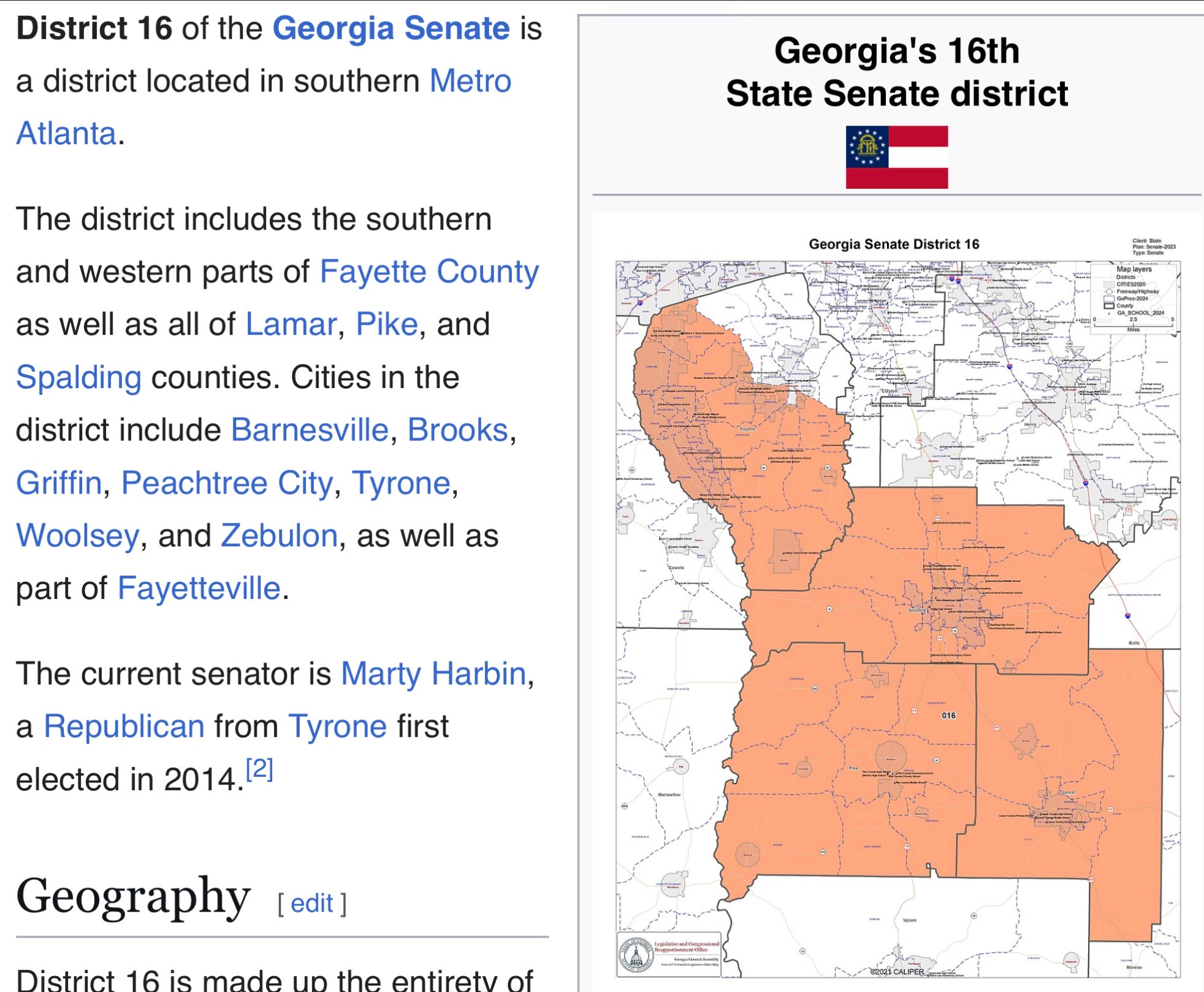
Georgia Senate District 16 is heavily Republican, not a swing-state fantasy waiting for the right viral clip. Incumbent Marty Harbin won it by more than 31 points in 2024. Hawkins must prove that a statewide revolt over utility costs and one-party rule can enter a district where voting Republican has become habit and infrastructure.
That makes this race useful well beyond Georgia. It is a stress test for how much electoral punishment the right can absorb while still holding power where it counts: not only in Washington, but in the statehouses, commissions and committee rooms that turn ideology into the monthly bill.
TLDR
Hawkins won the 2026 Democratic primary with 72.6 percent of the vote. Harbin, however, carried the district 65.77 to 34.23 percent in the 2024 general election. The structural challenge is enormous. [1][2]
Georgia voters already demonstrated real anger over electricity costs. In 2025, Democrats decisively defeated two Republican Public Service Commission incumbents, but Republicans still hold a 3–2 majority on the commission. [3]
The data-center boom has made utility planning, water use and financial risk into kitchen-table issues. Regulators and Georgia Power say large customers will cover their costs; critics warn that ordinary customers could still inherit stranded assets if projected demand fails to materialize. [5][6]
Harbin openly places faith at the center of his political identity and helped sponsor Georgia’s 2025 religious-freedom law. Supporters call it a shield against government intrusion; opponents note that Georgia has no comprehensive statewide civil-rights law protecting LGBTQ people. [8][9]
Georgia’s maternal-health emergency makes the stakes physical. State reviewers found that 87 percent of pregnancy-related deaths from 2020 through 2022 had at least some chance of prevention. [10]
If this analysis makes a Georgia district feel less distant, restack this and send it to one person who thinks utility regulation or religious-liberty law is somebody else’s local story. That distance is one of power’s best defenses.
Sonya Wimberly Hawkins Interview: Watch by Chapter
1 | THE RACE AND THE WOMAN RUNNING IT
0:00 — Harbin’s faith-and-freedom worldview
0:24 — Meet Sonya Wimberly Hawkins
2:33 — Why she could no longer remain a private citizen
5:11 — The medical trauma she still carries
8:41 — When public policy became personal
2 | WHAT POWER COSTS
17:00 — Can a Democrat break through in Georgia Senate District 16?
18:08 — Data centers, water and special treatment
20:55 — The Public Service Commission and utility accountability
25:01 — Restoring Georgia’s utility consumer watchdog
3 | FAITH, CULTURE AND THE BALLOT
27:45 — Harbin’s religious rhetoric and freedom of worship
31:00 — What voters need beyond culture-war politics
33:40 — Books, voting access and the machinery of power
38:02 — How Sonya plans to defeat Marty Harbin
4 | WHEN POLICY ENTERS THE BODY
40:10 — Georgia’s Black maternal-health crisis
42:06 — What Sonya would change in maternal healthcare
45:00 — Why this seat matters beyond District 16
47:15 — Registered nonvoters and the path to victory
5 | THE CLOSE
49:45 — How to support the campaign
51:20 — Closing: Relief here, not only heaven later
Why Policy Became Personal
Hawkins’s political formation begins inside her own body. In the interview, she described an emergency C-section in which the epidural wore off, her pleas for pain relief were met with suspicion, and staff required a drug test before giving her additional medication. Her blood pressure rose to a dangerous level. The memory still carried force: she knew something was wrong and discovered that being articulate did not guarantee being believed.
She later worked in Pennsylvania with a rehabilitation program serving children as young as twelve. It included a school and treatment that could offer an alternative to incarceration. Hawkins said the work taught her that policy can redirect a life, and unlikely allies become possible when the argument returns to healthy families, healthy children and work that pays enough to live.
Those experiences explain the through line of her campaign. A system is not abstract to the person trapped inside it. The point of politics is not to perfect the argument while leaving that machinery untouched.
The Wall Is Real
Hawkins enters the November 3 general election with a genuine primary mandate. She won 72.6 percent against Pauline Henley on May 19. That is decisive inside the Democratic electorate, but not evidence by itself that the district is ready to change parties. [1]
The harder number is Harbin’s. In 2024 he received 71,842 votes to Democrat Amili Blake’s 37,388, a margin of 31.54 points. You do not close that gap with better branding or a few additional lawn signs. Hawkins needs higher Democratic participation, some Republican persuasion and enough money to show voters who may never attend a Democratic event that their private frustrations have public authors. [2]
The Headwind Republicans Have Already Felt
There is evidence for Hawkins’s theory, although not yet proof of her path.
In November 2025, Georgia voters removed two Republican incumbents from the Public Service Commission. Democrats Alicia Johnson and Peter Hubbard each won roughly 63 percent statewide. The victories were widely read as a backlash to years of Georgia Power increases and growing anxiety about the energy demands of data centers. They were also the first statewide, state-level Democratic victories in Georgia since 2006. Republicans nevertheless retained a 3–2 commission majority. [3]
That result is the strongest headwind behind Hawkins, with an important warning. A statewide protest vote for utility regulators does not transfer automatically to a legislative contest, where incumbency, partisan identity and culture-war signals can return a wavering voter to familiar ground.
District 16 therefore becomes a sharper test than the statewide result. Can material anger travel down the ballot, survive the culture-war sorting machine and attach itself to a Democratic challenger? Or can the Republican coalition absorb the anger, concede that the bills hurt and still keep the seat?
The Public Service Commission Is Not Background Scenery
The Georgia Public Service Commission has exclusive rate-setting authority over investor-owned utilities. In electricity, that means Georgia Power. It does not set rates for municipal utilities or electric membership cooperatives, a distinction that matters in a state with several kinds of power provider. The commission also reviews Georgia Power’s long-range plans and determines whether new generation should be certified. [4]
For customers in Georgia Power territory, those proceedings have been expensive. A three-year plan raised base rates in 2023, 2024 and 2025; fuel and Plant Vogtle added more. By January 2025, the Georgia Recorder calculated that the typical household bill was about $43 a month higher than at the beginning of 2023. A June 2026 fuel-and-storm settlement then reduced the typical bill by $4.04 a month, according to Georgia Power. [5]
The commission later approved a freeze on base rates through the end of 2028. That phrase requires all three words. It is a base-rate freeze, not a promise that the total bill cannot change. Fuel and storm-recovery charges live outside that guarantee. [5]
Hawkins offered one concrete response: restore an independent Consumers’ Utility Counsel to represent residential and small-business customers in rate cases. Georgia had such an office from the 1970s until recession-era cuts eliminated it in 2008. The PSC says its existing public-interest staff already performs that work; supporters argue that customers need an advocate separate from the regulator. A 2024 restoration bill passed the Senate without opposition but died in a House committee. [12]
This is why the PSC changed the scale of the interview. West Coast readers know that an obscure regulatory proceeding can reorganize a household budget. The acronyms change; the machinery does not. A public body approves private investment, the company earns a return, and customers are told that today’s pain purchases tomorrow’s reliability.
The Data-Center Bargain

Georgia’s electricity forecast changed at astonishing speed. According to the PSC’s own fact sheet, Georgia Power’s seven-year projection for new demand rose from about 400 megawatts in 2022 to 6,600 megawatts in 2023 and 8,500 megawatts in 2025. In December 2025, regulators approved nearly 10 gigawatts of additional capacity, most of it associated with data-center growth. [6]
The Associated Press estimated roughly $16.3 billion in construction costs and $50 billion to $60 billion over time once financing and utility returns are included. Georgia Power and the PSC say new contract rules will make large users pay the costs they create. Critics argue that the safeguards cannot eliminate stranded-asset risk if forecasts fail or a large customer leaves. The new rules do not establish that families are already paying data-center costs, but they do not make stranded risk imaginary. [6]
In Fayette County, the argument also became a water story. A massive QTS project drew attention after records showed tens of millions of gallons used during construction before all use had been properly metered and billed. The company later paid a retroactive bill. Residents connected the project to weak water pressure, while county officials said the site accounted for less than 1 percent of production and did not affect residential pressure. [7]
Both facts belong in the account, along with the larger question Hawkins raised: Who approves a project, who measures its use, who receives the promised benefit and who can demand an accounting before the concrete is dry?
That question reverberates nationally because data centers are not weightless clouds. They arrive as substations, transmission lines, backup generation, water demand, tax abatements and land-use fights. The artificial-intelligence economy may be global. Its invoices are intensely local.
When Faith Becomes a Governing Program

Harbin does not hide the role of religion in his politics. His public biography says he is guided by “faith, family, and freedom” and calls the freedom to believe and worship the most important freedom. He has represented District 16 since 2015 and repeatedly sponsored religious-liberty legislation. [8]
Georgia enacted one of those measures in 2025. Senate Bill 36 requires the state to meet a demanding legal test when government action substantially burdens religious exercise. Supporters describe the law as protection against government overreach. Opponents point out that Georgia has no comprehensive statewide civil-rights law protecting LGBTQ people and warn that the measure could become a defense for discrimination. An amendment meant to add anti-discrimination language failed. [9]
That record also reached libraries. In 2024, Harbin co-sponsored Senate Bill 390, which would have barred covered institutions from spending public or private funds on American Library Association materials or services. It passed the Senate 33–20 but died in a House committee. [14]
The useful contrast with Hawkins is not believer against nonbeliever. That would be cheap, inaccurate and politically stupid. The question is what happens after religious conviction enters the statute book.
Whose exercise is being protected? Who can be denied a service? Which child can find a book? What remedy exists when one person’s freedom collides with a more powerful person’s faith?
Hawkins’s challenge is to make that distinction without insulting the deeply religious voters she needs to reach. Harbin’s challenge is to show that a language of moral authority produces measurable public good beyond the coalition already fluent in it. A decade in office deserves an audit, not a halo.
Hawkins also connected that moral language to the machinery of remaining in power. Georgia’s 2021 election law restricted third parties from giving food or water to voters within 150 feet of a polling place, limited absentee drop boxes and tightened other voting procedures. State officials defend the law as an election-security measure. The Biden Justice Department challenged several provisions as racially discriminatory in 2021; the Trump Justice Department dismissed the federal government’s claims in March 2025. [13] Her underlying point was broader than one statute: the people who win elections also write the rules for the next one.
The Body Keeps the Record
Maternal health is where abstractions lose their cover.
Georgia’s Department of Public Health reviewed 141 pregnancy-related deaths from 2020 through 2022. Eighty-seven percent had at least some chance of prevention, and 30 percent occurred from 43 days to one year after pregnancy. In a separate review of 2021, the pregnancy-related mortality ratio for Black women was 81.4 per 100,000 live births, compared with 27.9 for white women. [10]
Those numbers describe failures in recognition, treatment, insurance, transportation, staffing and the willingness to believe Black women when they report that something is wrong.
Hawkins answered with a policy bundle which is to recruit more physicians from underrepresented communities, require cultural-competency training, cover doula care through Medicaid and expand Medicaid. Her own birth story explains why training belongs beside coverage. Insurance cannot protect a patient whose pain is discounted after she reaches the hospital.
They also force precision. Medicare is principally a federal program for older people and certain people with disabilities. The state-level coverage fight for low-income, nonelderly adults is Medicaid. Georgia has extended Medicaid through twelve months postpartum. Its broader Pathways program covers some adults up to 100 percent of the poverty level if they document qualifying activities. [11]
A candidate promising action should still be judged by implementation as in which funding line moves first, what changes for rural hospitals, which agency owns the deadline and what result voters should inspect a year later. Empathy tells us which suffering matters. Governing determines whether the system behaves differently after the speech.
What Winning Would Actually Mean
Hawkins cannot win by proving that Harbin is conservative. Many of his voters consider that the point. Her first pool, she said, is registered voters who habitually sit elections out. She believes layoffs, rising costs and the question of who profits from public policy can give those voters a reason to participate.
That is a turnout theory, not a complete coalition. She still needs some disaffected Republicans and independents, repeated voter contact and an alternative that feels competent rather than symbolic.
The 2025 PSC results give her an opening, not a forecast. If she wins, the lesson will be that economic pressure and resistance to one-party rule can crack even a district Republicans carried by more than 30 points. If she loses narrowly, the margin and county movement will still tell us whether the wall is weakening. If Harbin reproduces something close to his 2024 result, that will demonstrate just how resilient right-wing legislative power remains even when voters punish Republicans elsewhere on the same underlying issues.
Every outcome contains information. Only one gives Hawkins a Senate seat.
The Final Verdict
I began this project wondering whether I could make a Georgia state Senate race matter to readers three time zones away. That was the wrong burden of proof.
The power grid does not care where you subscribe from. Neither do the recurring fights over when faith becomes law, who bears infrastructure risk and why preventable maternal deaths remain so common. The names of the commissions change. The distribution of power is painfully familiar.
District 16 will show whether voters who feel the cost of Republican governance are willing to change the party that has governed the state, or whether partisan identity can hold the line after the material bargain starts to fail.
A canary does not tell you exactly when the mine will collapse. It tells you what kind of air everybody is breathing.
Politics cannot manufacture heaven on earth. It can decide whether mothers survive, whether families can afford the lights, whether public money builds public value and whether freedom belongs to everybody in the room. That is not fanciful. It is the minimum standard for power that asks to be renewed.
Support XVOA
This Reader’s Cut is completely public because the stakes should not disappear behind a paywall. If you want XVOA to keep doing the slow work of turning local contests into national accountability, become a paid subscriber.
Current paid supporters, thank you. You make the reporting possible. That support matters. If a subscription is not your move, Buy Me a Coffee is the flexible backstop. As little as 5 dollars is a tremendous help and helps XVOA keeps the lights on.
Sources
[1] Georgia Secretary of State: Official May 19, 2026 primary results and November 3, 2026 general-election calendar.
[2] Georgia Secretary of State: Official November 2024 general-election results.
[3] Georgia Secretary of State and GPB/AP: Official 2025 Public Service Commission election results and reporting on the winners, rate backlash and commission balance.
[4] Georgia Public Service Commission: The commission’s authority and the utilities it regulates.
[5] Georgia Recorder, Associated Press and Georgia Power: The cumulative effect of Georgia Power increases through January 2025, the Plant Vogtle increase, the base-rate freeze through 2028 and the June 2026 bill reduction.
[6] Georgia Public Service Commission and Associated Press: PSC data-center and load-growth fact sheet and reporting on the nearly 10-gigawatt expansion, projected costs and dispute over risk.
[7] Fayette County and Atlanta News First: The county’s QTS water-use fact sheet and reporting on meters, billing, usage and the county’s response.
[8] Marty Harbin campaign biography: Harbin’s account of his tenure, faith and governing principles.
[9] Georgia General Assembly and Associated Press: Senate Bill 36 legislative record and reporting on the arguments for and against Georgia’s 2025 religious-freedom law.
[10] Georgia Department of Public Health: 2020–2022 maternal-mortality fact sheet and 2019–2021 case review with racial disparities and preventability findings.
[11] Georgia Medicaid: Family Medicaid and twelve-month postpartum coverage and current eligibility rules for Georgia Pathways.
[12] Georgia Public Broadcasting and Georgia Recorder: History of the Consumers’ Utility Counsel and the 2024 bill to restore it and the later effort to revive the office.
[13] Georgia Secretary of State and U.S. Department of Justice: The state’s account of SB 202’s line-relief and drop-box provisions, the federal government’s 2021 challenge and the Justice Department’s March 2025 dismissal of its claims.
[14] Georgia General Assembly and Associated Press: Senate Bill 390 legislative record and reporting on the proposal to end state library ties to the American Library Association.