


BLACKOUT BRIEF DAILY: U.S. Strikes Iran as Saudi Arabia Joins Attacks in Iraq
Also today: A Russian missile crosses into Poland after attacks kill at least 10 in Ukraine; Fauci takes the Fifth before Rand Paul’s committee; the Fed holds rates; and Black America’s 50th national audit warns of civil-rights retreat.
Thursday, July 30, 2026
Small desk note at the bottom today about the operating gap. First, the Brief.
Note to Readers
This Reader’s Cut is the edited written record of today’s completed Blackout Brief audio. The performance settled one question which is that the map now looks more frightening than the alliance structure, so the responsible answer on World War III remains no, for now.
The text below adds the receipts, updates developing figures and places the loud wars beside the quieter machinery they can bury. Readers who skip the audio lose none of the reporting, including the Fauci hearing, the State of Black America, California policing data, and the health and civil-rights stories moving underneath the broadcast cycle.
Today’s Charge
Are we in World War III? Today’s evidence supports a narrower and more useful answer. The U.S.–Iran war has widened across Iran, Iraq, Jordan, Kuwait and Egypt. Saudi Arabia has entered offensive operations, and three shipping chokepoints now sit under pressure. Yet no Russian or Chinese force is confirmed in sustained direct combat with the United States, and NATO has not entered either conflict collectively. The danger is real precisely because the threshold remains uncrossed while supply lines, alliances and household prices are being pulled toward it. Today’s charge is to count the combatants, track the authorizations and follow the people who pay before Washington ever names the war.
Five Things That Matter Today
Overnight: The United States completed a two-hour strike wave against dozens of Iranian Revolutionary Guard targets after Saudi Arabia publicly joined offensive strikes in Iraq on Tuesday and an unidentified drone hit two gas vessels at Egypt’s Damietta port on Wednesday, widening the war’s pressure on global shipping. [1][2][3]
Overnight: Russia launched more than 70 missiles and roughly 280 drones across Ukraine, killing at least 10 civilians. A Russian missile entered Polish airspace and landed in a rural area, prompting NATO aircraft to scramble while Polish officials said they had no evidence the country was deliberately targeted. [4]
Yesterday: The Federal Reserve held its benchmark interest-rate range at 3.50% to 3.75% by a 9–3 vote, while three dissenters sought an increase and the committee explicitly placed Middle East uncertainty and energy-related supply shocks inside its inflation calculation. [5]
Today: The National Urban League released the 50th State of Black America report, arguing that changes in civil-rights enforcement, voting policy and economic opportunity have pushed the American dream farther from Black Americans than at any point since the Civil Rights Movement. [6][7]
Earlier this week: A study of 4.6 million California police stops found that people officers perceived as transgender were searched and arrested far more often than people perceived as cisgender, even though contraband-discovery rates were nearly identical. [8]
Restack This Brief
Restack this Brief and send it to one person asking whether this is World War III. The value here is the map: American strikes inside Iran, Saudi operations in Iraq, a Russian missile in NATO airspace, and the quieter policy decisions still moving beneath the war coverage.
Circulation keeps the headline from swallowing the evidence. It also puts the workers, patients, Black businesses, older adults and trans people carrying these decisions back inside the story. Move the Brief while the facts are still being flattened into spectacle. The question is bigger than a label, and this report gives readers the thresholds they need to judge what happens next.
The Hierarchy Audit
The World War III question belongs at the top because the facts have earned it. American strikes landed inside Iran, Iranian attacks crossed neighboring states, Saudi aircraft entered offensive operations in Iraq, and a Russian missile came down inside NATO territory on the same night. Cable news can fill every hour with those images without once defining what would turn two dangerous wars into one global military system. The label can become a substitute for the harder work of counting combatants, tracking alliance commitments and separating confirmed participation from material support.
That allocation of attention also creates cover. While the missiles dominate the screen, a federal civil-rights process has allegedly stopped moving class discrimination cases, and Black-owned firms have lost a race-conscious contracting remedy in Houston. Haitian workers are being pulled off schedules after losing work authorization. A patient-safety agency is running with roughly one-quarter of its former staff, while California’s policing data shows how an officer’s perception can change who gets searched before evidence changes at all. The hierarchy is the story: war receives the emergency language, while domestic machinery capable of altering work, health, voting and bodily freedom is allowed to arrive as paperwork.
Top Breaking National Stories
1. U.S. Strikes Iran as Saudi Arabia Enters Offensive Operations in Iraq
Overnight: U.S. forces completed a two-hour strike wave against dozens of Islamic Revolutionary Guard Corps command centers, missile and drone facilities, coastal surveillance and defense sites, and maritime capabilities, according to Central Command. Iran said the attacks killed civilians and IRGC members and damaged student dormitories; those casualty and damage claims were reported through Iranian state media. Jordan said it intercepted five Iranian missiles, while Kuwait said an Iranian attack hit a building owned by a Chinese company and killed a worker. [1][2]
On Tuesday, Saudi Arabia publicly joined U.S. strikes against Iran-aligned groups in eastern Iraq for the first time in the five-month war. At Egypt’s Damietta port on Wednesday, an unidentified drone caused fires aboard two gas vessels. No group has claimed responsibility, and the Suez Canal itself was neither struck nor reported closed. That restraint in the wording matters because Damietta still adds the Suez route to a pressure map that already includes the Strait of Hormuz and Bab el-Mandeb. [1]
Why it matters: The White House already calls this an “ongoing international armed conflict with Iran,” although Congress has enacted no specific authorization for the current war. Russia has reportedly supplied Iran with targeting intelligence, and Reuters reports that Iran may receive up to 400 Chinese-made shoulder-fired air-defense launchers, a claim Beijing denies. Material support is dangerous, but it remains distinct from confirmed sustained combat by Russian or Chinese forces against the United States. The World War III threshold changes if great-power forces begin fighting directly, NATO enters collectively, or these theaters become one coordinated war effort. None of those conditions is established today. [3][9][1]
2. Russian Attack Kills at Least 10 in Ukraine as a Missile Lands in Poland
Overnight: Russia launched a massive missile-and-drone attack across Ukraine that killed at least 10 civilians, including children, and wounded more than 50. Ukrainian authorities reported more than 70 missiles and roughly 280 drones, with air defenses intercepting most of the cruise missiles and drones but only one of nine ballistic missiles. Tens of thousands of people sheltered in Kyiv’s subway system while strikes hit residential areas and other targets across the country. [4]
One Russian missile entered Polish airspace and landed in a rural area without causing injuries or damage. Polish and allied aircraft were scrambled, and officials said the object appeared to be a Russian Kh-101 cruise missile. Poland’s prime minister said there was no reason to believe the country was deliberately targeted, leaving the incident under investigation rather than treating it as a deliberate armed attack on NATO territory.
Why it matters: The dead in Ukraine remain the human center of this attack, even as the missile in Poland marks a dangerous alliance boundary. Article 5 is a political and military commitment, not an automatic switch triggered by every object that crosses a border. The wider connection to Iran appears first in the warehouse: Ukraine and the Middle East are competing for some of the same air-defense missiles, production capacity and political attention. Separate wars can form a global system through supply pressure long before they become one declared world war.
3. Fauci Invokes the Fifth More Than 100 Times as Rand Paul Schedules a Contempt Vote
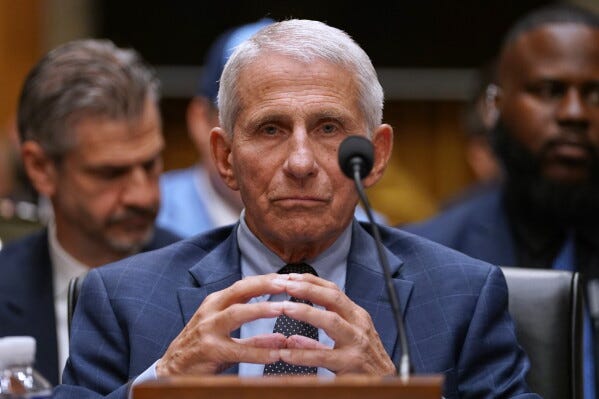
Yesterday: Dr. Anthony Fauci repeatedly invoked the Fifth Amendment during an approximately three-hour hearing before the Senate Homeland Security and Governmental Affairs Committee. Fauci, who had been subpoenaed by committee chair Rand Paul, declined to answer more than 100 questions about his handling of the COVID-19 pandemic. Paul announced that the committee will vote next week on whether to hold Fauci in contempt, although he did not specify whether he would pursue a criminal contempt referral. [10][11]
Fauci said Paul’s repeated public calls for his prosecution made any new sworn answer a possible route to legal jeopardy. Paul argued that the presidential pardon Fauci received in early 2025 undermined his Fifth Amendment claim, while acknowledging questions about the pardon’s reach. The pardon would not cover new conduct after it was issued, including a new false statement under oath.
Why it matters: Invoking the Fifth is a constitutional right and establishes neither guilt nor innocence. A contempt vote is a congressional step, not a conviction. The real machinery sits between those two facts: answering can create new exposure, while refusing can produce a contempt fight that may eventually reach the courts. The public will be shown two Faucis, one framed as a cornered suspect and another as a survivor of political persecution. XVOA’s concern is the constitutional struggle underneath both photographs: subpoena power, witness rights, pardon limits, accusation and theater operating in the same room.
4. Federal Reserve Holds Rates as the Iran War Enters Its Inflation Calculation
Yesterday: The Federal Open Market Committee held the federal-funds target range at 3.50% to 3.75% by a 9–3 vote. The majority said economic activity continued to expand at a solid pace despite elevated uncertainty tied partly to the Middle East conflict. The statement also said inflation remained above the Fed’s 2% goal, reflecting supply shocks that had raised prices in sectors including energy. Three voting members preferred a quarter-point increase. [5]
The committee did not identify the war as the cause of its decision. Its statement instead places military escalation inside the central bank’s assessment of prices, growth and risk. Even when energy continues to move, insurance, rerouting, scarcity fears and disrupted delivery schedules can raise costs before a tanker disappears from the market.
Why it matters: Monetary policy is where distant violence becomes a household bill without appearing on a casualty list. Higher energy and shipping costs can keep inflation elevated, while higher rates make mortgages, car loans and business credit more expensive. The people least able to absorb either pressure are asked to finance the war’s economic reach through daily purchases and debt service.
5. Urban League’s 50th State of Black America Warns of a Civil-Rights Retreat
Today: The National Urban League released the 50th edition of its State of Black America report, warning that Black economic and political prospects have worsened under federal policy changes affecting civil-rights enforcement, voting protections, diversity programs and economic opportunity. The organization says those changes threaten working-class and middle-class Americans more broadly, while Black communities remain the most visible target. [6][7]
The first report appeared in 1976 after President Gerald Ford’s State of the Union and the Democratic response both omitted the economic condition of Black America. Fifty years later, the institution is still producing a parallel national account because the official portrait continues to crop Black life out of the frame. This year’s edition connects the Justice Department’s Civil Rights Division, the Equal Employment Opportunity Commission, voting law and corporate retreat from diversity work into one diagnosis rather than treating each change as an isolated dispute.
Why it matters: Black historical memory is doing policy work here. The report measures today’s rollback against the institutions built after the Civil Rights Movement and asks what happens when enforcement is weakened without the underlying statutes being formally repealed. A right can remain printed in federal law while the office, staff, procedure or remedy required to enforce it is dismantled. That is how a bridge gets pulled up while the government insists the road is still open.
Stories Buried Beneath the National Headlines
6. California Police Search People Perceived as Transgender at Far Higher Rates
Earlier this week: Researchers released an analysis of 4.6 million adult police stops recorded in California in 2023. Officers searched about 24% of people they perceived as transgender men or women, compared with 14% of perceived cisgender men and 8% of perceived cisgender women. Contraband was found in approximately 26% to 27% of searches across the groups. [8]
Arrest rates were 19% for people perceived as transgender men and 20% for those perceived as transgender women, compared with 10% for perceived cisgender men. The data records officer perception rather than each person’s verified identity, and it does not establish a specifically Black transgender finding.
Why it matters: Police discretion lives in the decision to extend a stop, ask another question or convert nervousness into suspicion. The study cannot identify the motive inside every officer’s mind, but it can measure the pattern after millions of encounters. Perception changed the burden long before evidence recovery changed at all.
7. Federal Workers Sue Over an Alleged EEOC Freeze on Class Discrimination Cases
Earlier this week: The American Federation of Government Employees and two female correctional officers sued the Equal Employment Opportunity Commission, alleging that the agency has indefinitely stopped processing all class discrimination complaints brought by federal workers. The officers are part of a certified case alleging systemic sexual harassment at a Louisiana federal prison, including rape threats, unwanted touching and workplace nudity. [12]
The lawsuit says a blanket directive has paused hearings, discovery, motions and decisions in federal-sector class cases since at least December. The EEOC has not publicly explained the alleged suspension, and the plaintiffs are asking a federal court to vacate it.
Why it matters: Congress does not have to repeal workplace protections for enforcement to fail. A civil-rights process can be disabled by halting the procedure and leaving workers in administrative storage. The law remains visible while the route to a remedy disappears.
8. Federal Judge Blocks Houston’s Race-Conscious Contracting Rules
Earlier this week: U.S. District Judge David Hittner permanently blocked Houston and its Midtown Management District from enforcing race-conscious portions of public-contracting programs for minority-owned businesses. The ruling applied the Supreme Court’s 2023 affirmative-action framework to municipal contracting and found that Houston had not identified sufficiently specific past discrimination to justify its use of race. The city is considering an appeal. [13]
The order does not erase every provision supporting women-owned and small businesses. It targets the racial classifications and reaches a program through which Houston set annual goals for awarding different kinds of contracts to minority-owned firms.
Why it matters: Public contracting converts tax dollars into business capacity, payroll and generational wealth. Once race-conscious remedies are removed, the bidding process can be described as open to everyone while the history that shaped access to capital, networks and city work becomes legally harder to repair.
9. Planned Parenthood Challenges Ideological Scoring in Title X Grants
Earlier this week: Planned Parenthood affiliates sued the Trump administration over the application criteria for the 2027–2032 Title X family-planning grant cycle. The challenged funding notice gives weight to alignment with administration priorities including natural family planning, “life-affirming care,” marriage before childbearing and what the notice calls respect for biological reality. [14]
The lawsuit argues that the government has turned a grant competition for reproductive and preventive health care into an ideological threshold. The claims remain untested in court. Title X supports contraception, sexually transmitted infection testing and treatment, cancer screening and related care, especially for low-income and uninsured patients.
Why it matters: Grant language becomes health policy at the clinic door. When political alignment helps determine which providers can compete, patients can lose care without Congress banning a service. The administrative scoring sheet does the work before an appointment is ever scheduled.
10. AHRQ Withholds Continuation Funding for at Least 104 Research Grants
Yesterday: KFF Health News reported that the Agency for Healthcare Research and Quality withheld continuation funding from at least 104 research awards. Congress appropriated $345 million for the agency this fiscal year, yet it had spent less than $15 million on grants. The Department of Health and Human Services said roughly 75% of the staff had been fired or had left. [15]
AHRQ funds work on medical errors, hospital infections, telehealth, rural pregnancy care and the software systems used inside clinics and hospitals. HHS says the agency is strengthening and refocusing its grant process, while former staff and researchers say the grant-management capacity has been stripped away.
Why it matters: Quiet dismantling often leaves the agency name on the door. Congress can appropriate money while staff disappears, grants stop and safety research never happens. Rural patients, children and older adults discover the loss only after a preventable error or missing program reaches them.
11. Medicare Ends the Part D Premium Stabilizer After 2026
Earlier this week: The Centers for Medicare & Medicaid Services announced that the Part D Premium Stabilization Demonstration will end after the 2026 plan year. The temporary program helped restrain premiums for standalone prescription-drug plans while insurers adjusted to benefit changes under the Inflation Reduction Act. Nearly 25 million people are enrolled in standalone Part D plans. [16]
CMS says most beneficiaries will see increases of less than $10 and some will pay less. KFF estimates that the program lowered this year’s average standalone premium by about $16 a month, while final 2027 plan prices will not be available until September.
Why it matters: The average cannot tell an individual senior what will happen to a specific plan. The temporary cushion is ending, and older adults on fixed incomes will carry the uncertainty into open enrollment. A modest premium change can still force a choice between prescriptions, food and utilities.
12. Haitian Workers Lose Work Authorization as Employers Pull Them Off Schedules
As of today: Thousands of Haitian immigrants and their employers are navigating lost work authorization after the Supreme Court allowed the administration to end Temporary Protected Status for Haitians. In Key West, a restaurant manager suspended six longtime workers after a federal system showed their permits were no longer valid. Haitian TPS holders work across hospitality, construction and home care. [17]
The administration says TPS was always temporary and has encouraged voluntary departure. Haitian workers and advocates point to deadly gang violence and state collapse in Haiti, while employers are suddenly losing experienced staff. The legal status does not provide a path to citizenship, even after years of lawful work.
Why it matters: “Immigrant labor” hides cooks, caregivers, construction workers and parents whose legal status can disappear while their work remains essential. The policy turns a humanitarian designation into an employment shock, then distributes the loss across families, patients, customers and local businesses.
13. Wisconsin Judge Denies New Ballots to Voters Who Already Returned Absentee Votes
Yesterday: A Wisconsin judge ruled that voters who had already returned absentee ballots for the August primary could not void them and request replacements after two Democratic candidates for governor left the race. More than 117,000 absentee ballots had been returned when Judge David Conway upheld the Wisconsin Elections Commission’s guidance against allowing those ballots to be spoiled. [18]
Democrats argued that state law permits a voter to change a ballot before counting begins. The judge read the statute differently and denied the requested temporary order.
Why it matters: Election administration becomes democracy at the moment a rule meets a ballot already cast. Candidate turmoil may be political, but the remedy depends on statutory language, commission guidance and judicial timing. Voters carry the consequence of that machinery into the August primary.
Closing Note on Coverage Gaps
The World War III question exposes something psychological as well as geopolitical. Collective fear wants one enormous name because a single name makes the danger feel visible. Power is usually less cooperative. It moves through a strike order in one country, an interceptor shortage in another, a grant notice, a court ruling, a suspended work permit and an officer’s discretionary decision on the side of a road.
War remains the lead, and precision becomes a form of public defense. The United States is already in what its own White House calls an ongoing international armed conflict, and the map is widening faster than the democratic authorization around it. Congress owes the public a vote on the mission, its limits, its money and its consequences. NATO owes the public clarity about the Polish incursion. Every government making claims about Damietta, Chinese weapons or Russian assistance owes evidence that can survive the first news cycle.
Meanwhile, the quieter machinery will keep moving whether cameras follow it or not. The task of this desk is to hold both scales at once: the missile crossing a border and the administrative order changing a life. Fear wants the headline to become the whole world. XVOA will keep watching what power tries to move outside the frame.
Support XVOA
Producing this Reader’s Cut required following military claims across several governments, separating direct combat from material support, updating the death toll in Ukraine, reading the Fauci hearing record and restoring the civil-rights, health, policing and immigration stories the audio could only compress.
A paid XVOA subscription gives this desk the dependable base to keep doing that work every day. Thank you to every paid reader already carrying it.
For free readers passing on another recurring subscription, Buy Me a Coffee remains the flexible one-time lane. Choose the amount that fits. It buys the desk more room to report, verify and publish without turning every national emergency into somebody else’s framing.
Sources
[1] Reuters, “Drone strike near Suez Canal in Egypt raises new security threat in widening war” - Supports the Damietta strike, Saudi participation, attacks involving Jordan and Kuwait, shipping pressure and the disputed Chinese air-defense report.
[2] U.S. Central Command, “U.S. Strikes IRGC Targets After Attempted Iranian Attacks” - Supports the timing, target categories and U.S. account of the latest strike wave.
[3] White House Office of Management and Budget, “Statement of Administration Policy on S.J. Res. 180” - Supports the administration’s “ongoing international armed conflict” language and opposition to the Iran war-powers resolution.
[4] Associated Press, “Russian strikes across Ukraine kill 10 and NATO scrambles jets after a missile falls in Poland” - Supports the latest casualty count, attack scale, air-defense shortage and Polish airspace incursion.
[5] Federal Reserve, “Federal Reserve issues FOMC statement” - Supports the rate range, 9–3 vote, dissenters and the committee’s inflation and Middle East language.
[6] National Urban League, “State of Black America: The 2026 Report” - Supports the report’s 50th-edition civil-rights, democracy and economic diagnosis.
[7] Associated Press, “Urban League report says Trump administration is harming Black Americans’ chances at American Dream” - Supports the report’s release, historical context and policy findings.
[8] Williams Institute at UCLA School of Law, “Police in California more likely to search and arrest people perceived to be transgender” - Supports the 4.6 million-stop dataset, search, arrest and contraband-discovery rates.
[9] Reuters, “Iran strikes on CIA facilities prompt questions about possible Russian role” - Supports the attributed reporting on Russian targeting and technical assistance and the unresolved link to particular attacks.
[10] Senate Homeland Security and Governmental Affairs Committee, “Testimony of Anthony Fauci” - Supports the official hearing date, witness identity and proceeding.
[11] Associated Press, “Fauci repeatedly invokes the Fifth Amendment in a contentious Senate committee hearing” - Supports the number of invocations, Fauci’s stated reason and Paul’s planned contempt vote.
[12] Federal News Network, “Union sues EEOC for halting work on federal class action complaints” - Supports the lawsuit, alleged freeze and underlying correctional-officer case.
[13] Reuters, “US judge blocks Houston’s minority contracting program” - Supports the ruling, programs affected, legal reasoning and possible appeal.
[14] Planned Parenthood, “Planned Parenthood sues Trump-Vance administration over ideologically driven changes to Title X family planning program” - Supports the plaintiffs’ challenge and the disputed 2027–2032 grant criteria.
[15] KFF Health News via CBS News, “Trump administration has quietly throttled an agency devoted to the safety of American healthcare” - Supports the halted grants, appropriations, spending, staffing and patient-safety research affected.
[16] KFF, “CMS’s decision to end temporary subsidies to Medicare’s stand-alone drug plans could mean larger premium increases for some beneficiaries next year” - Supports the end of the demonstration and estimates of its premium effect.
[17] Associated Press, “Loss of work authorization sows confusion for thousands of Haitian immigrants and their US employers” - Supports the TPS consequences for Haitian workers, employers and affected industries.
[18] Associated Press, “Wisconsin judge says voters who returned absentee ballots cannot get new ones” - Supports the ruling, returned-ballot total and dispute over ballot replacement.


