


Tuesday, August 4, 2026
Small desk note at the bottom today about the operating gap. First, the Brief.
A Brief so damn reliable you forget how good it is. Like COOL AC, baby.
Note to Readers
This Reader’s Cut is the edited written record of the completed Blackout audio. The recording made the day’s hierarchy audible: Washington removed a benefit carrying a $1.8 billion sign while quieter protections and administrative burdens remained. The two audio inserts, from Todd Blanche’s confirmation hearing and Daphy Michel’s family attorney, are translated here into full context. Developments that changed after recording have also been updated, including the U.S.-Iran standoff, wildfire losses, the visa-bond mechanics, and the complete reach of the Gilead ruling. Readers lose nothing essential by skipping playback; the argument, qualifications, corrections, and receipts are all here.
Today’s Charge
The loud victory was the formal rescission of a fund that might have paid people claiming political persecution. The quieter tax agreement covering Donald Trump, his sons, and the Trump Organization survived. Farther down the ladder, family-assistance records are being pulled toward immigration enforcement, lawful visitors face bonds large enough to exclude them, and patients have lost a path to challenge a drugmaker’s research timetable. Legal protection is being rationed upward, while vulnerable people are turned into data, debtors, and risk. Today’s machinery is the paperwork that decides whose liability disappears, whose private information travels, and who must absorb the danger.
Five Things That Matter Today
Earlier this week: Acting Attorney General Todd Blanche formally rescinded the Justice Department’s $1.8 billion Anti-Weaponization Fund, winning promised support from Republican holdouts John Cornyn and Thom Tillis. The separate agreement covering past tax filings by Trump, his sons, and the Trump Organization remains in place.[1][2]
As of today: Trump says U.S.-Iran talks are underway and calls this Tehran’s last chance; Iran says no talks are taking place or scheduled. An overnight shipping attack near the Strait of Hormuz has made the uncertainty more dangerous for civilians, trade, and global energy flows.[3]
Yesterday: Twenty-four states and the District of Columbia sued to stop a federal policy that could share TANF recipients’ Social Security numbers, addresses, immigration status, and other records with agencies including the Department of Homeland Security. The policy is scheduled to take effect August 11.[4]
Yesterday: A permanent visa-bond rule took effect for covered B-1 and B-2 applicants from 50 countries, 30 of them in Africa. Covered nationals must post $10,000, $15,000, or $20,000 before a visa is issued, with only a narrow waiver route.[5][6]
Yesterday: The California Supreme Court ruled 6-1 for Gilead Sciences and ordered judgment against an estimated 24,000 HIV patients. The court held that California negligence law created no duty to develop and release a potentially safer medicine sooner when the existing drug was treated as nondefective.[7][8]
Restack This Brief
Restack this report, forward it, or send it to one person who needs the map. The fund headline will travel on its own because $1.8 billion is easy to see. The audit agreement, the TANF data rule, Daphy Michel’s death, and the visa-bond machinery can disappear into legal language and local coverage unless readers move them together. This Brief shows how the same hierarchy crosses a tax settlement, a benefits office, a consular window, and a pharmaceutical courtroom. Circulation keeps those mechanisms visible after the spectacle moves somewhere else.
The Hierarchy Audit
National attention settled on Blanche’s rescission because the Anti-Weaponization Fund came with an outrageous price tag, obvious political beneficiaries, and a confirmation fight. That allocation made sense, up to a point. The fund had never appointed members, transferred money, opened a claims process, or paid anyone, and Blanche’s order now says it has no force or effect. The simpler scandal was also the easiest part of the settlement to remove from view.[1]
The quieter benefit concerns retroactive tax protection for named Trump plaintiffs. It is limited on paper, disputed in law, and potentially connected to more than $100 million in claimed back taxes. Below that national fight sit people with far less institutional shelter: a Haitian woman released miles from home during a mental-health crisis, families whose benefit records may reach DHS, African travelers confronting five-figure bonds, and Native residents rebuilding while water and electrical systems remain unstable. The day’s hierarchy emerges from those distances. One level of power receives negotiated limits and written clarifications. Another receives an ankle monitor, a data transfer, a boil-water notice, or a bill large enough to close the door.
Top Breaking National Stories
1. Blanche Rescinds $1.8B Fund While Trump Audit Agreement Survives
Earlier this week: Blanche issued a Sunday-night order rescinding the $1.776 billion Anti-Weaponization Fund and declaring that it had no force or effect. His order said no members had been appointed, no money had moved, no claims process had been created, and no claims had been paid. The order rescinds DOJ’s implementation, while challengers argue its unilateral form leaves the original settlement’s contractual status disputed. Cornyn and Tillis, who had held up his nomination for the permanent attorney general post, then said they would support moving it forward. Their support clears a committee obstacle; it does not complete confirmation, and the Senate Judiciary Committee vote remains the next formal test.[1]
The audit agreement grew out of Trump’s lawsuit against the IRS and Treasury. It covers Trump, his sons, and the Trump Organization, applies to past filings rather than future returns, and is confined to the named parties and government defendants in the settlement. Associated Press reporting says the disputed protection could affect more than $100 million in back taxes claimed by the government. That figure describes contested exposure rather than a final judgment establishing what Trump owes, and the agreement’s enforceability remains contested.[2]
During Blanche’s hearing, Senator Dick Durbin read language saying the government “releases, waives, acquits and forever discharges” the plaintiffs from covered liabilities. Blanche answered yes when Durbin asked whether the language reached past filings. Why it matters: The visible fund became expendable once it threatened Blanche’s nomination. The more technical agreement survived with limits that sounded reassuring enough to move the nomination. This is how privilege often survives scrutiny: the flashing red light comes down while the consequential clause remains inside the paperwork.
2. U.S.-Iran Talks Remain Unverified as a Shipping Attack Raises the Stakes
As of today: Washington and Tehran are giving conflicting descriptions of whether current contacts amount to negotiations during a five-month war. Trump said Monday that talks were happening and called the moment Iran’s last chance to sign an agreement. Iranian Foreign Ministry spokesperson Esmail Baghaei said no U.S. negotiations were taking place or scheduled, adding that Iran’s current discussions involved Oman and management of the Strait of Hormuz.[3]
The contradiction carried into Tuesday as a cargo vessel reported being hit by an unknown projectile near the strait, according to the United Kingdom Maritime Trade Operations agency. Traffic through Hormuz remained slow, while hopes for a settlement had already moved markets: Reuters reported that Brent crude fell about 7 percent Monday as major stock indexes rose. Those reactions arrived before either side established that a negotiating channel existed.[3]
Why it matters: Presidential language can alter military expectations, shipping decisions, oil prices, and civilian fear long before diplomacy produces a document. Iran can also impose economic pressure through a waterway carrying a major share of global oil and gas shipments. Direct talks, indirect mediated contacts, and technical discussions with Oman are being described as though they were interchangeable, leaving the public without a verified shared negotiating channel.
3. States Sue to Stop TANF Records From Entering a Wider Federal Pipeline
Yesterday: New York and California led 22 other states and the District of Columbia in suing the Administration for Children and Families over a policy scheduled to begin August 11. TANF, the Temporary Assistance for Needy Families program, is federally funded and administered through states, territories, and tribal governments. The challenged policy would allow detailed recipient records to be shared with other federal agencies, including DHS. The information can include Social Security numbers, addresses, immigration status, income, and family details.[4]
The states argue that Congress assigned them responsibility for eligibility decisions and that the new policy violates federal law and the Constitution. Federal officials have said the expanded access would help assess whether states are verifying citizenship or immigration status. The complaints seek to block the policy, but no court order had issued by publication, leaving the August 11 implementation date live.[4]
Why it matters: A parent applies for assistance because the children need food, rent is due, or a family is fleeing domestic violence. Under this policy, the same application may place the household’s information within reach of the department that runs immigration enforcement. Eligible families then have to decide whether the benefits office is still a place of assistance or the beginning of an enforcement chain.
4. Permanent Visa-Bond Rule Places Five-Figure Barrier on Travelers From 50 Countries
Yesterday: The State Department’s permanent visa-bond program took effect for covered B-1 and B-2 business and tourist applicants. Nationals of listed countries who otherwise qualify for a covered visa must post a bond before issuance unless a narrow national-interest or humanitarian waiver is initiated by a consular officer. Applicants have no procedure for requesting that waiver. The officer selects one of three amounts based on the applicant’s circumstances: $10,000, $15,000, or $20,000. A compliant traveler can recover the money after leaving on time.[5]
The covered list currently includes 50 countries, 30 in Africa.[6] The government’s own rule describes the exclusionary effect recorded during the pilot: about 20,000 applications were found subject to a bond, nearly half of those applicants did not pay it, and visa issuance in pilot countries fell 83 percent during the first 10 months. The rule says the program temporarily shifted about $115 million from the public through posted bonds.[5]
Why it matters: Refundability does not erase the requirement to produce the cash before travel. The program turns lawful entry into a wealth test, and African travelers carry most of the country-level exposure. Consular discretion determines the size of the barrier, while the rule’s own data show that many applicants disappear from the process before a visa can be issued.
5. California Supreme Court Ends 24,000 HIV Patients’ Gilead Litigation
Yesterday: The California Supreme Court ruled 6-1 that drugmakers have no negligence duty to develop and release a potentially safer medicine sooner when the medicine already on the market is considered nondefective. The court directed judgment for Gilead on all causes of action in the consolidated litigation brought by an estimated 24,000 patients. Its decision resolved the legal theory before trial rather than deciding whether every factual allegation against the company was true.[7][8]
The patients took medicines containing tenofovir disoproxil fumarate, or TDF, an effective HIV drug approved in 2001 that carried possible kidney and bone side effects. They alleged that Gilead halted development of tenofovir alafenamide fumarate, or TAF, in 2004 and delayed its release for nearly a decade to extend profits from the older medicine. Gilead said the early TAF evidence showed too little improvement to justify continued expense and warned that retrospective jury review would punish uncertain scientific decisions.[7]
Justice Joshua Groban’s majority opinion accepted the concern that a broad “duty to innovate” could burden research and patient safety. Justice Kelli Evans dissented, called the alleged conduct morally blameworthy, and urged California lawmakers to consider whether drugmakers deserve this protection. Why it matters: The legal category “nondefective” can coexist with patients suffering serious known side effects. The ruling removes the company’s development calendar from this jury and sends the accountability question to legislators and regulators. That question lands in a country where the CDC counted 38,793 HIV diagnoses in 2024, including 15,128 among Black people, or 39 percent of the total.[9]
Stories Buried Beneath the National Headlines
6. Daphy Michel’s Family Plans Suit After Her Death Following ICE Release

Earlier this week: An attorney for Daphy Michel’s family said a civil suit against the United States and other government and nongovernment entities should be filed within weeks. Michel was a 31-year-old Haitian asylum seeker who had spent six months in a county jail after a reported mental-health crisis. When her charges were dismissed, she was transferred to ICE, fitted with an ankle monitor, and released in Pittsburgh about 20 miles from home.[10]
Michel had untreated mental-health needs, a significant language barrier, and summer clothing in subfreezing weather. Transit footage showed her at a bus shelter for at least 24 hours before she died of hypothermia on March 2. The medical examiner classified her death as a homicide without declaring criminal guilt; DHS denies responsibility, and criminal and civil liability remain unresolved.[11] Why it matters: Federal release became abandonment because the distance between custody and actual safety belonged to the most vulnerable person in the chain.
7. Miami Residents Demand an End to the Police Department’s ICE Agreement
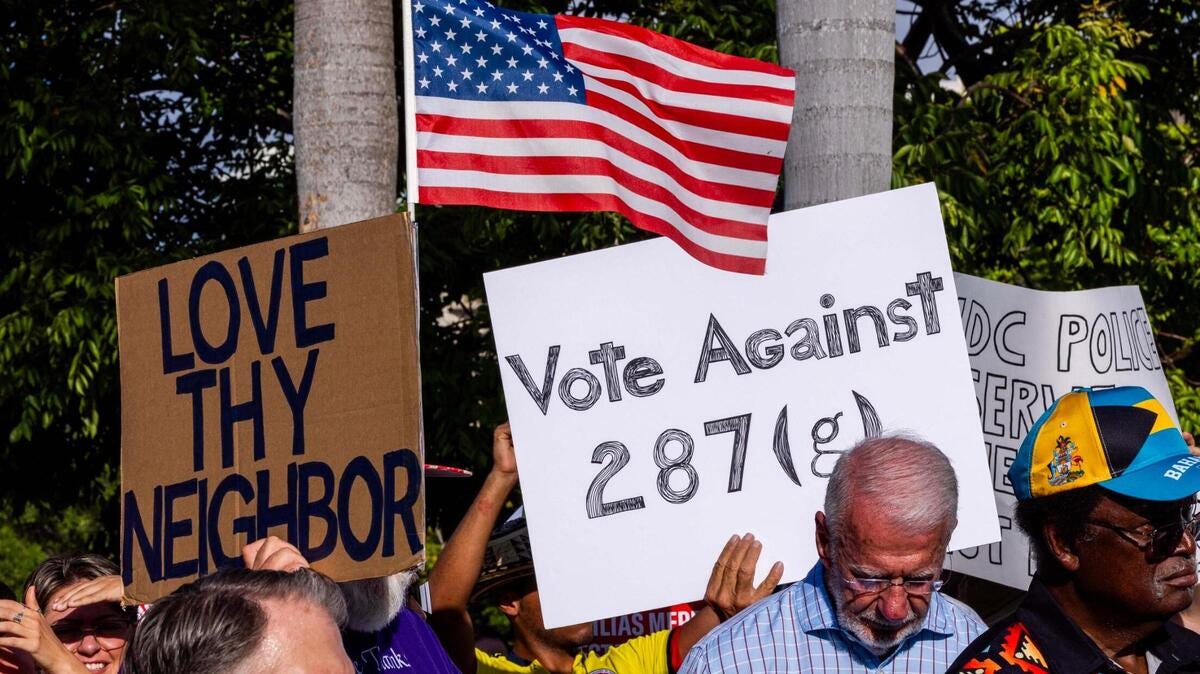
Yesterday: Protesters gathered outside Miami City Hall and asked commissioners to terminate the police department’s 287(g) agreement with ICE. The 2025 agreement authorizes certain local officers to perform federal immigration-enforcement functions under ICE supervision. The protest came one week after Temporary Protected Status for Haitians ended under the federal government’s current timeline.[12]
Why it matters: A domestic-violence victim, robbery witness, or sick neighbor needs to know that calling 911 brings help. When the local uniform can also become an entry point into immigration enforcement, every call carries a second calculation. Public safety begins eroding before an arrest occurs.
8. Cuba’s Grid Collapses Again During an Unstable Restoration

Yesterday: Cuba’s national grid failed again Monday afternoon while authorities were restoring service after Sunday night’s island-wide collapse. The renewed disconnection left restoration partial and unstable for a population of roughly 10 million. Aging plants, fuel shortages, weak maintenance, and underinvestment all constrain the system.[13]
Reuters also reported that a U.S. oil blockade eliminated Cuba’s key Venezuelan supply after Washington’s January ouster of Nicolás Maduro and that Mexican shipments stopped under U.S. pressure. Cuba blames U.S. restrictions, while Washington blames the state-run economy. Why it matters: Competing causes land together in the same home through spoiled food, interrupted medical care, stalled transportation, and dangerous heat.
9. Spokane-Area Wildfires Destroy 700 Structures and Force 64,000 to Flee
Earlier this week: Three major fires that began Saturday had destroyed at least 700 structures and placed roughly 64,000 people under immediate evacuation orders by Monday, according to Reuters. All three remained uncontained after burning more than 8,000 acres. Patients and staff at the Mann-Grandstaff Veterans Affairs Medical Center were evacuated, and the hospital and nearby VA clinics remained closed Monday.[14][15]
Why it matters: Acreage captures the fire’s size, while closed hospitals, displaced patients, lost housing, and exhausted public systems show its social reach. Weather may start the evacuation clock, while public capacity determines who finds care and how long the displacement lasts.
10. Bench Fire Compounds Water and Power Failures on Warm Springs Reservation
Earlier this week: The Bench Fire had burned 67,238 acres and was 52 percent contained Sunday, according to the official incident update. On the Warm Springs Reservation, six homes had burned and residents still faced sporadic electricity, boil-water notices, a critical water shortage, road closures, and displacement. Thousands had lived with unstable basic services for nearly a week.[16][17]
The fire compounded an aging water system rather than supplying one simple cause; officials also warned about depleted storage and a cracked pipe. Why it matters: Native communities can survive the flames and still remain inside the emergency. Historical underinvestment decides whether recovery begins with resilient infrastructure or another failure already waiting underneath the first one.
11. Israeli Strikes Kill at Least 18 in Gaza as Peace Roadmap Remains Unresolved
Earlier this week: Israeli strikes on Sunday killed at least 18 Palestinians, according to Palestinian medical officials, during one of the deadliest days since the October 2025 ceasefire. A couple and their child were among the dead. Israel said it targeted military operatives; its defense minister said troops would remain until Hamas disarmed and its tunnels were destroyed, while Hamas said attacks must stop first.[18]
Why it matters: Trump had called the latest peace-plan movement a major milestone, yet the sequence of disarmament, withdrawal, and halted attacks remains unresolved. Gazans are living inside the distance between diplomatic announcements and continuing strikes, where a promised roadmap offers no shelter from the next blast.
12. South African Court Hears Challenge to Land Law Targeted by Trump
Yesterday: The Western Cape High Court began hearing consolidated challenges to South Africa’s Expropriation Act from the Democratic Alliance, AfriForum, the Institute of Race Relations, and other applicants. The law allows expropriation for public purposes or in the public interest, with no compensation only in limited circumstances. No land has been seized under it, and judgment may take weeks or months.[19]
Trump has portrayed the law as a threat to white Afrikaner farmers, frozen U.S. aid, and offered Afrikaners preferential refugee treatment, while South Africa rejects the persecution claim. Why it matters: Colonial seizure and apartheid built the land distribution the statute addresses. Casting the remedy as white endangerment recruits historical memory to defend the outcome of dispossession.
13. Twenty-Five States Challenge Trump’s Forced-Labor Tariffs
Yesterday: Twenty-five Democratic-led states sued in the U.S. Court of International Trade over tariffs of 10 or 12.5 percent on most goods from 60 economies, meaning 59 countries plus the European Union. The administration imposed the duties under Section 301 of the Trade Act after investigations into weak enforcement against forced-labor goods.[20][21]
The states allege the investigation was inadequate and forced labor became a pretext for restoring broad tariffs rejected under another authority. The White House says the action is lawful, and no court has ruled on this challenge. Why it matters: Importers receive the tariff bill first. The resulting costs can travel through households, small businesses, and public agencies while the legal fight unfolds.
14. Federal Workers Sue Over Gender-Affirming-Care Insurance Exclusion
Yesterday: Five anonymous federal employees filed a proposed class action alleging that the government’s insurance exclusion for gender-affirming care violates Title VII’s prohibition on sex discrimination. The policy took effect January 1 across federal employee and postal health plans. It excludes medical and surgical transition care while preserving counseling and limited case-by-case continuity exceptions for people already in treatment.[22][23]
The Williams Institute estimates that at least 39,400 transgender people covered by the Federal Employees Health Benefits program are subject to the policy change.[24] OPM had not responded to Reuters when its report was published, and the class has yet to be certified. Why it matters: The legal claim awaits adjudication. The coverage loss is already shaping whether workers can continue treatment, absorb the cost themselves, or remain in jobs tied to the plan.
Closing Note on Coverage Gaps
The coverage hierarchy made the $1.8 billion fund the day’s obvious scandal. The paperwork underneath it tells the larger story. A settlement can reach backward toward a president’s possible tax exposure. A TANF file can move forward toward immigration enforcement. A consular officer can place a five-figure condition on lawful travel. A court can define a drugmaker’s research sequence as a choice outside this negligence theory. The rank structure is written into which liabilities get waived, which records get shared, which travelers can afford entry, and which injuries the law assigns to private judgment.
The next pressure points are concrete. The Senate Judiciary Committee must decide whether Blanche’s written concessions resolve the ethical problem. The TANF transfer date is August 11 unless a court intervenes. Miami commissioners own the local 287(g) decision. The visa program now needs an implementation audit showing who receives each bond amount and who disappears from the application process. California lawmakers and regulators now own the policy question left by the Gilead court. XVOA will keep following those deadlines because a technical rule often reveals its moral character only after somebody without power is forced to live inside it.
Support XVOA
Following this machinery required reading the court ruling, the federal visa rule, state complaints, local reporting, and the late changes that made parts of the completed audio stale by publication. Paid subscriptions give this Black-led intelligence desk the dependable base to keep doing that work every day.
Become a paid XVOA subscriber if you are reading free.
To every current paid reader carrying the desk already, thank you.
Buy Me a Coffee is the flexible lane for readers who do not want another recurring subscription, paid readers who want to add support, and anyone choosing anything from a small contribution to a substantial one-time gift. A $300 operating gap from the last urgent update remains si please help close this gap so this desk can return tomorrow.
Sources
[1] CBS News and Associated Press, “Acting Attorney General Todd Blanche Issues Order Rescinding ‘Anti-Weaponization’ Fund” - Supports the rescission order, the fund’s inactive status, the Cornyn-Tillis hold, and the remaining procedural steps.
[2] Associated Press, “As Blanche’s Path to Confirmation Is Cleared, Trump’s Tax Audit Immunity Remains in Place” - Supports the audit agreement’s parties, retroactive scope, disputed tax exposure, and legal controversy.
[3] Reuters, “Status of U.S.-Iran Talks Uncertain as Ship Struck in Hormuz” - Supports the contradictory diplomacy claims, shipping attack, traffic conditions, and market reaction.
[4] Office of the New York Attorney General, “Attorney General James Sues Trump Administration to Protect Vulnerable New Yorkers’ Personal Information” - Supports the TANF coalition count, challenged data policy, information at issue, and states’ legal claims.
[5] Federal Register, “Visas: Visa Bond Program” - Supports the effective date, covered visas, bond amounts, waiver structure, pilot results, and refundability.
[6] U.S. Department of State, “Countries Subject to Visa Bonds” - Supports the current 50-country list and its concentration in Africa.
[7] Reuters, “California’s Highest Court Rules for Gilead, Says Drugmakers Don’t Have ‘Duty to Innovate’” - Supports the 6-1 ruling, patient estimate, TDF-TAF history, parties’ arguments, and dissent.
[8] Judicial Branch of California, “Gilead Tenofovir Cases, S283862” - The California Supreme Court’s published opinion and disposition.
[9] Centers for Disease Control and Prevention, “HIV Diagnoses, Deaths, and Prevalence” - Supports the 2024 national HIV diagnosis totals and demographic percentages.
[10] The Guardian, “Family to Sue After Woman Released From ICE Custody Froze to Death” - Supports the planned civil suit, Michel’s vulnerability, custody history, and disputed responsibility.
[11] Pittsburgh’s PublicSource, “Death of Haitian Immigrant Ruled a Homicide. ICE Denies Responsibility” - Supports Michel’s cause and manner of death, bus-shelter timeline, DHS response, and criminal-liability qualification.
[12] WSVN 7News, “Anti-ICE Protesters Gather Outside Miami City Hall Calling for Change” - Supports the Miami protest, 287(g) demand, and Haitian TPS context.
[13] Reuters, “Cuba’s Power Grid Collapses Again During Restoration Efforts After Nationwide Blackout” - Supports Monday’s second collapse, restoration status, infrastructure problems, and fuel-pressure context.
[14] Reuters, “Wildfires Near Spokane Destroy More Than 700 Buildings, Force 64,000 to Flee” - Supports the updated destruction, evacuation, acreage, and containment figures.
[15] Air Force Times, “VA Medical Center, Clinics in Spokane Evacuated for Wildfire” - Supports the evacuation of VA patients and staff and the Monday facility closures.
[16] OPB and KLCC, “Warm Springs Reservation Faces Years of Recovery After Bench Fire Sweeps Through” - Supports the Reservation’s housing, water, power, displacement, and recovery conditions.
[17] Central Oregon Fire Information, “Bench Fire, August 2, 2026” - Supports the official acreage, containment, cause, and personnel figures.
[18] Reuters, “After Deadly Day, Gazans Say Trump’s Touting of Plan Jars With Grim Reality” - Supports the reported deaths, Israeli account, disarmament dispute, and peace-plan context.
[19] Associated Press, “Court Fight Begins Over South Africa’s Land Law That Irks the Trump Administration” - Supports the court challenge, the law’s scope, no-seizure status, competing claims, and expected timeline.
[20] Reuters, “Democratic U.S. States Sue to Challenge Trump’s Latest Tariffs” - Supports the coalition, tariff rates, court, legal authority, and procedural status.
[21] Office of the New York Attorney General, “Complaint in Oregon et al. v. Trump et al.” - Supports the plaintiffs’ Section 301, process, pretext, and requested-relief claims.
[22] Human Rights Campaign Foundation, “Federal Employee Health Benefits Class Action” - Supports the plaintiffs, policy scope, Title VII theory, and treatment exceptions.
[23] Reuters, “Trump Administration Sued Over Ban on Trans Care Coverage for Federal Workers” - Supports the filing date, proposed class posture, covered treatments, and OPM response status.
[24] Williams Institute, “The Impact of Changes to the Federal Employee Health Benefits Program on Transgender People” - Supports the estimate of at least 39,400 affected transgender enrollees.


