
Thank you Hugh la, Suzie’s World, Zelda Zulu, Gilda Johnson, Donna Everett, Jerry Spiegler and many others for tuning into my live video! Join me for my next live video in the app.
A Black face in authority can change the temperature of an encounter. I know that from twenty years in county patrol and from being a Black Army veteran who learned what a uniform communicates before the person inside it speaks. Shared identity can interrupt suspicion and create trust. It can also lower people’s guard before the policy, budget, chain of command, or institution’s appetite for punishment has changed.
That is the trap inside the easy celebration of representation. We see a person who looks like us cross a threshold, then we treat access as if it were proof of transformation. The institution receives the moral credit of inclusion while the people subject to it are asked to stop examining what it does. A familiar face can become a bridge to power, but it can also become power’s shield.
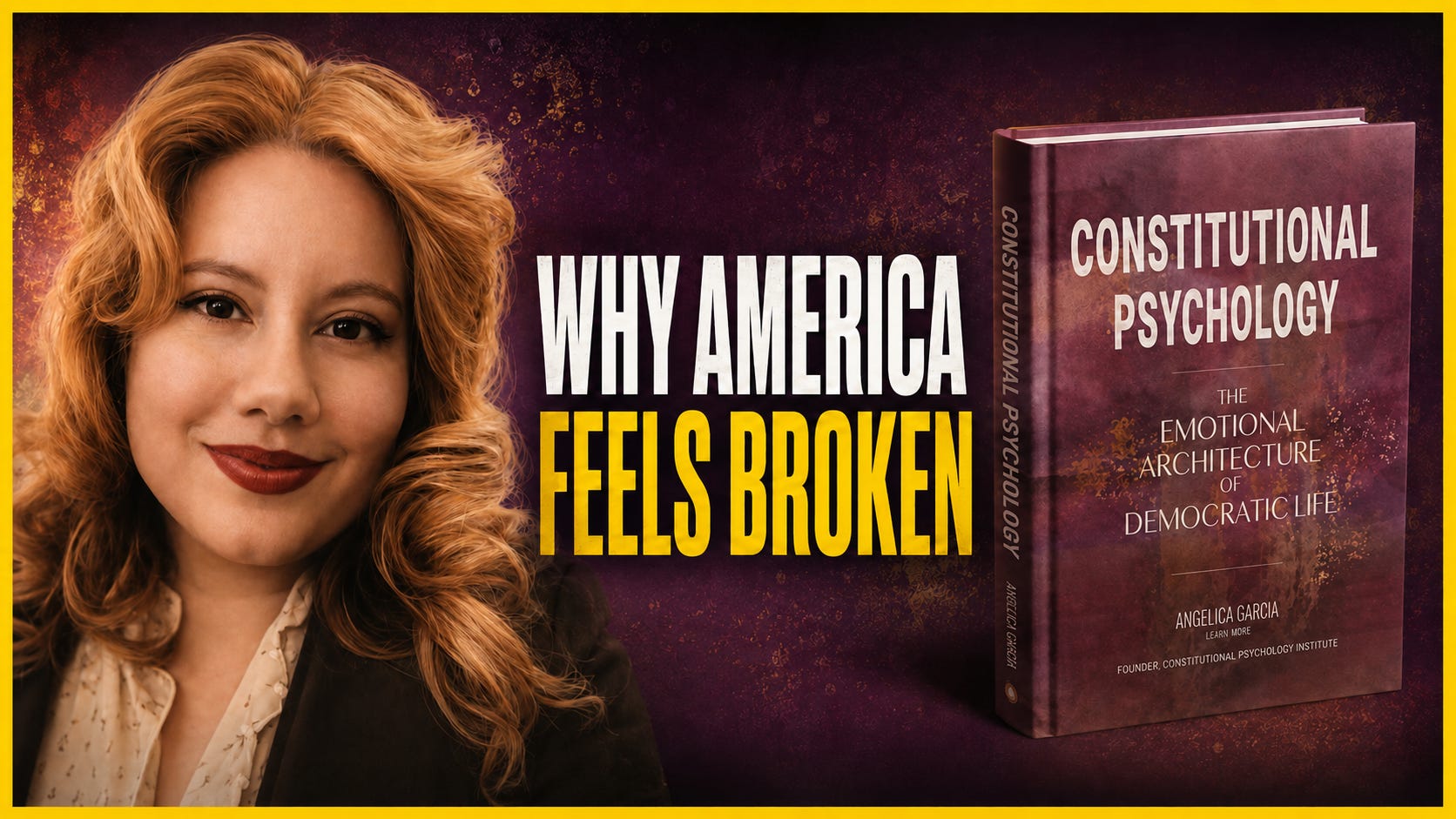
I invited Constitutional Psychology aka Angelica Garcia, LCSW, MBA, onto XVOA because her book, Constitutional Psychology: The Emotional Architecture of Democratic Life, offers language for that contradiction. Her framework connects democratic structures to people’s sense of safety, attachment, belonging, instability, and public trust.[1] It is not a license to diagnose politicians, police officers, media figures, or voters from a clip. It examines the emotional environment created by institutions, rhetoric, and observable patterns of power.
The conversation moved through Dr. Steven W. Thrasher’s “overseer class,” Black policing, the individualism advanced by Brandon Tatum, known professionally as Officer Tatum, Dr. Jason Johnson’s analysis of Black women’s reported motivation ahead of the midterms, and Disney’s reversal on Wonder Man. Each example presented a different version of the same question. When representation opens the door, does the function of power change, or does the new occupant become evidence that no further change is required?
TLDR
Representation is not transformation. Identity can open access and alter an encounter, but institutional change must be measured by who gains protection, who carries risk, who can make decisions, and who faces consequences.
Public psychology is not private diagnosis. The framework examines how institutions organize safety, belonging, fear, and attachment without inferring a person’s clinical condition from a clip.
The “overseer class” is an institutional argument. Dr. Thrasher uses the category to describe marginalized people elevated into visible authority while the institution’s underlying disciplinary function remains intact.[2]
A personal success story cannot acquit a system. Officer Tatum centers individual agency.[3] My test begins with repeatable institutional outcomes, then asks what an individual can resist or reproduce inside them.
Material threat is more intimate than symbolic identification. Among the registered Black women surveyed, self-reported intention and motivation rose sharply from the poll’s 2024 comparison.[4][5] That does not turn polling motivation into turnout or a forecast, but it helps explain why danger can mobilize where representation alone does not.
Institutions can comply before they are ordered to. Disney’s announced renewal and later cancellation of Wonder Man are documented.[6][7] The claim that anti-DEI pressure caused the reversal is not. That evidentiary gap is exactly where anticipatory compliance must be investigated rather than presumed.
The central test here is functional, so help put it before readers taught to confuse a first with a finish. Restack this Reader’s Cut, share it, and send it to one person who needs the evidence. If you value an XVOA investigation that checks the record, corrects its source on air, and separates documented reversal from unproven cause,
Paid membership finances this research and production. The desk’s daily operating floor is $50. Readers who cannot or do not want another subscription, and paid readers who want to give again, can use Buy Me a Coffee for anything from a small contribution to a substantial one-time gift.
Constitutional Psychology and the Function of Power: Watch by Chapter
1 | THE FRAMEWORK AND ITS LIMITS
0:00 — When representation changes the face of power
0:46 — Meet Angelica Garcia, LCSW, MBA
1:46 — A working definition of Constitutional Psychology
4:04 — The ethical boundary: a framework, not a diagnosis
2 | REPRESENTATION, BELONGING, AND THE BADGE
9:04 — Dr. Steven W. Thrasher on representation as institutional camouflage
12:56 — Does the Constitution protect property more than people?
16:50 — What a constitutional breach feels like
17:25 — The overseer class and Black policing
21:18 — Why representation alone does not change an institution
3 | THE HISTORY INSIDE THE INSTITUTION
26:48 — From slave patrols to modern policing
33:14 — Demilitarization and reinvestment in communities
35:40 — The Second Amendment, slavery, and constitutional enforcement
44:27 — Dr. Thrasher on diversified discipline on college campuses
4 | INDIVIDUALISM, MATERIAL PRESSURE, AND CULTURE
47:34 — Officer Tatum: individual success versus systemic racism
54:46 — Dr. Jason Johnson: Black women, the midterms, and material pressure
59:50 — Wonder Man and institutional retreat
5 | FEAR, BELONGING, AND DEMOCRATIC REPAIR
1:06:37 — Audience questions and Angelica Garcia’s work
1:12:12 — Dr. Johnson, the FCC, anti-DEI pressure, and Disney
1:14:48 — Projection, displacement, and scapegoating
1:18:18 — Did Angelica Garcia coin “Constitutional Psychology”?
1:20:01 — Representation opens the door. Does power change?
The Constitution Is Also a Lived Environment
Most political argument treats the Constitution as text, doctrine, and institutional design. Garcia asks what happens when those structures are lived long enough to become expectation. A promise of equal protection that repeatedly arrives as unequal exposure does more than produce a legal dispute. It teaches people what kind of safety they can expect, whether authority can be trusted, and whether belonging is conditional.
That distinction matters because public legitimacy is partly emotional memory. People do not meet a police officer, court, school, or election as blank slates. They arrive carrying what happened to them, what happened to their families, and what their communities learned about the distance between the official promise and the practiced rule. A constitutional breach therefore has a public afterlife even when no clinician is in the room and no individual diagnosis is being made.
This is where Constitutional Psychology earns its usefulness. It allows us to ask how a public institution organizes fear and attachment without pretending that a political disagreement is a mental disorder. Projection, displacement, and scapegoating can describe observable public mechanisms. They should never become remote diagnoses applied to people we have not examined and do not know.
Representation Can Become Camouflage
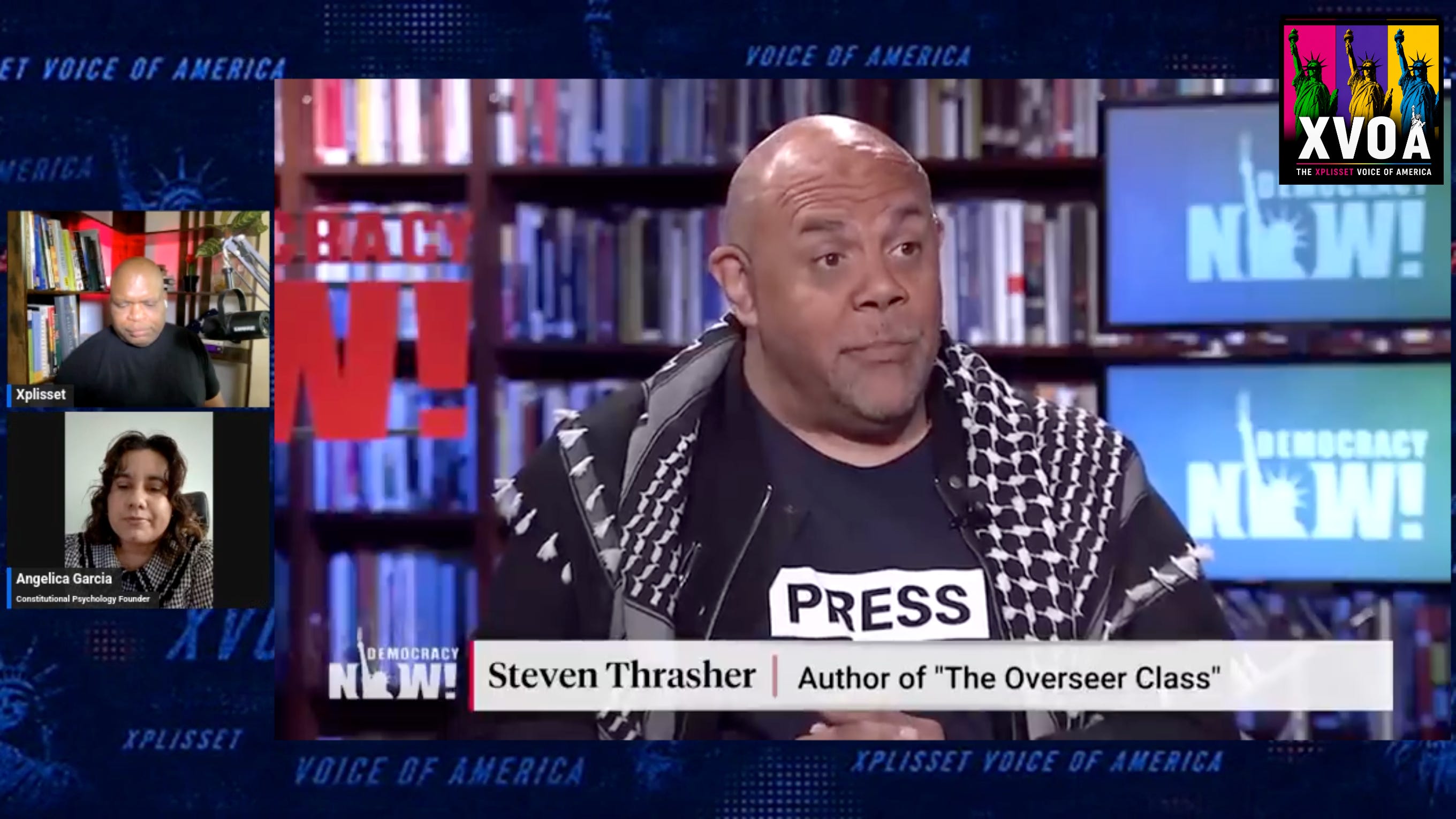
Dr. Steven W. Thrasher is a journalist, interdisciplinary scholar, and author whose work connects racism, policing, incarceration, public health, HIV/AIDS, and LGBTQ life. At broadcast time, Northwestern University listed Dr. Thrasher as an assistant professor of journalism and the inaugural Daniel H. Renberg Chair of Social Justice in Reporting at its Medill School. He holds a PhD in American Studies from New York University. His first book, The Viral Underclass, examined how inequality shapes exposure to disease and survival. His 2026 follow-up, The Overseer Class: A Manifesto, turns that lens toward marginalized people elevated into authority while the machinery beneath them preserves its disciplinary function.[2]
Dr. Thrasher’s category of the “overseer class” gave the conversation its sharpest institutional challenge. He applies the argument to Black police leadership and to universities that diversified the people administering discipline without redistributing meaningful power. The point is not that every Black official, police officer, dean, or executive is a traitor, but that institutions can turn identity into evidence on their own behalf. They invite the public to identify upward with the breakthrough figure rather than laterally with people still receiving punishment. When Dr. Thrasher says, “We diversified the disciplinary apparatus and nothing else,” he names the possibility that inclusion can modernize power’s appearance without changing its work.
That possibility gives representation a burden of proof. A historic appointment may matter, especially to people once excluded from the room, but the celebration cannot be the audit. We still have to ask who controls the budget, who writes the policy, who can challenge a decision, who receives the benefit of doubt, and who pays when the institution is wrong. The face of authority proves access, but it does not prove that authority has been repaired.
The Badge Does Not Erase the Institution
Policing makes this distinction personal for me. A Black officer may lower the temperature of an encounter, recognize a cultural cue, or use discretion differently. Those choices matter to the person standing on the shoulder of the road. They still do not, by themselves, rewrite deployment patterns, use-of-force rules, union power, disciplinary systems, budget priorities, or the political demands placed on the department.
American policing also carries more than one historical lineage. English-derived sheriffs, constables, and night watches shaped municipal law enforcement, while legally organized slave patrols became a significant early form of policing in the South, controlling movement, suppressing resistance, and enforcing slave law.[8] That history does not prove that every present department is a slave patrol in modern clothing. It does require us to examine which functions of racial and labor control survived changes in uniform, jurisdiction, and personnel.
The same care is required with prison labor. The Thirteenth Amendment abolished slavery and involuntary servitude while preserving an exception for punishment after criminal conviction.[9] After emancipation, Black Codes and racially selective enforcement fed convict-leasing systems supplying incarcerated labor to private employers.[10] The amendment did not create convict leasing by itself, but its exception and the policies built around it belong in the same record.
Demilitarization offers a present-day test of function. The federal 1033 program transfers excess military property to participating law-enforcement agencies, one documented channel through which military equipment has entered civilian policing.[11] Changing the officer’s race while preserving the equipment, incentives, and mission is not institutional transformation. Reinvestment becomes meaningful when it changes where public money goes, what conduct is rewarded, and whether communities receive safety before they receive force.
The broadcast also examined slavery, militias, and the Second Amendment. Southern militias performed slave-control functions, and legal scholar Carl Bogus argues that fear of federal interference helped shape the amendment.[12] That is an influential interpretation, not the only account. Congress’s constitutional history also locates the amendment within English rights, fear of standing armies, and broader militia traditions.[13] Evidence does not grow stronger when a contested history becomes a slogan.
The Individual Exception Is Not an Audit
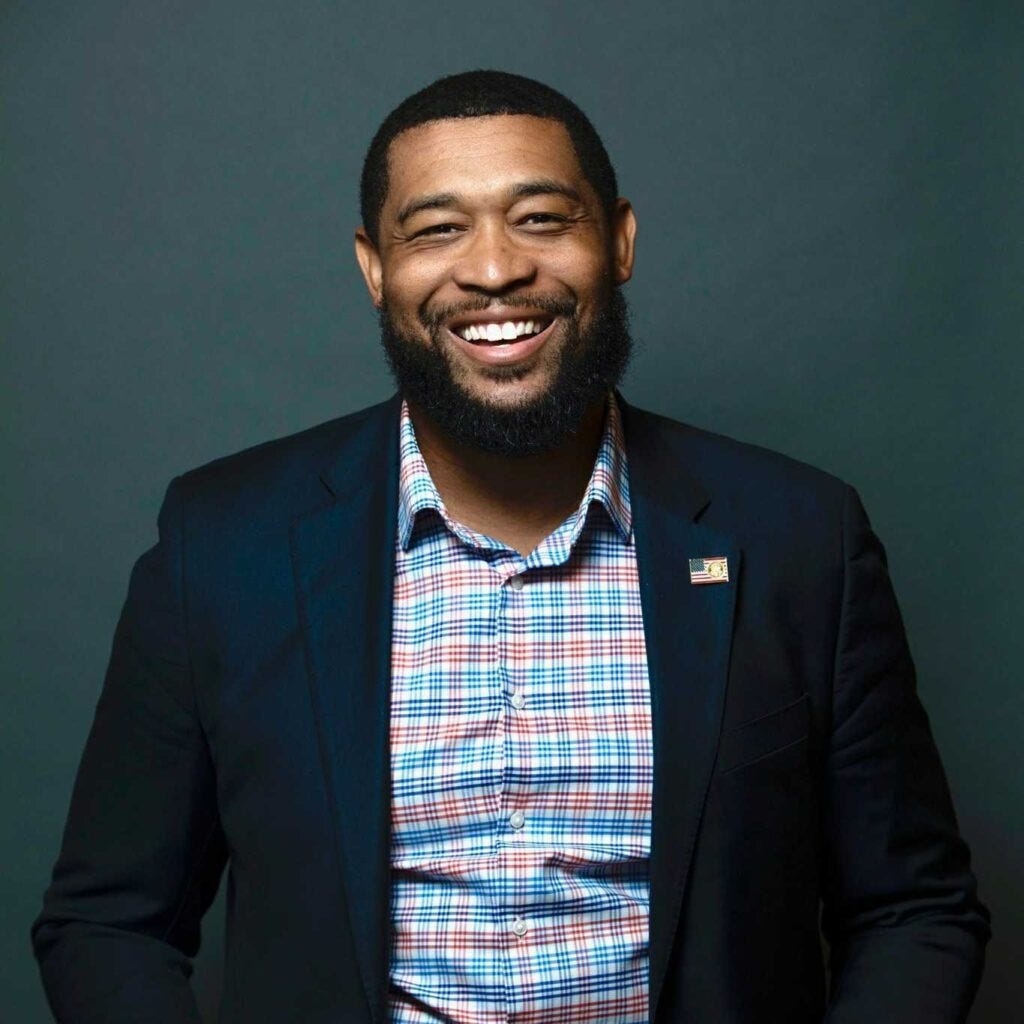
Brandon Tatum, known professionally as Officer Tatum, is a former Tucson Police Department officer who later built a conservative media career around his experience in uniform. Salem Media says he served on the department’s SWAT team and as a public information officer. After a video about a 2016 Donald Trump rally went viral, Officer Tatum co-founded BLEXIT, worked in outreach for Turning Point USA, published Beaten Black and Blue, and developed his media platform.[3] The clip is therefore not a neutral departmental assessment. It is a political argument from a former officer whose public project emphasizes personal responsibility and skepticism toward structural explanations for racial inequality.
Officer Tatum’s public statement supplied a clean contrast. “Systemic racism, does it affect you today and does it affect your life moving forward? I do not believe so,” he said.[3] His argument begins with individual capacity and gives culture and individual agency more explanatory weight than present-day systemic constraint. Mine begins with repeatable institutional outcomes and then asks what an individual can do inside them.
That is where he and yours truly, Xplisset, part company. I do not deny agency, achievement, resilience, or the dignity of refusing to be defined by injury. I deny that one person’s survival, promotion, or success can function as an institutional acquittal. A Black officer’s career can be real testimony about opportunity while remaining insufficient evidence about the distribution of stops, force, punishment, wealth, safety, and credibility.
This is not a clinical diagnosis of Officer Tatum, and it is not a shortcut to calling him an overseer. It is an analysis of what his rhetoric does for power. When an institution points to its successful exceptions, it can make the burden of proof disappear: the person who did not advance is blamed for lacking discipline, while the structure is relieved of answering for its pattern. Identity and professional experience become a permission slip for the institution to escape scrutiny.
When Threat Collapses Politics Into the Body
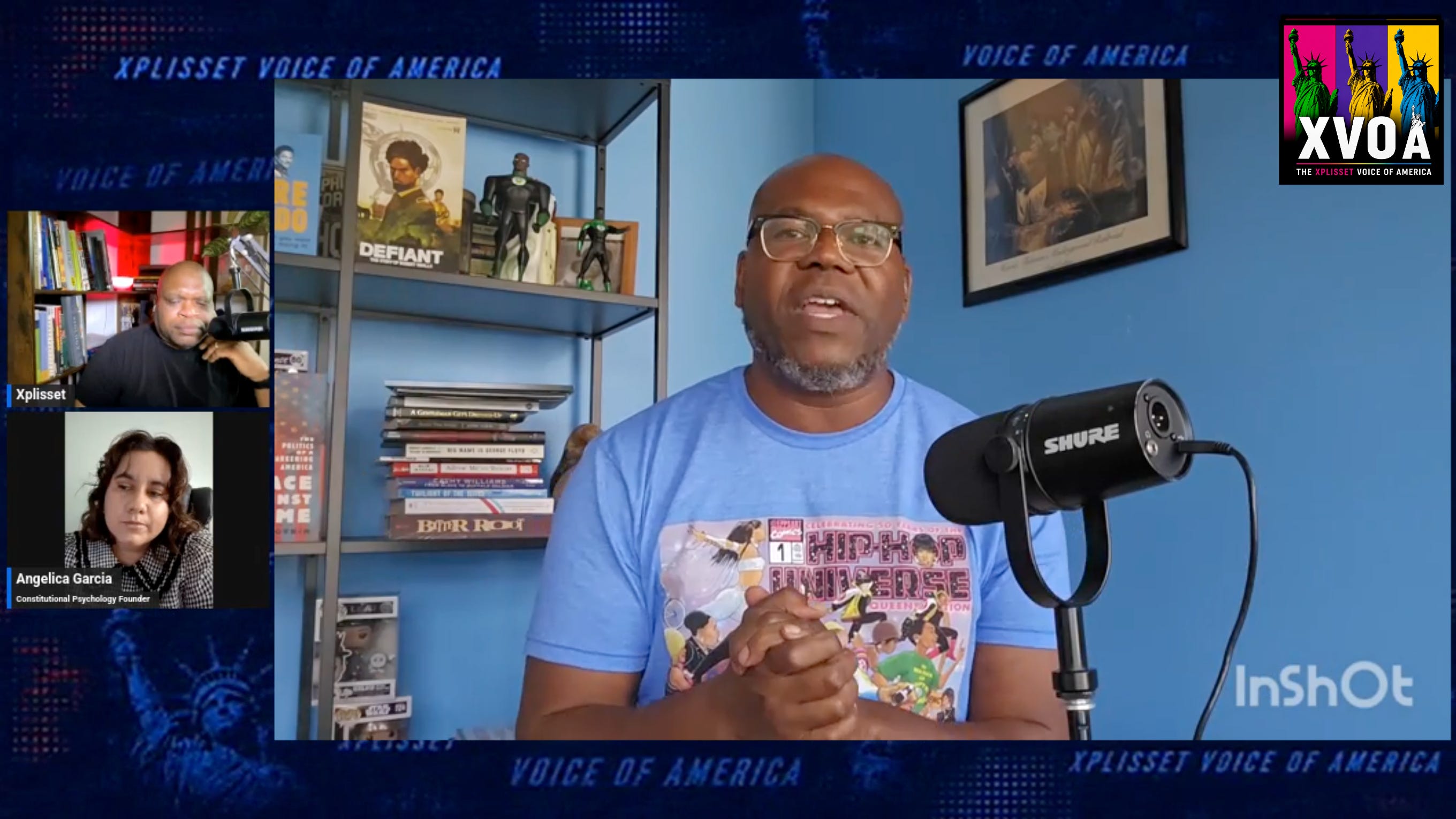
Dr. Jason Johnson is a political scientist, professor of politics and journalism at Morgan State University, and political analyst whose work spans campaigns, political communication, and popular culture. He earned his PhD in political science from the University of North Carolina at Chapel Hill and wrote Political Consultants and Campaigns: One Day to Sell.[5] That expertise grounds his segment’s shift from policing into electoral behavior while leaving his interpretation distinct from the poll’s findings.
Dr. Johnson reported greater self-described motivation among surveyed registered Black women and interpreted that motivation through the economic pressures bearing down on their households.[4][5] The responsible limit is important: a comparison between poll waves is not a panel following the same people, and reported intention does not establish why motivation changed, what turnout will be, or who will win an election.
Garcia’s contribution was not a forecast. It was an explanation of why material pressure can feel different from symbolic identification. Representation may inspire, reassure, or create attachment, but rent, groceries, gas, health care, and a child’s future shorten the distance between policy and the body. When stability feels endangered, politics stops being a distant contest of personalities and becomes a demand for self-protection.
That distinction keeps us from dismissing voters as irrational when their behavior changes under pressure. It also keeps us from converting fear into automatic partisan loyalty. Material threat can mobilize, but it can also be redirected. The democratic question is whether people are given an accurate account of who created the danger, who profits from it, and which remedy would materially change their lives.
Anticipatory Compliance Is Still Compliance
The Wonder Man discussion supplied a cultural example of that redirection. Marvel announced in March that the series would return for a second season, then Disney canceled it in late July.[6][7] Those events establish a reversal, but they do not establish Dr. Johnson’s argument that anti-DEI political pressure and anti-Haitian hostility caused it.
There is, however, a documented political environment around Disney. In 2025, Federal Communications Commission chair Brendan Carr asked the agency’s Enforcement Bureau to investigate whether Disney and ABC’s diversity practices complied with federal communications rules.[14] Dr. Johnson identified the Justice Department on air, and I corrected the record: it was the FCC. That correction was not housekeeping. If we are accusing institutions of laundering fear into policy, our own evidence must be more disciplined than the machinery we are criticizing.
Garcia’s framework helps identify the question that remains after the correction. Did Disney receive a direct order to cancel this particular show? The public record cited here does not establish one. Could executives facing political scrutiny, culture-war pressure, and commercial risk narrow their choices before anyone issued such an order? Yes, and that is what anticipatory compliance looks like as an institutional hypothesis.
Institutions do not always wait to be commanded. They read the emotional weather around power, estimate which stories will attract punishment, and make preventive decisions later explained as ordinary business judgment. The canceled show then becomes less important than its decision-making environment. The deepest form of obedience may be the one power no longer has to request.
Fear Needs a Target
The final movement of the conversation applied projection, displacement, and scapegoating to public life. Projection attaches fear to an external figure, while displacement moves anxiety away from its real source. Scapegoating concentrates diffuse pain in a person or group that can be named, punished, or expelled while the institution producing the pain remains intact.
That sequence helps explain why a debate can feel ferocious while leaving its material cause untouched. Economic insecurity becomes a fight over a Haitian hero, DEI, a media personality, or some other culturally legible target. The public receives an object for its anger, politicians receive a theater for mobilization, and the institution receives cover. The emotional mechanism masquerades as policy debate even when it is rerouting attention away from power.
This language still requires restraint. Not every cancellation is censorship, every corporate retreat is ideological obedience, or every political opponent is projecting. The framework becomes credible only when we distinguish documented chronology from inferred motive and an institutional pattern from a diagnosis of an individual. Otherwise, Constitutional Psychology would become the same kind of unfalsifiable permission structure it is supposed to expose.
The Verdict
The evidence supports a narrow conclusion with broad consequences. Representation can alter access, recognition, and the human quality of an encounter. It can open a door that should never have been closed. What it cannot do on its own is prove that the institution behind the door has changed its function.
Dr. Thrasher warns that diversity can be recruited into discipline. Officer Tatum shows how personal achievement can stand in for a structural audit. Dr. Johnson’s polling argument shows how material insecurity can outrun symbolic identification, while the Wonder Man reversal raises an unresolved question about institutions learning to obey political pressure in advance.
The democratic standard must therefore remain functional. After the breakthrough appointment, the election, the promotion, or the celebrated first, who possesses more power, who receives more safety, whose testimony carries more weight, and who continues to absorb the cost? Representation becomes repair only when the institution changes what it protects, what it punishes, and whom it is willing to sacrifice.
The question I left with the audience is the one I want readers to carry into every institution that advertises its diversity as proof of virtue: Where have you seen representation transform power, and where have you seen it merely shield power?
Support XVOA
An institution should be judged by what it does after the door opens. XVOA applies that standard to its own work by checking the public record, preserving uncertainty, and correcting factual mistakes before they can harden into the argument. To keep this Black-led intelligence desk working at its $50 daily operating floor,
Current paid supporters make this level of reporting possible, and I thank you. If a recurring commitment is not your lane, or you are already paid and want to give again, Buy Me a Coffee is the flexible one-time route. Like, comment, share, and Restack this Reader’s Cut so the institutional test travels farther than the slogans it is built to challenge.
Sources
Constitutional Psychology: The Emotional Architecture of Democratic Life by Angelica Garcia. Google Books provides the book’s bibliographic record and publisher description of Garcia’s framework.
Dr. Steven W. Thrasher’s Northwestern Medill profile, Macmillan’s page for The Viral Underclass, and Dr. Thrasher’s Democracy Now! interview about The Overseer Class. These sources establish Dr. Thrasher’s professional background, research fields, earlier book, and account of Black policing, diversified disciplinary systems, and the “overseer class.”
Officer Tatum’s professional biography, Salem Media’s account of his policing and media career, and his statement on systemic racism and individual agency. These sources establish the former officer’s professional and political-media background and provide the statement examined in the broadcast.
Black Women’s Roundtable 2026 survey results. The primary report documents the survey’s national sample and its 2024-to-2026 comparison of intention, motivation, efficacy, hope, economic concern, and dissatisfaction.
Dr. Jason Johnson’s Morgan State University profile and his segment on Black women and the 2026 midterms. These sources establish Dr. Johnson’s academic and media background and provide the economic interpretation discussed on air.
Marvel announces Wonder Man Season 2. Marvel’s March 2026 announcement documents the renewal.
Wonder Man canceled after its Season 2 renewal. Variety reports Disney’s July 2026 reversal and the absence of a publicly stated cancellation reason.
Slave Patrols: An Early Form of American Policing. The National Law Enforcement Officers Memorial Fund outlines both English-derived policing traditions and the role of slave patrols in the American South.
Thirteenth Amendment. Congress’s Constitution Annotated provides the official text, including the punishment exception.
Convict Leasing System. The Library of Congress traces the post-emancipation development of convict leasing and its reliance on Black Codes and incarcerated labor.
Law Enforcement Support Office public information. The Defense Logistics Agency describes the 1033 program and its transfer of excess military property to participating law-enforcement agencies.
“The Hidden History of the Second Amendment”. Carl T. Bogus presents the argument that Southern concern over slave-control militias helped shape the amendment.
Historical Background on the Second Amendment. Congress’s Constitution Annotated surveys the broader English, standing-army, and militia history of the right to bear arms.
FCC chair’s letter to Disney. Brendan Carr’s March 2025 letter documents his request for an FCC Enforcement Bureau investigation into Disney and ABC’s diversity practices.