

Thank you M Hope, Sandra Trimble, Jean, Silent Majority, Gilda Johnson, and many others for tuning into my live video! Join me for my next live video in the app.

I went into this conversation thinking I had a pretty strong frame. Maybe too strong. That happens sometimes when you have been sitting with history long enough that the ghosts start organizing your argument before the guest even logs on.
My guest was Deuce Davis, formerly known as Steward Beckham, the writer behind Stew on This and one of the sharper critics of The Bulwark from inside the broader anti-Trump conversation. Deuce is not coming at this as some random poster with a grudge or somebody doing left-flank theater for applause. He is a history teacher, writer, and close reader of conservative media who has spent years watching how The Bulwark moved from Never Trump refuge to one of the loudest narrative forces inside the pro-democracy coalition.
He also co-hosts Reality Checking The Bulwark with Evan Stern , of Certain Thoughts, a project that starts from a more generous place than some people might assume. Their argument is not that The Bulwark is useless or evil. Their argument is that The Bulwark can operate in good faith, oppose Trump sincerely, and still carry limitations that matter because of the narrative power it now holds over Democratic strategy, media framing, and the way the coalition talks about race, class, gender, progressives, and Trump voters.
That is why I wanted him in the room.
My premise was simple: Black political history has almost never given us clean tools. Sherman was not Frederick Douglass. FDR was not some racial prophet. Truman carried ugly racial views. LBJ came out of Southern good-old-boy politics. These were not men Black folks could mistake for deliverers. These were not saints in suits. These were power brokers, war men, party men, ambitious men, compromised men.
And yet, under pressure, each one moved machinery that mattered. Sherman became tied to Field Order No. 15 and the demand remembered as forty acres and a mule. FDR’s New Deal state, flawed and exclusionary as it was, helped pull Black voters toward a Democratic Party that had not earned their moral trust. Truman desegregated the military. LBJ signed civil rights and voting rights into law after Black organizers forced the nation to stop pretending.
So my question for Deuce was this:
Do we need our allies to love us?
Or do we need them to move the machinery?
That was the frame. Then Deuce sharpened the blade. Because his answer was not, “The Bulwark is impure.” His answer was closer to: a tool is only useful if it actually moves something.
And there it was.
The whole conversation turned. Not purity versus impurity. Power versus performance. Not whether The Bulwark is allowed inside the anti-Trump coalition. But whether The Bulwark, and the broader Never Trump conservative world around it, has been given too much authority to narrate the coalition while refusing the policy and institutional reforms that would actually confront the conditions that made Trump possible.
In other words:
It is one thing to use the tool.
It is another thing to let the tool start drawing the blueprint..
TL;DR
The video is up top for those who want the full conversation with Deuce Davis.
This write-up is for readers who prefer the argument without livestream sprawl, audio glitches, clip chaos, and me playing producer, host, historian, and tech support like I’m running CNN out of a broom closet.
My opening argument was that Black political history teaches us how to use compromised power.
Deuce’s counterargument was stronger than a purity test: Sherman, FDR, Truman, and LBJ were compromised, but they were forced into material policy movement. Never Trump conservatives, he argued, often oppose Trump rhetorically while resisting the structural reforms needed to defeat Trumpism.
The Bulwark question is not whether Tim Miller, Sarah Longwell, JVL, Charlie Sykes, and that universe are “bad people.” The question is why their frame gets so much power inside the pro-democracy coalition.
The danger is not that The Bulwark is conservative. The danger is that it can be anti-Trump while still protecting the pre-Trump order that made Trump possible.
This was not about purity. This was about power.
Fundraiser Update: We Are In The Homestretch
Quick note before the essay continues. The current XVOA fundraiser is at $900 toward the $1,200 goal. That means we are $300 away. That is not abstract. That is not vibes. That is not “support independent media” wallpaper language people scroll past while pretending they didn’t see it.
That $300 is the difference between this desk limping and this desk breathing. Thank you to everyone who has already contributed. Seriously. Every contribution has helped keep this work moving while I am building the livestreams, editing the clips, writing the posts, monitoring the news, assembling the source rooms, and trying to turn XVOA into the kind of Black-led intelligence desk this moment actually deserves.
We are close. Not “one day maybe” close. Close close. The part of the movie where the hero is crawling toward the finish line and somebody in the audience starts yelling, “Get up!” close. So, if this work has helped you see the machinery more clearly, this is the moment to help close the gap.
The fundraiser is $300 from the goal.
Let’s finish it.
The strongest way to support XVOA is to become a paid subscriber. A paid subscription is $8 a month.
You can make a one-time contribution through Buy Me a Coffee and help close the fundraiser gap without making a longer-term commitment.
The Question I Brought Into The Room
The show opened with a question politics keeps trying to avoid: Do we need our allies to love us, or do we need them to help move the machinery? That question matters because anti-Trump politics has become emotionally confused. We accuse MAGA of making politics tribal, performative, grievance-soaked, and identity-driven.
And they for sure do. MAGA can turn a gas stove, a beer can, a mermaid movie, a football halftime show, and a school library into the goddamn fall of Western civilization before breakfast. These people need a nap, a therapist, and a hobby that does not involve threatening librarians or losing their damn minds over whatever the culture-war landed in their feed that morning.
But the anti-Trump side has its own shadow. Sometimes we also confuse politics with emotional self-expression. Sometimes we need the ally to validate us before we use the ally. Sometimes we turn coalition politics into a moral hygiene inspection. Did you confess enough? Did you apologize enough? Did you post correctly? Did you suffer the proper public shame period before being allowed to oppose fascism in our presence?
Now, to be clear, accountability matters. History matters. Harm matters. Nobody should get to burn down half the village, show up with a water bottle, and expect a parade. But Black political history has never been that sentimental. The enslaved did not wait for the Union Army to become an anti-racist institution before treating its arrival as a possible rupture in the slave system. Black voters did not shift toward the Democratic Party because Democrats suddenly became angels with better stationery.
A. Philip Randolph did not wait for Roosevelt or Truman to achieve racial enlightenment before applying pressure. King did not ask LBJ to become a saint. He forced him to become useful. That was my opening frame.
The tool does not have to love you.
The tool has to move.
Sherman Was Not The Point. Movement Was.
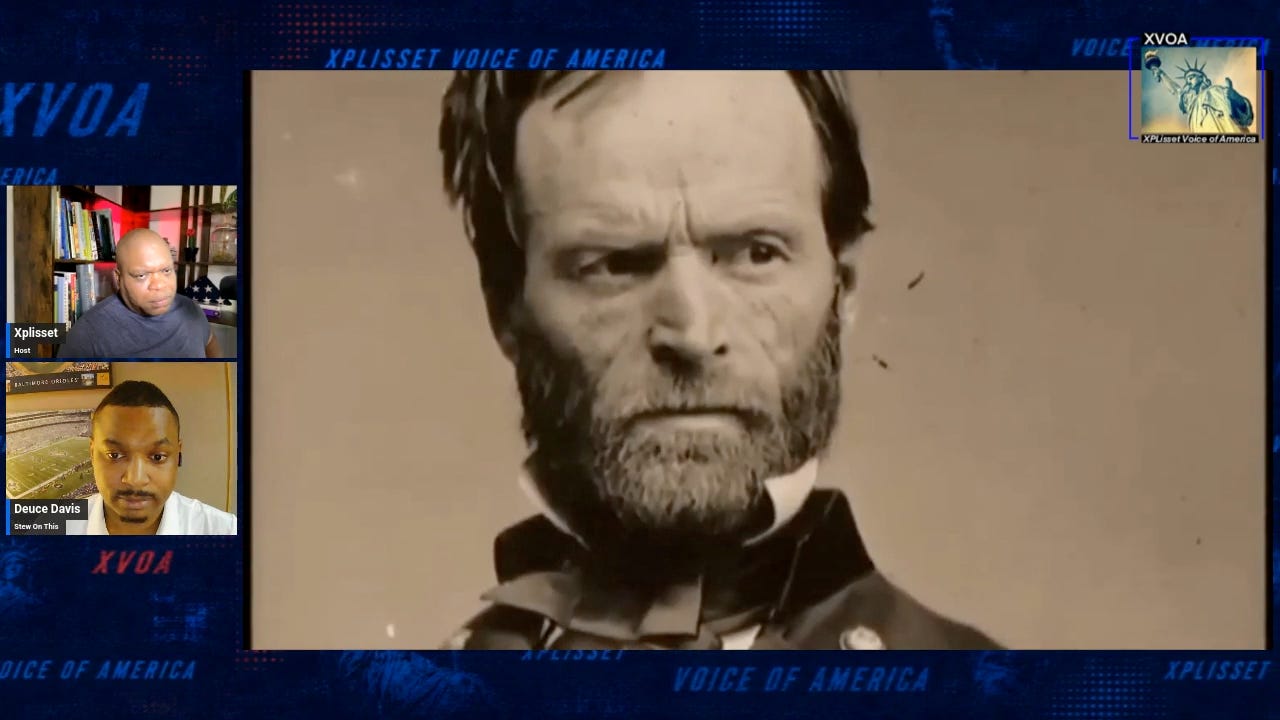
The first visual presentation took us back to Savannah, Georgia, January 1865. Sherman and Stanton met with Black leaders. Reverend Garrison Frazier spoke. The freed people named land as the material foundation of freedom. Not vibes. Not “representation.” Not a roundtable about healing.
Land.
The way we can best take care of ourselves is to have land. That is still one of the most devastatingly clear political statements in American history. You can take all the consultant memos ever written, stack them from here to the moon, and they still will not be as clear as that. Freedom required land. Not a commemorative month. Not a nice speech. Not “we hear you.”
Land.
Then came Field Order No. 15. Was Sherman a racial egalitarian? No. Did he see Black people as full democratic equals in the way we would demand today? No. Was he a tool that, under pressure and circumstance, helped move a policy demand into military order? Yes. That was the lesson. Not purity. Movement.
But Deuce’s response complicated the analogy. He accepted the historical frame, then drew the line where it needed to be drawn. Sherman was forced by historical circumstance into material movement. FDR was forced by crisis into state-building. Truman was forced by Black pressure, labor pressure, and Cold War contradiction into desegregating the military. LBJ was forced by the movement into civil rights law. The pressure produced policy.
The question, then, is not whether The Bulwark is compromised.
The question is: what material movement is their influence producing?
That is where the conversation got real.
The Difference Between Opposition and Repair
Deuce’s strongest argument was that the Never Trump conservative world is not equivalent to those earlier compromised allies because it is not pushing the machinery forward. It is opposing Trump. That matters. But opposing Trump is not the same as repairing the system that produced him.
This is where a lot of liberal politics gets cute. And by cute, I mean dangerously unserious in a very expensive blazer. The argument goes something like this right here: Trump is an emergency. Democracy is on fire. The courts are captured. Voting rights are being gutted. The presidency is being turned into a throne room. Authoritarianism is at the door.
But please, let’s not get carried away with structural reform.
No court expansion. No serious Senate reform. No aggressive voting rights strategy. No deep challenge to corporate power. No confrontation with the media ecosystem that made reactionary politics profitable. No economic populism that might upset donors. No civil rights language that might scare the people who got scared when a Target had rainbow shirts.
So democracy is supposedly dying, but the treatment plan is: be normal, be moderate, be quiet, and for the love of God, do not make suburban white people feel like they are in history. That is not strategy. That is institutional self-soothing. That is a fire department arriving at a burning house and saying, “We need to be careful not to overuse water. Some people find water polarizing.”
Sir, the kitchen is gone.
The baby pictures are smoke.
The dog is on the roof.
Use the hose.
The Bulwark Question
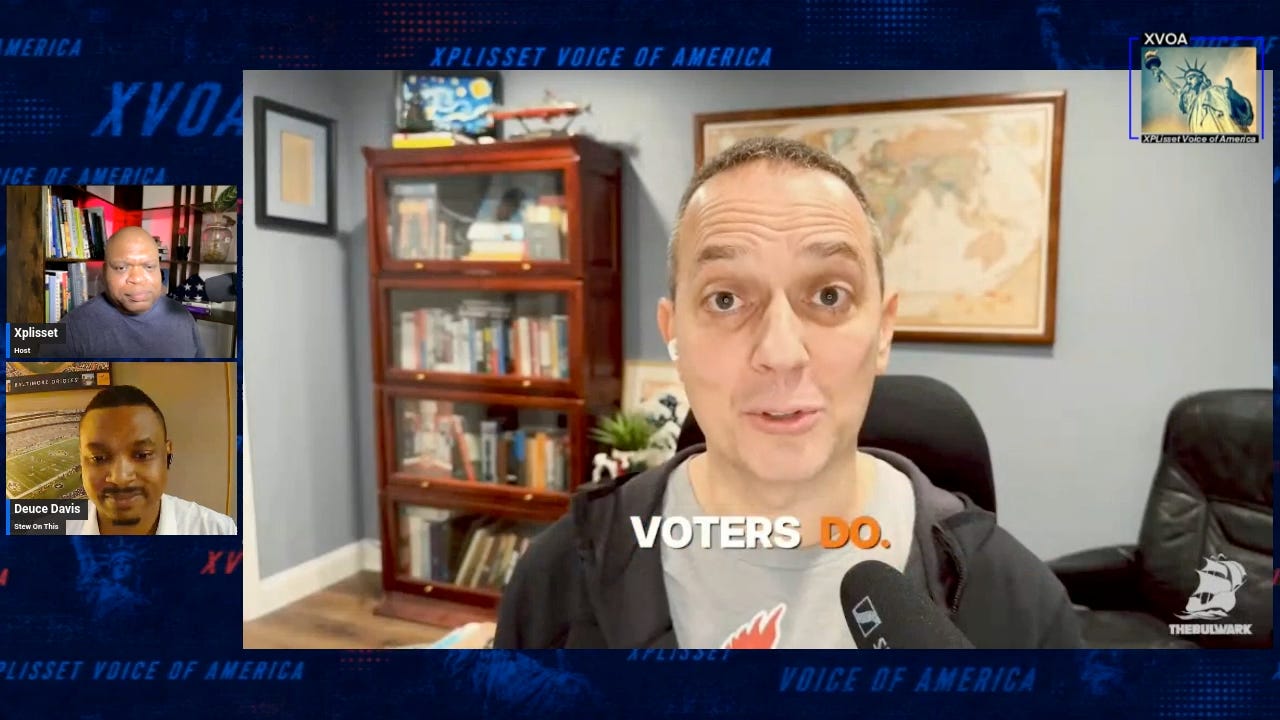
The point of the conversation was not to declare The Bulwark useless. That would be too easy and not especially interesting. The Bulwark has been useful. Tim Miller, Charlie Sykes, Sarah Longwell, JVL, Bill Kristol, and others in that world have opposed Trump loudly and consistently in a media environment where many conservatives bent the knee, kissed the ring, and then pretended they were just checking the weather down there.
The Bulwark helped create space for anti-Trump Republicans and anti-Trump conservatives to say what needed to be said about Trump’s authoritarianism. That matters. But Deuce’s critique is that The Bulwark has become more than a dissenting conservative outlet. It has become part of the narrative machinery inside the pro-democracy coalition.
And when a media institution becomes a narrative force, the question changes. It is no longer: Are they against Trump? It becomes: What story are they telling about how we got Trump? Who gets blamed? Who gets erased? Who gets disciplined? Who gets called unreasonable? Who gets framed as the problem? Whose voters are treated as fragile? Whose voters are treated as disposable? Whose rights become “bad messaging”? Whose anger gets called unprofessional? Whose fear becomes data? Whose survival becomes a focus group variable?
That is the machinery.
And XVOA exists to show the machinery.
Racism Is Not One Slice Of The Pie
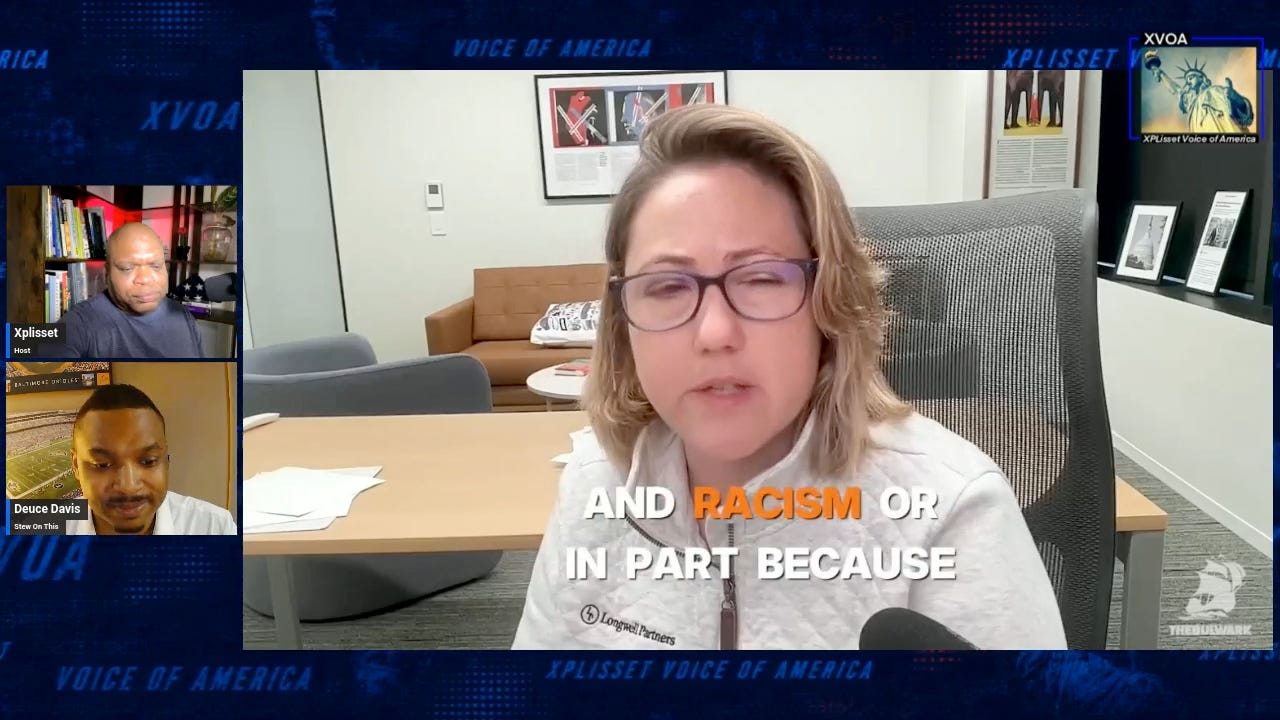
The sharpest part of the conversation came when we discussed the Bulwark clip involving JVL and Sarah Longwell talking about Kamala Harris’s loss, racism, sexism, and how much of the outcome should be attributed to those forces. The frame that bothered Deuce was the “pie chart” approach. How much was racism? How much was sexism? Seven percent? Thirty percent? Somewhere between “not nothing” and “please stop making brunch uncomfortable”?
The problem with that framing is that it treats racism and sexism like one slice of the pie. But what if racism and sexism are not the slice? What if they season the whole pie? What if they shape the economy conversation? What if they shape who is believed on inflation? What if they shape who gets called “authentic”? What if they shape who gets coded as angry, unserious, radical, shrill, dangerous, divisive, or not quite ready? What if they shape who gets to be “populist” and who gets to be “identity politics”? What if they shape who gets described as “working class” in a country where Black women have been working since before America knew what a wage was?
This is the part of American politics that elite analysis keeps trying to solve by pretending it can be separated into neat little containers. Race over here. Class over there. Gender in this drawer. Economics in that cabinet. Sir, this is America. The cabinets were built by the same carpenter. Race has been attached to labor policy, housing policy, health policy, welfare policy, voting policy, criminal justice policy, education policy, foreign policy, and the entire question of who deserves state protection. That is not a side quest.
That is the operating system right there folks.
The Spectacular Candidate Trap
Another clip dealt with the idea that Democrats should stop thinking about race and gender and just find somebody “spectacular.” On paper, that sounds reasonable. Who does not want a spectacular candidate?
I too would like a candidate who can win the Midwest, explain the administrative state, make billionaires sweat, talk to young men without sounding like a hostage video, defend trans kids, protect Black voting power, handle Gaza, handle groceries, handle the Supreme Court, quote scripture without pandering, beat Trumpism, charm the normies, energize the base, and make cable news producers stop looking like they just smelled smoke. Sure. Find that person. Put them in the cart with the eggs, the toilet paper, and the $7 orange juice.
The problem is not wanting talent. The problem is that the “spectacular” threshold is not applied equally. Some candidates get to be raw, blunt, imperfect, angry, weird, experimental, or “authentic.” Other candidates have to be flawless just to be considered viable. A white male candidate can be rough around the edges and get called real. A Black woman does the same thing and suddenly everybody becomes a communications professor. A Muslim candidate speaks from moral clarity and suddenly the room wants “tone.” A progressive talks about material policy and suddenly the donor class develops a migraine.
This is how structural bias hides inside electability talk. Nobody says, “We are uncomfortable with this kind of person holding power.” They say, “Can they win?” Nobody says, “We prefer candidates who do not force us to confront the hierarchy.” They say, “We need someone who can sit in different rooms.”
Which brings us to Mark Cuban.
Room-Access Politics Is Not A Theory Of Democracy
The Mark Cuban clip was fascinating because it revealed the fantasy candidate lurking inside a lot of elite political imagination. The person who can sit with Rogan. Sit with Theo Von. Sit in NBA locker rooms. Sit with business elites. Sit on television. Sit everywhere. The man who can enter every room.
Now, that skill is not worthless. In politics, room access matters. Media comfort matters. Cultural fluency matters. But room access is not a theory of democracy. A man who can sit in every room may still be accountable to none of them.
That is the danger.
America has become obsessed with the idea that celebrity plus perceived authenticity equals leadership. We keep doing this like we are trying to prove we learned absolutely nothing from the last escalator ride into hell. Good businessman? Celebrity? Talks tough? Can go on podcasts? Have we tried maybe not handing the republic to the Shark Tank cinematic universe?
At some point, we have to ask whether the problem is that our political imagination has been colonized by entertainment logic. The Bulwark did not create that problem. But at times, it seems too comfortable inside it. And Deuce’s point was that this kind of room-access thinking is what happens when politics becomes campaign craft detached from material repair.
Who can win the room? Who can code authentic? Who can reassure the anxious voter? Who can avoid saying the thing that needs to be said because saying it might make the wrong people uncomfortable? That is how politics becomes theater. Very expensive theater. The kind where the audience gets robbed in the parking lot after applauding the performance.
Where I Landed
I still believe imperfect allies can be useful. I still believe anti-Trump conservatives have a role in the coalition. I still believe it is politically immature to demand that every person fighting authoritarianism share the same ideological home. But Deuce made the stronger distinction.
A useful ally must be judged by movement. Not by tone. Not by branding. Not by how many times they say Trump is bad. Not by whether they make liberals feel like respectable adults again. Movement.
Are they helping restore voting rights? Are they helping rebuild labor power? Are they helping confront court capture? Are they helping defend reproductive freedom beyond campaign-season slogans? Are they helping challenge the corporate order that hollowed out working life and made demagoguery more attractive? Are they helping name race as central to American politics, or are they treating it like an unfortunate seasoning packet Democrats should stop opening in public? Are they helping build a democracy that can survive Trumpism? Or are they helping rebuild the pre-Trump room with better lighting?
That is the question.
Key Moments From The Conversation
00:34 — Opening frame: do we need allies to love us or move the machinery?
07:00 — Why XVOA starts with memory.
11:44 — Sherman was not a racial saint, but Black leaders spoke, power listened, and a military order moved.
18:16 — Deuce argues The Bulwark does not fit the Sherman analogy because it is not supporting structural movement forward.
44:33 — Black voters did not emotionally switch parties. They followed policy, pressure, survival, and opportunity.
59:42 — The question: why can’t anti-Trump voters use The Bulwark without pretending it is our ideological home?
84:54 — Truman’s military desegregation as material movement, contrasted with the absence of similar institutional reform from Never Trump conservatives.
96:29 — The move from history to the present: is The Bulwark helping the coalition see clearly or teaching it to accommodate the structure?
102:08 — Racism and sexism as one slice of the pie versus the seasoning in the whole pie.
128:37 — Mark Cuban, room-access politics, celebrity, authenticity, and the fantasy of the candidate who can sit everywhere.
143:06 — Closing frame: this was not about purity. This was about power.
The Lesson
The lesson is not “never work with Never Trump conservatives.” That is way too simple. The lesson is also not “stop criticizing allies.” That is how coalitions become nursing homes for bad ideas.
The lesson is this:
Use the tool.
Audit the tool.
Never worship the tool.
If The Bulwark is useful against Trumpism, use it. If The Bulwark exposes Republican authoritarianism, cite it. If The Bulwark helps pull some people out of the MAGA fever swamp, good. But do not let anti-Trump conservatives become the priests of democracy. Do not let them narrate innocence. Do not let them tell the story as if Trump fell from the sky, landed on the Republican Party, and corrupted an otherwise noble tradition that had never flirted with racial backlash, Christian nationalism, militarism, union-busting, voter suppression, or corporate rule.
Please.
America loves a redemption story, especially when the redeemed person does not have to give anything back. But democracy does not need a redemption arc. It needs repair. And repair requires more than saying Trump is bad. Everybody with two eyes and a working smoke alarm can see Trump is bad. The harder question is what made him possible.
The harder question is why so many respectable people missed it. The harder question is why the people who warned about it were dismissed as too angry, too woke, too radical, too racial, too young, too left, too loud, too much. The harder question is who gets to define “normal” after the emergency. Because if “normal” means going back to the conditions that produced the emergency, then normal is not the cure.
Normal is the getaway car.
Support XVOA
This is what XVOA is built to do. Not outrage for outrage’s sake. Not partisan comfort food. Not “Trump bad” on a loop until everybody claps and goes home spiritually unchanged. XVOA exists to use Black historical memory as a diagnostic instrument for American power.
That means we do not just ask what happened. We ask who benefited. Who got erased. Who was protected. Who paid. Whose fear counted. Whose rights became negotiable. Whose vote got diluted. Whose anger got pathologized. Whose analysis got dismissed until the building was already on fire.
This conversation with Deuce Davis is exactly the kind of work this desk is supposed to produce: historically grounded, psychologically alert, politically unsentimental, and allergic to easy answers. Because the easy answer is: The Bulwark is good. The other easy answer is: The Bulwark is bad. The XVOA answer is: The Bulwark is a tool with narrative power, and any tool with narrative power must be audited before it starts designing the future.
That is the work. And that work needs support.
Right now, the XVOA fundraiser is in the homestretch: $900 raised toward the $1,200 goal. That leaves $300 to go. That is close enough to finish. Not “maybe someday” close. Finish-line close.
If this conversation helped you see the machinery more clearly, help close that gap. The fundraiser keeps the desk moving right now. It helps cover the work already being done: the livestreams, the clips, the posts, the research, and the time it takes to build something serious without waiting for permission from the same institutions being diagnosed.
The strongest way to support XVOA is to become a paid subscriber. A paid subscription is $8 a month. That $8 helps turn XVOA from a project running on fumes into a living publication with enough runway to keep showing up. Not for hot takes. Not for partisan comfort food. Not for “Trump bad” on repeat until everybody claps and goes home unchanged. For diagnosis. For memory. For a Black-led intelligence desk that treats American history as evidence, not decoration.
If you are ready to support this work directly, subscribe here:
If you are not ready to cross the line into a paid subscription yet, that is fine. There is still a way to help. You can make a one-time contribution through Buy Me a Coffee and help close the fundraiser gap without making a longer-term commitment.
Buy Me a Coffee:
The goal is simple: close the final $300, keep the desk moving, and make sure this work does not have to depend on fumes, exhaustion, or algorithmic luck.
Subscribe if you can. Contribute once if that is what you can do right now. Share the post if money is tight. But do not just nod along and leave the machinery to the people who already have the microphones, the donors, and the institutional protection.
Help keep XVOA alive. Help finish the fundraiser. Help build the desk.
Sources
Video Clip Sources Used In The Livestream
1. PBS / YouTube
Title: 1876: Reconstruction
Clip used: Sherman, Edwin Stanton, Black religious leaders in Savannah, Garrison Frazier, Field Order No. 15, “40 acres and a mule.”
Used for: Opening historical frame: compromised power can still be forced to move.
Approx. livestream placement: 07:16–11:26.
The transcript identifies this as the first clip: a PBS 1876 Reconstruction clip focused on Sherman, Black leaders in Georgia, Field Order No. 15, and forty acres and a mule.
2. A Fresh Perspective With Jeff Charles / YouTube
Title: How The Republican Party Lost The Black Vote Part 2
Clip used: FDR, the New Deal, lily-white Republicanism, Black voters leaving the Republican Party, and the Black vote shift toward Democrats.
Used for: Showing that Black voters did not switch parties out of emotional loyalty, but because of interests, pressure, policy, survival, and opportunity.
Approx. livestream placement: 35:54–44:16.
The transcript identifies this as Jeff Charles’s How the Republican Party Lost the Black Vote, Part 2.
3. US Civil Rights History Channel / YouTube
Title: President Harry Truman and Civil Rights
Clip used: Truman addressing the NAACP, the 1948 civil rights plank, Dixiecrat revolt, A. Philip Randolph, Executive Order 9981, desegregation of the armed forces.
Used for: Truman as the sharp example of ugly personal racial views colliding with material state action.
Approx. livestream placement: 70:36–77:02.
The transcript identifies this as coming from the US Civil Rights History Channel and titled President Harry Truman and Civil Rights.
4. The Bulwark / JVL and Sarah Longwell
Working source title: Bulwark episode debriefing the Jonathan Capehart post-election focus group
Clip used: Harris loss, racism, sexism, Democratic nominee strategy, whether Democrats should nominate a woman in 2028, “find somebody spectacular,” Obama as the standard, and the “American electorate seems pretty bad” on sexism line.
Used for: The “racism and sexism as a slice of the pie vs. seasoning in the whole pie” section, plus the “spectacular candidate” critique.
Approx. livestream placement: 96:29–102:05.
The transcript introduces this as a Bulwark clip with Sarah and JVL on Harris’s loss, racism, sexism, and the pie-chart framing, then the clip itself moves into the woman-candidate / spectacular-candidate discussion.
5. The Bulwark / JVL and Sarah Longwell
Working source title: Mark Cuban as Democratic standard-bearer / room-access politics clip
Clip used: Mark Cuban, healthcare, celebrity, authenticity, Joe Rogan, Theo Von, Call Her Daddy, NBA locker rooms, Shark Tank, “he can sit in a lot of different rooms.”
Used for: Room-access politics and the fantasy of the candidate who can enter every room.
Approx. livestream placement: 124:00–128:32.
The transcript identifies this as “the Mark Cuban turn” and describes Cuban as a possible Democratic standard-bearer who can sit in different rooms.


